Thank you for visiting SNEWPapers!
Sign up free
Editorial
January 18, 1945
Marion Progress
Marion, Mcdowell County, North Carolina
What is this article about?
The editorial lauds the heroic defense of Bastogne by 10,000 American soldiers against five German divisions during the Battle of the Bulge, crediting airborne supply operations and overall U.S. troop resistance for thwarting the offensive and averting disaster.
Clipping
OCR Quality
98%
Excellent
Full Text
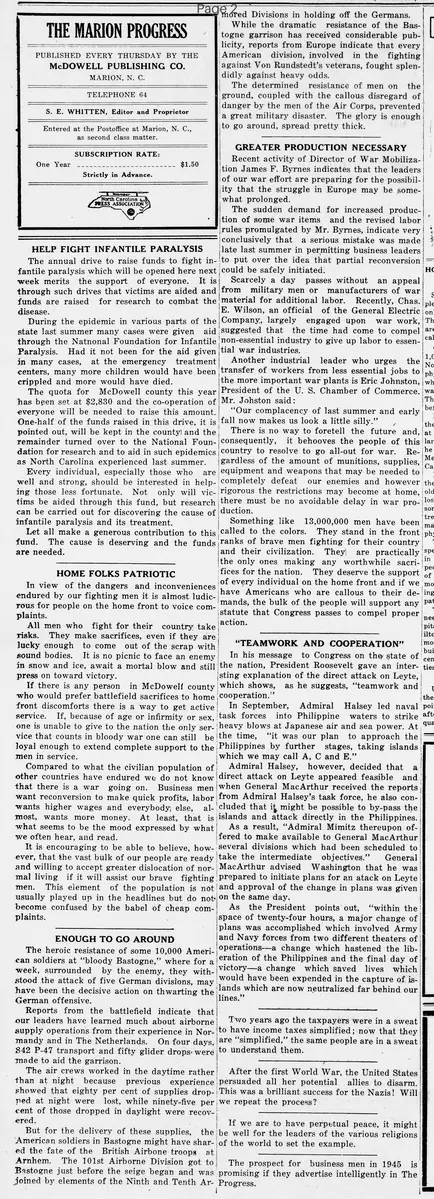
ENOUGH TO GO AROUND
The heroic resistance of some 10,000 American soldiers at "bloody Bastogne," where for a week, surrounded by the enemy, they withstood the attack of five German divisions, may have been the decisive action on thwarting the German offensive.
Reports from the battlefield indicate that our leaders have learned much about airborne supply operations from their experience in Normandy and in The Netherlands. On four days, 842 P-47 transport and fifty glider drops were made to aid the garrison.
The air crews worked in the daytime rather than at night because previous experience showed that eighty per cent of supplies dropped at night were lost, while ninety-five per cent of those dropped in daylight were recovered.
But for the delivery of these supplies, the American soldiers in Bastogne might have shared the fate of the British Airborne troops at Arnhem. The 101st Airborne Division got to Bastogne just before the siege began and was joined by elements of the Ninth and Tenth Armored Divisions in holding off the Germans.
While the dramatic resistance of the Bastogne garrison has received considerable publicity, reports from Europe indicate that every American division, involved in the fighting against Von Rundstedt's veterans, fought splendidly against heavy odds.
The determined resistance of men on the ground, coupled with the callous disregard of danger by the men of the Air Corps, prevented a great military disaster. The glory is enough to go around, spread pretty thick.
The heroic resistance of some 10,000 American soldiers at "bloody Bastogne," where for a week, surrounded by the enemy, they withstood the attack of five German divisions, may have been the decisive action on thwarting the German offensive.
Reports from the battlefield indicate that our leaders have learned much about airborne supply operations from their experience in Normandy and in The Netherlands. On four days, 842 P-47 transport and fifty glider drops were made to aid the garrison.
The air crews worked in the daytime rather than at night because previous experience showed that eighty per cent of supplies dropped at night were lost, while ninety-five per cent of those dropped in daylight were recovered.
But for the delivery of these supplies, the American soldiers in Bastogne might have shared the fate of the British Airborne troops at Arnhem. The 101st Airborne Division got to Bastogne just before the siege began and was joined by elements of the Ninth and Tenth Armored Divisions in holding off the Germans.
While the dramatic resistance of the Bastogne garrison has received considerable publicity, reports from Europe indicate that every American division, involved in the fighting against Von Rundstedt's veterans, fought splendidly against heavy odds.
The determined resistance of men on the ground, coupled with the callous disregard of danger by the men of the Air Corps, prevented a great military disaster. The glory is enough to go around, spread pretty thick.
What sub-type of article is it?
Military Affairs
What keywords are associated?
Bastogne
German Offensive
Airborne Supplies
101st Airborne
Battle Of The Bulge
Von Rundstedt
What entities or persons were involved?
101st Airborne Division
Ninth Armored Division
Tenth Armored Division
Von Rundstedt
American Soldiers
Air Corps
Editorial Details
Primary Topic
Heroic Resistance At Bastogne
Stance / Tone
Laudatory Praise For American Forces
Key Figures
101st Airborne Division
Ninth Armored Division
Tenth Armored Division
Von Rundstedt
American Soldiers
Air Corps
Key Arguments
Resistance At Bastogne Was Decisive In Thwarting German Offensive
Airborne Supply Operations Improved From Normandy And Netherlands Experiences
Daytime Drops Recovered 95% Of Supplies Vs. 80% Loss At Night
Supplies Prevented Fate Similar To British At Arnhem
All American Divisions Fought Splendidly Against Heavy Odds
Ground And Air Efforts Prevented Military Disaster