Thank you for visiting SNEWPapers!
Sign up free
Story
March 15, 1877
The Anderson Intelligencer
Anderson, Anderson County, South Carolina
What is this article about?
Jeremiah S. Black's speech before the Electoral Tribunal on February 28 protests counting fraudulent electoral votes from South Carolina for Hayes in the 1876 election, citing lack of voter registration, military control, and commission precedents ignoring fraud.
Clipping
OCR Quality
98%
Excellent
Full Text
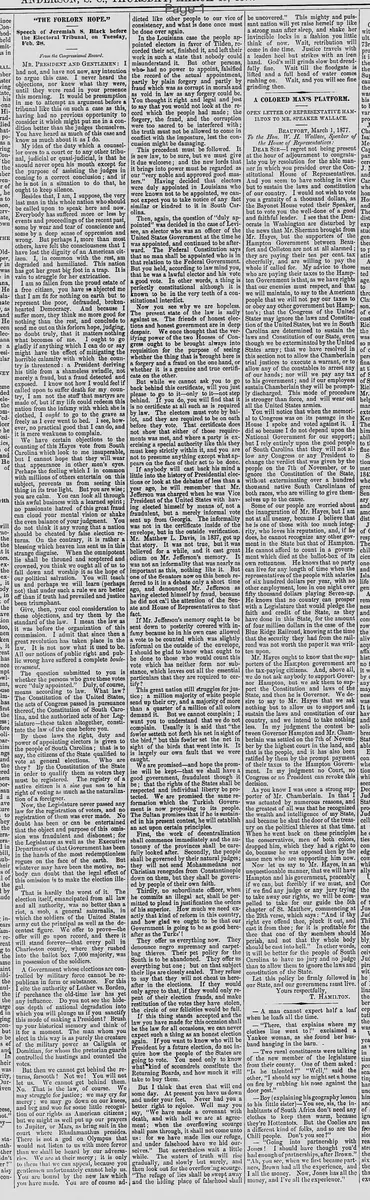
"THE FORLORN HOPE."
Speech of Jeremiah S. Black before the Electoral Tribunal, on Tuesday Feb. 28.
From the Congressional Record.
MR. PRESIDENT AND GENTLEMEN:—I had not, and have not now, any intention to argue this case. I never heard the objections, nor knew what they were, until they were read in your presence this morning. It would be presumption in me to attempt an argument before a tribunal like this on such a case as this, having had no previous opportunity to consider it which might put me in a condition better than the judges themselves. You have heard as much of this case and know as much about it as I do.
My idea of the duty which a counsellor owes to a court or to any other tribunal, judicial or quasi-judicial, is that he should never open his mouth except for the purpose of assisting the judges in coming to a correct conclusion; and if he is not in a situation to do that, he ought to keep silence.
Besides that, I am, I suppose, the very last man in this whole nation who should be called upon to speak here and now. Everybody has suffered more or less by events and proceedings of the recent past, some by wear and tear of conscience and some by a deep sense of oppression and wrong. But perhaps I, more than most others, have felt the consciousness that I have lost the dignity of an American citizen. I, in common with the rest, am degraded and humiliated. This nation has got her great big foot in a trap. It is vain to struggle for her extrication. I am so fallen from the proud estate of a free citizen, you have so abjected me that I am fit for nothing on earth but to represent the poor, defrauded, broken-hearted Democracy. And because I suffer more, they think me more good for nothing than the rest, and conclude to send me out on this forlorn hope, judging, no doubt truly, that it matters nothing what becomes of me. I ought to go gladly if anything which I can do or say might have the effect of mitigating the horrible calamity with which the country is threatened: a President deriving his title from a shameless swindle, not merely a fraud, but a fraud detected and exposed. I know not how I would feel if called upon to suffer death for my country, I am not the stuff that martyrs are made of, but if my life could redeem this nation from the infamy with which she is clothed, I ought to go to the grave as freely as I ever went to bed. I see, however, no practical good that I can do, and it is mere weakness to complain.
We have certain objections to the counting of this Hayes vote from South Carolina which look to me insuperable, but I cannot hope that they will wear that appearance in other men's eyes. Perhaps the feeling which I in common with millions of others entertain on this subject, prevents us from seeing this thing in its true light. But you are wise; you are calm. You can look all through this awful business with a learned spirit; no passionate hatred of this great fraud can cloud your mental vision or shake the even balance of your judgment. You do not think it any wrong that a nation should be cheated by false election returns. On the contrary, it is rather a blessing which heaven has sent us in this strange disguise. When the omnipotent lie shall be throned and sceptered and crowned, you think we ought all of us to fall down and worship it as the hope of our political salvation. You will teach us and perhaps we will learn (perhaps not) that under such a rule we are better off than if truth had prevailed and justice been triumphant.
Give, then, your cool consideration to these objections, and try them by the standard of the law. I mean the law as it was before the organization of this commission. I admit that since then a great revolution has taken place in the law. It is not now what it used to be. All our notions of public right and public wrong have suffered a complete bouleversement.
The question submitted to you is whether the persons who gave these votes were "duly appointed." Duly, of course, means according to law. What law? The Constitution of the United States, the acts of Congress passed in pursuance thereof, the Constitution of South Carolina, and the authorized acts of her Legislature—these taken altogether, constitute the law of the case before you.
By these laws the right, duty and power of appointing electors is given to the people of South Carolina; that is to say, the citizens of the State qualified to vote at general elections. Who are they? By the Constitution of the State in order to qualify them as voters they must be registered. The registry of a native citizen is a sine qua non to his right of voting as much as the naturalization of a foreigner.
Now, the Legislature never passed any law for the registration of voters, and no registration of them was ever made. No doubt has been or can be entertained that the object and purpose of this omission was fraudulent and dishonest; for the Legislature as well as the Executive Department of that Government has been in the hands of the most redemptionless rogues on the face of the earth. But whatever may have been the motive, nobody can doubt that the legal effect of this omission is to make the election illegal.
That is hardly the worst of it. The election itself, emancipated from all law and all authority, was no better than a riot, a mob, a general saturnalia, in which the soldiers of the United States army cut the principal as well as the decentest figure. We offer to prove—the offer will go upon record, and there it will stand forever—that every poll in Charleston county, where they rushed into the ballot box 7,000 majority, was in possession of the soldiers.
A Government whose elections are controlled by military force cannot be republican in form or substance. For this I cite the authority of Luther vs. Borden, if perchance the old-time law has yet any influence. Do you not see the hideous depth of national degradation into which you will plunge us if you sanctify this mode of making a President? Brush up your historical memory and think of it for a moment. The man whom you elect in this way is as purely the creature of the military power as Caligula or Domitian, for whom the pretorian guards controlled the hustings and counted the votes.
But then we cannot get behind the returns, forsooth! Not we! You will not let us. We cannot get behind them. No. That is the law, of course. We may struggle for justice; we may cry for mercy; we may go down on our knees, and beg and woo for some little recognition of our rights as American citizens; but we might as well put up our prayers to Jupiter, or Mars, as bring suit in the court where Rhadamanthus presides. There is not a god on Olympus that would not listen to us with more fervor than we shall be heard by our adversaries. We are at their mercy; it is only to them that we can appeal, because you gentlemen unfortunately cannot help us. You are bound by the new law which you have made. You are of course addicted like other people to our vice of consistency, and what is done once must be done over again.
In the Louisiana case the people appointed electors in favor of Tilden, recorded their act, finished it, and left their work in such a state that nobody could misunderstand it. But other persons, who had no power to appoint, falsified the record of the actual appointment, partly by plain forgery and partly by fraud which was as corrupt in morals and as void in law as any forgery could be. You thought it right and legal and just to say that you would not look at the record which the people had made; the forgery, the fraud, and the corruption were too sacred to be interfered with; the truth must not be allowed to come in conflict with the imposture, lest the concussion might be damaging.
This precedent must be followed. It is new law, to be sure, but we must give it due welcome; and the new lords that it brings into power must be regarded as our "very noble and approved good masters."
Having decided that electors were duly appointed in Louisiana who were known not to be appointed, we cannot expect you to take notice of any fact similar or kindred to it in South Carolina.
Then, again, the question of "duly appointed" was decided in the case of Levi-see, an elector who was an officer of the United States Government at the time he was appointed, and continued to be afterward. The Federal Constitution says that no man shall be appointed who is in that relation to the Federal Government. But you held, according to law mind you, that he was a lawful elector and his vote a good vote. In other words, a thing is perfectly constitutional although it is known to be in the very teeth of a constitutional interdict.
Now you see why we are hopeless. The present state of the law is sadly against us. The friends of honest elections and honest government are in deep despair. We once thought that the verifying power of the two Houses of Congress ought to be brought always into requisition for the purpose of seeing whether the thing that is brought here is a forgery and a fraud on the one hand, or whether it is a genuine and true certificate on the other.
But while we cannot ask you to go back behind this certificate, will you just please to go to it—only to it—not step behind. If you do, you will find that it is no certificate at all such as is required by law. The electors must vote by ballot, and they are required to be on oath before they vote. That certificate does not show that either of those requirements was met, and where a party is exercising a special authority like this they must keep strictly within it, and you are not to presume anything except what appears on the face of their act to be done.
If anybody will cast back his mind a little into the history of Presidential elections or look at the debates of less than a year ago, he will remember that Mr. Jefferson was charged when he was Vice President of the United States with having elected himself by means of, not a fraudulent, but a merely informal vote sent up from Georgia. The informality was not in the certificate inside of the envelope, but in the outside verification. Mr. Matthew L. Davis, in 1837, got up that story. It was not true, but it was believed for a while, and it cast great odium on Mr. Jefferson's memory. It was not an informality that was nearly as important as this, nothing like it. But one of the Senators now on this bench referred to it in a debate only a short time ago, and denounced Mr. Jefferson as having elected himself by fraud, because he did not call the attention of the Senate and House of Representatives to that fact.
If Mr. Jefferson's memory ought to be sent down to posterity covered with infamy because he in his own case allowed a vote to be counted which was slightly informal on the outside of the envelope, I should be glad to know what ought to be done to those who would count this vote which has neither form nor substance, which leaves out all the essential particulars that they are required to certify?
This great nation still struggles for justice; a million majority of white people send up their cry, and a majority of more than a quarter of a million of all colors demand it. But we cannot complain; I want you to understand that we do not complain. Usually it is said that "the fowler setteth not forth his net in sight of the bird," but this fowler set the net in sight of the birds that went into it. It is largely our own fault that we were caught.
We are promised—and hope the promise will be kept—that we shall have a good government, fraudulent though it be; that the rights of the States shall be respected and individual liberty be protected. We are promised the same reformation which the Turkish Government is now proposing to its people. The Sultan promises that if he is sustained in his present contest, he will establish an act upon certain principles.
First, the work of decentralization shall commence immediately and the autonomy of the provinces shall be carefully looked after. Secondly, the people shall be governed by their natural judges; they will not send Mohammedans nor Christian renegades from Constantinople down on them, but they shall be governed by people of their own faith.
Thirdly, no subordinate officer, when he commits an illegal act, shall be permitted to plead in justification the orders of his superior. How much we need exactly that kind of reform in this country, and how glad we ought to be that our Government is going to be as good hereafter as the Turks'!
They offer us everything now. They denounce negro supremacy and carpet-bag thieves. Their pet policy for the South is to be abandoned. They offer us everything but one; but on that subject their lips are closely sealed. They refuse to say that they will not cheat us hereafter in the elections. If they would only agree to that, if they would only repent of their election frauds, and make restitution of the votes they have stolen, the circle of our felicities would be full.
If this thing stands accepted and the law you have made for this occasion shall be the law for all occasions, we can never expect such a thing as an honest election again. If you want to know who will be President by a future election, do not inquire how the people of the States are going to vote. You need only to know what kind of scoundrels constitute the Returning Boards, and how much it will take to buy them.
But I think that even that will end some day. At present you have us down and under your feet. Never had you a better right to rejoice. Well may you say, "We have made a covenant with death, and with hell we are at agreement; when the overflowing scourge shall pass through, it shall not come unto us: for we have made lies our refuge, and under falsehood have we hid ourselves." But nevertheless wait a little while. The waters of truth will rise gradually, and slowly but surely, and then look out for the overflowing scourge. "The refuge of lies shall be swept away and the hiding place of falsehood shall be uncovered." This mighty and puissant nation will yet raise herself up like a strong man after sleep, and shake her invincible locks in a fashion you little think of now. Wait, retribution will come in due time. Justice travels with a leaden heel but strikes with an iron hand. God's mill grinds slow but dreadfully fine.
Wait till the floodgate is lifted and a full head of water comes rushing on. Wait, and you will see fine grinding then.
Speech of Jeremiah S. Black before the Electoral Tribunal, on Tuesday Feb. 28.
From the Congressional Record.
MR. PRESIDENT AND GENTLEMEN:—I had not, and have not now, any intention to argue this case. I never heard the objections, nor knew what they were, until they were read in your presence this morning. It would be presumption in me to attempt an argument before a tribunal like this on such a case as this, having had no previous opportunity to consider it which might put me in a condition better than the judges themselves. You have heard as much of this case and know as much about it as I do.
My idea of the duty which a counsellor owes to a court or to any other tribunal, judicial or quasi-judicial, is that he should never open his mouth except for the purpose of assisting the judges in coming to a correct conclusion; and if he is not in a situation to do that, he ought to keep silence.
Besides that, I am, I suppose, the very last man in this whole nation who should be called upon to speak here and now. Everybody has suffered more or less by events and proceedings of the recent past, some by wear and tear of conscience and some by a deep sense of oppression and wrong. But perhaps I, more than most others, have felt the consciousness that I have lost the dignity of an American citizen. I, in common with the rest, am degraded and humiliated. This nation has got her great big foot in a trap. It is vain to struggle for her extrication. I am so fallen from the proud estate of a free citizen, you have so abjected me that I am fit for nothing on earth but to represent the poor, defrauded, broken-hearted Democracy. And because I suffer more, they think me more good for nothing than the rest, and conclude to send me out on this forlorn hope, judging, no doubt truly, that it matters nothing what becomes of me. I ought to go gladly if anything which I can do or say might have the effect of mitigating the horrible calamity with which the country is threatened: a President deriving his title from a shameless swindle, not merely a fraud, but a fraud detected and exposed. I know not how I would feel if called upon to suffer death for my country, I am not the stuff that martyrs are made of, but if my life could redeem this nation from the infamy with which she is clothed, I ought to go to the grave as freely as I ever went to bed. I see, however, no practical good that I can do, and it is mere weakness to complain.
We have certain objections to the counting of this Hayes vote from South Carolina which look to me insuperable, but I cannot hope that they will wear that appearance in other men's eyes. Perhaps the feeling which I in common with millions of others entertain on this subject, prevents us from seeing this thing in its true light. But you are wise; you are calm. You can look all through this awful business with a learned spirit; no passionate hatred of this great fraud can cloud your mental vision or shake the even balance of your judgment. You do not think it any wrong that a nation should be cheated by false election returns. On the contrary, it is rather a blessing which heaven has sent us in this strange disguise. When the omnipotent lie shall be throned and sceptered and crowned, you think we ought all of us to fall down and worship it as the hope of our political salvation. You will teach us and perhaps we will learn (perhaps not) that under such a rule we are better off than if truth had prevailed and justice been triumphant.
Give, then, your cool consideration to these objections, and try them by the standard of the law. I mean the law as it was before the organization of this commission. I admit that since then a great revolution has taken place in the law. It is not now what it used to be. All our notions of public right and public wrong have suffered a complete bouleversement.
The question submitted to you is whether the persons who gave these votes were "duly appointed." Duly, of course, means according to law. What law? The Constitution of the United States, the acts of Congress passed in pursuance thereof, the Constitution of South Carolina, and the authorized acts of her Legislature—these taken altogether, constitute the law of the case before you.
By these laws the right, duty and power of appointing electors is given to the people of South Carolina; that is to say, the citizens of the State qualified to vote at general elections. Who are they? By the Constitution of the State in order to qualify them as voters they must be registered. The registry of a native citizen is a sine qua non to his right of voting as much as the naturalization of a foreigner.
Now, the Legislature never passed any law for the registration of voters, and no registration of them was ever made. No doubt has been or can be entertained that the object and purpose of this omission was fraudulent and dishonest; for the Legislature as well as the Executive Department of that Government has been in the hands of the most redemptionless rogues on the face of the earth. But whatever may have been the motive, nobody can doubt that the legal effect of this omission is to make the election illegal.
That is hardly the worst of it. The election itself, emancipated from all law and all authority, was no better than a riot, a mob, a general saturnalia, in which the soldiers of the United States army cut the principal as well as the decentest figure. We offer to prove—the offer will go upon record, and there it will stand forever—that every poll in Charleston county, where they rushed into the ballot box 7,000 majority, was in possession of the soldiers.
A Government whose elections are controlled by military force cannot be republican in form or substance. For this I cite the authority of Luther vs. Borden, if perchance the old-time law has yet any influence. Do you not see the hideous depth of national degradation into which you will plunge us if you sanctify this mode of making a President? Brush up your historical memory and think of it for a moment. The man whom you elect in this way is as purely the creature of the military power as Caligula or Domitian, for whom the pretorian guards controlled the hustings and counted the votes.
But then we cannot get behind the returns, forsooth! Not we! You will not let us. We cannot get behind them. No. That is the law, of course. We may struggle for justice; we may cry for mercy; we may go down on our knees, and beg and woo for some little recognition of our rights as American citizens; but we might as well put up our prayers to Jupiter, or Mars, as bring suit in the court where Rhadamanthus presides. There is not a god on Olympus that would not listen to us with more fervor than we shall be heard by our adversaries. We are at their mercy; it is only to them that we can appeal, because you gentlemen unfortunately cannot help us. You are bound by the new law which you have made. You are of course addicted like other people to our vice of consistency, and what is done once must be done over again.
In the Louisiana case the people appointed electors in favor of Tilden, recorded their act, finished it, and left their work in such a state that nobody could misunderstand it. But other persons, who had no power to appoint, falsified the record of the actual appointment, partly by plain forgery and partly by fraud which was as corrupt in morals and as void in law as any forgery could be. You thought it right and legal and just to say that you would not look at the record which the people had made; the forgery, the fraud, and the corruption were too sacred to be interfered with; the truth must not be allowed to come in conflict with the imposture, lest the concussion might be damaging.
This precedent must be followed. It is new law, to be sure, but we must give it due welcome; and the new lords that it brings into power must be regarded as our "very noble and approved good masters."
Having decided that electors were duly appointed in Louisiana who were known not to be appointed, we cannot expect you to take notice of any fact similar or kindred to it in South Carolina.
Then, again, the question of "duly appointed" was decided in the case of Levi-see, an elector who was an officer of the United States Government at the time he was appointed, and continued to be afterward. The Federal Constitution says that no man shall be appointed who is in that relation to the Federal Government. But you held, according to law mind you, that he was a lawful elector and his vote a good vote. In other words, a thing is perfectly constitutional although it is known to be in the very teeth of a constitutional interdict.
Now you see why we are hopeless. The present state of the law is sadly against us. The friends of honest elections and honest government are in deep despair. We once thought that the verifying power of the two Houses of Congress ought to be brought always into requisition for the purpose of seeing whether the thing that is brought here is a forgery and a fraud on the one hand, or whether it is a genuine and true certificate on the other.
But while we cannot ask you to go back behind this certificate, will you just please to go to it—only to it—not step behind. If you do, you will find that it is no certificate at all such as is required by law. The electors must vote by ballot, and they are required to be on oath before they vote. That certificate does not show that either of those requirements was met, and where a party is exercising a special authority like this they must keep strictly within it, and you are not to presume anything except what appears on the face of their act to be done.
If anybody will cast back his mind a little into the history of Presidential elections or look at the debates of less than a year ago, he will remember that Mr. Jefferson was charged when he was Vice President of the United States with having elected himself by means of, not a fraudulent, but a merely informal vote sent up from Georgia. The informality was not in the certificate inside of the envelope, but in the outside verification. Mr. Matthew L. Davis, in 1837, got up that story. It was not true, but it was believed for a while, and it cast great odium on Mr. Jefferson's memory. It was not an informality that was nearly as important as this, nothing like it. But one of the Senators now on this bench referred to it in a debate only a short time ago, and denounced Mr. Jefferson as having elected himself by fraud, because he did not call the attention of the Senate and House of Representatives to that fact.
If Mr. Jefferson's memory ought to be sent down to posterity covered with infamy because he in his own case allowed a vote to be counted which was slightly informal on the outside of the envelope, I should be glad to know what ought to be done to those who would count this vote which has neither form nor substance, which leaves out all the essential particulars that they are required to certify?
This great nation still struggles for justice; a million majority of white people send up their cry, and a majority of more than a quarter of a million of all colors demand it. But we cannot complain; I want you to understand that we do not complain. Usually it is said that "the fowler setteth not forth his net in sight of the bird," but this fowler set the net in sight of the birds that went into it. It is largely our own fault that we were caught.
We are promised—and hope the promise will be kept—that we shall have a good government, fraudulent though it be; that the rights of the States shall be respected and individual liberty be protected. We are promised the same reformation which the Turkish Government is now proposing to its people. The Sultan promises that if he is sustained in his present contest, he will establish an act upon certain principles.
First, the work of decentralization shall commence immediately and the autonomy of the provinces shall be carefully looked after. Secondly, the people shall be governed by their natural judges; they will not send Mohammedans nor Christian renegades from Constantinople down on them, but they shall be governed by people of their own faith.
Thirdly, no subordinate officer, when he commits an illegal act, shall be permitted to plead in justification the orders of his superior. How much we need exactly that kind of reform in this country, and how glad we ought to be that our Government is going to be as good hereafter as the Turks'!
They offer us everything now. They denounce negro supremacy and carpet-bag thieves. Their pet policy for the South is to be abandoned. They offer us everything but one; but on that subject their lips are closely sealed. They refuse to say that they will not cheat us hereafter in the elections. If they would only agree to that, if they would only repent of their election frauds, and make restitution of the votes they have stolen, the circle of our felicities would be full.
If this thing stands accepted and the law you have made for this occasion shall be the law for all occasions, we can never expect such a thing as an honest election again. If you want to know who will be President by a future election, do not inquire how the people of the States are going to vote. You need only to know what kind of scoundrels constitute the Returning Boards, and how much it will take to buy them.
But I think that even that will end some day. At present you have us down and under your feet. Never had you a better right to rejoice. Well may you say, "We have made a covenant with death, and with hell we are at agreement; when the overflowing scourge shall pass through, it shall not come unto us: for we have made lies our refuge, and under falsehood have we hid ourselves." But nevertheless wait a little while. The waters of truth will rise gradually, and slowly but surely, and then look out for the overflowing scourge. "The refuge of lies shall be swept away and the hiding place of falsehood shall be uncovered." This mighty and puissant nation will yet raise herself up like a strong man after sleep, and shake her invincible locks in a fashion you little think of now. Wait, retribution will come in due time. Justice travels with a leaden heel but strikes with an iron hand. God's mill grinds slow but dreadfully fine.
Wait till the floodgate is lifted and a full head of water comes rushing on. Wait, and you will see fine grinding then.
What sub-type of article is it?
Historical Event
Deception Fraud
What themes does it cover?
Deception
Justice
Misfortune
What keywords are associated?
Election Fraud
1876 Presidential Election
Electoral Commission
South Carolina Electors
Military Interference
Jeremiah Black Speech
What entities or persons were involved?
Jeremiah S. Black
Rutherford B. Hayes
Samuel Tilden
Thomas Jefferson
Where did it happen?
Electoral Tribunal
Story Details
Key Persons
Jeremiah S. Black
Rutherford B. Hayes
Samuel Tilden
Thomas Jefferson
Location
Electoral Tribunal
Event Date
Tuesday Feb. 28
Story Details
Jeremiah S. Black argues against counting South Carolina's electoral votes for Hayes, citing lack of voter registration, military interference in elections, fraudulent certificates, and precedents from Louisiana and other cases that ignore constitutional violations and fraud.