Thank you for visiting SNEWPapers!
Sign up free
Daily National Intelligencer
Washington, District Of Columbia
What is this article about?
On March 19, 1814, Pennsylvania Governor Simon Snyder vetoes a bill to regulate banks, arguing it would promote speculation, enrich the wealthy at the expense of the poor, exacerbate specie shortages, and undermine government stability and public morals.
Clipping
OCR Quality
Full Text
VAA
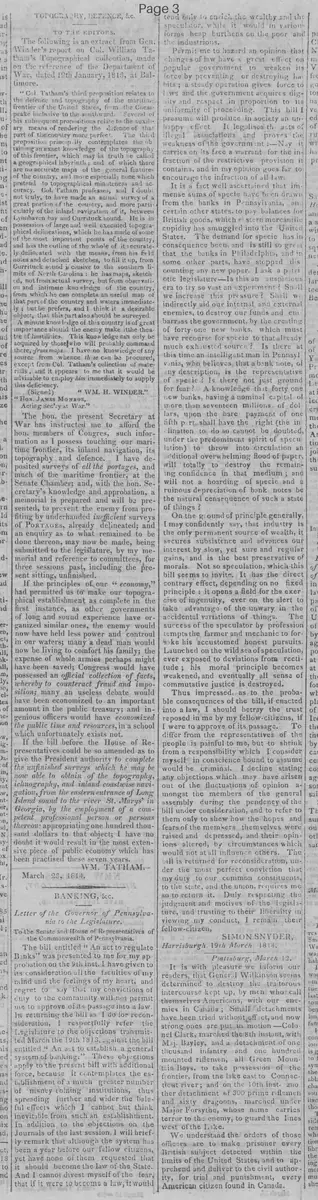
Letter of the Governor of Pennsylvania to the Legislature.
To the Senate and House of Representatives of the Commonwealth of Pennsylvania.
The bill entitled "An act to regulate Banks" was presented to me for my approbation on the 9th inst. I have given to its consideration all the faculties of my mind and the feelings of my heart, and regret to say that my convictions of duty to the community will not permit me to approve of its passage into a law.
In returning the bill as I do for reconsideration, I respectfully refer the Legislature to the objections transmitted March the 19th 1813, against the bill entitled "An act to establish a general system of banking:" These objections apply to the present bill with additional force, because it contemplates the establishment of a much greater number of money coining institutions, thus spreading further and wider the baneful effects which I cannot but think inevitable from such an establishment.
In addition to the objections on the Journals of the last session, I will briefly remark that although the system has been a year before our fellow citizens, yet have none of them requested that it should become the law of the State. And I cannot divest myself of the fear, that if it were to become a law, it would tend only to enrich the wealthy and the speculator, while it would in various forms heap burthens on the poor and the industrious.
Permit me to hazard an opinion that changes of law have a great effect on popular government to weaken its force by preventing or destroying habits; a steady operation gives force to laws and the government acquires dignity and respect in proportion to its uniformity of proceeding. This bill I presume will produce in society an unhappy effect. It legalizes the acts of illegal associations and proves the weakness of the government:—Nay it carries on its face a warrant for the infraction of the restrictive provision it contains, and in my opinion goes far to encourage the infraction of all law.
It is a fact well ascertained that immense sums of specie have been drawn from the banks in Pennsylvania, and certain other states, to pay balances for British goods, which eastern mercantile cupidity has smuggled into the United States. The demand for specie has in consequence been, and is still so great that the banks in Philadelphia, and in some other parts, have stopped discounting any new paper. I ask a patriotic legislature—Is this an auspicious era to try so vast an experiment? Shall we increase this pressure? Shall we indirectly aid our internal and external enemies, to destroy our funds and embarrass the government, by the creating of forty-one new banks, which must have recourse for specie to that already much exhausted source? Is there at this time an intelligent man in Pennsylvania, who believes that a bank note, of any description, is the representative of specie? Is there not just ground for fear? A knowledge that forty one new banks, having a nominal capital of more than seventeen millions of dollars, upon the bare payment of one fifth part, shall have the right (the inclination to do so cannot be doubted under the predominant spirit of speculation) to throw into circulation an additional overwhelming flood of paper, will totally destroy the remaining confidence in that medium: and will not a hoarding of specie and a ruinous depreciation of bank notes be the natural consequence of such a state of things?
On the ground of principle generally I may confidently say, that industry is the only permanent source of wealth, it secures subsistence and advances our interest by slow, yet sure and regular gains, and is the best preservative of morals. Not so speculation, which—this bill seems to invite. It has the direct contrary effect, depending on no fixed principle: it opens a field for the exercise of ingenuity, ever on the alert to take advantage of the unwary in the accidental variations of things. The success of the speculator by profession tempts the farmer and mechanic to forsake his accustomed honest pursuits. Launched on the wild sea of speculation, ever exposed to deviations from rectitude; his moral principle becomes weakened, and eventually all sense of commutative justice is destroyed.
Thus impressed, as to the probable consequences of the bill, if enacted into a law, I should betray the trust reposed in me by my fellow-citizens, if I were to approve of its passage. To differ from the representatives of the people is painful to me, but to shrink from a responsibility which I consider myself in conscience bound to assume would be criminal. I decline stating any objections which may have arisen out of the fluctuations of opinion amongst the members of the general assembly during the pendency of the bill under consideration, and to refer to them only to shew how the hopes and fears of the members themselves were raised and depressed, and their opinions altered, by circumstances which would not at all influence others. The bill is returned for reconsideration, under the most perfect conviction that my duty to our common constituents, to the state, and the union, requires me so to return it. Duly respecting the judgment and motives of the legislature, and trusting to their liberality in viewing my conduct, I remain their fellow-citizen,
SIMON SNYDER,
Harrisburgh, 19th March 1814.
What sub-type of article is it?
What keywords are associated?
What entities or persons were involved?
Where did it happen?
Domestic News Details
Primary Location
Pennsylvania
Event Date
1814 03 19
Key Persons
Outcome
the bill entitled 'an act to regulate banks' is vetoed and returned to the legislature for reconsideration.
Event Details
Governor Simon Snyder returns the bank regulation bill without approval, citing previous objections, lack of public support, potential to enrich speculators at the expense of the poor, exacerbation of specie shortages due to new banks, promotion of speculation over industry, and weakening of government stability and morals.