Thank you for visiting SNEWPapers!
Sign up free
Letter to Editor
April 6, 1787
The New York Packet
New York, New York County, New York
What is this article about?
An anonymous submission to the New-York Packet includes a letter dated March 30, 1787, decrying the cruelty of indefinite imprisonment for debt, comparing it to slavery, and urging reform to align with religious and natural liberty principles. It invokes poetry and moral reflections to highlight societal injustices.
Clipping
OCR Quality
98%
Excellent
Full Text
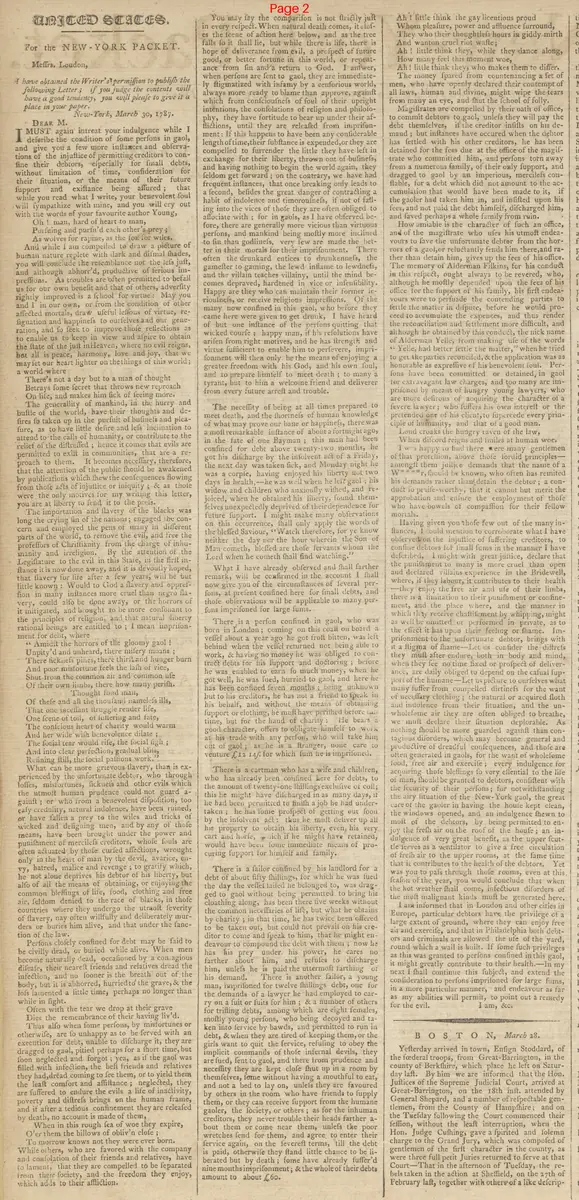
UNITED STATES.
For the NEW-YORK PACKET.
Messrs. Loudon,
I have obtained the Writer's permission to publish the following Letter; if you judge the contents will have a good tendency, you will please to give it a place in your paper.
New-York, March 30, 1787
DEAR SIR,
I MUST again intreat your indulgence while I describe the condition of some persons in gaol, and give you a few more instances and observations of the injustice of permitting creditors to confine their debtors, especially for small debts, without limitation of time, consideration for their situation, or the means of their future support and existence being assured; that while you read what I write, your benevolent soul will sympathize with mine, and you will cry out with the words of your favourite author Young,
Oh! man, hard of heart to man,
Pursuing and pursued each other's prey;
As wolves for rapine, as the fox for wiles.
And while I am compelled to draw a picture of human nature replete with dark and dismal shades, you will conclude the resemblance not the less just, and although abhorred, productive of serious impressions. As troubles are often permitted to befall us for our own benefit and that of others, adversity rightly improved is a school for virtue: May you and I in our own, or from the condition of other affected mortals, draw useful lessons of virtue, resignation and happiness to ourselves and our generation, and seek to improve those reflections as to enable us to keep in view and aspire to obtain the state of the just in Heaven, where no evil reigns, but all is peace, harmony, love and joy, that we mayest our heart lighter on the things of this world;
a world where
There's not a day but to a man of thought
Betrays some secret that throws new reproach
On life, and makes him sick of seeing more.
The generality of mankind, in the hurry and bustle of the world, have their thoughts and desires so taken up in the pursuit of business and pleasure, as to have little desire and less inclination to attend to the calls of humanity, or contribute to the relief of the distressed; hence it comes that evils are permitted to exist in communities, that are a reproach to them. It becomes necessary, therefore, that the attention of the public should be awakened by publications which shew the consequences flowing from those acts of injustice or iniquity; & as those were the only motives for my writing this letter, you are at liberty to send it to the press.
The importation and slavery of the blacks was long the crying sin of the nations; engaged the concern and employed the pens of many in different parts of the world, to remove the evil, and free the professors of Christianity from the charge of inhumanity and irreligion. By the attention of the Legislature to the evil in this State, in the first instance it is now done away, and it is devoutly hoped, that slavery for life after a few years, will be but little known: Would to God a slavery and oppression in many instances more cruel than negro slavery, could also be done away, or the horrors of it mitigated, and brought to be more consonant to the principles of religion, and that natural liberty rational beings are entitled to; I mean imprisonment for debt, where
"Amidst the horrors of the gloomy gaol!
Unpity'd and unheard, there misery moans;
There sickness pines, there thirst and hunger burn
And poor misfortune feels the lash of vice.
Shut from the common air and common use
Of their own limbs, there how many perish.
Thought fond man,
Of thee and all the thousand nameless ills,
'That one incessant struggle render life,
One scene of toil, of suffering and fate,
The conscious heart of charity would warm
And her wide wish benevolence dilate;
The social tear would rise, the social sigh;
And into clear perfection, gradual bliss,
Refining still, the social passions work."
What can be more grievous slavery, than is experienced by the unfortunate debtor, who through losses, misfortunes, sickness and other evils which the utmost human prudence could not guard against; or who from a benevolent disposition, too easy credulity, natural indolence, have been ruined, or have fallen a prey to the wiles and tricks of wicked and designing men, and by any of those means, have been brought under the power and punishment of merciless creditors, whose souls are often actuated by those cursed affections, wrought only in the heart of man by the devil, avarice, envy, hatred, malice and revenge; to gratify which, he not alone deprives his debtor of his liberty, but also of all the means of obtaining, or enjoying the common blessings of life, food, clothing and free air, seldom denied to the race of blacks, in those countries where they undergo the utmost severity of slavery, nay often willfully and deliberately murders or buries him alive, and that under the sanction of the law.
Persons closely confined for debt may be said to be civilly dead, or buried while alive. When men become naturally dead, occasioned by a contagious disease, their nearest friends and relatives dread the infection, and no sooner is the breath out of the body, but it is abhorred, hurried to the grave, & the loss lamented a little time, perhaps no longer than while in sight.
Often with the tear we drop at their grave
Dies the remembrance of their having liv'd.
Thus also when some persons, by misfortunes or otherwise, are so unhappy as to be served with an execution for debt, unable to discharge it, they are dragged to gaol, pitied perhaps for a short time, but soon neglected and forgot; yea, as if the gaol was filled with infection, the best friends and relatives they had, dread coming to see them, or to yield them the least comfort and assistance; neglected, they are suffered to endure the evils a life of inactivity, poverty and distress brings on the human frame, and if after a tedious confinement they are released by death, no account is made of them,
When in this rough sea of woe they expire,
O'er them the billows of oblivion close;
To morrow knows not they were ever born.
While others, who are favored with the company and consolation of their friends and relatives, have to lament, that they are compelled to be separated from their society, and the freedom they enjoy, which adds to their affliction.
For the NEW-YORK PACKET.
Messrs. Loudon,
I have obtained the Writer's permission to publish the following Letter; if you judge the contents will have a good tendency, you will please to give it a place in your paper.
New-York, March 30, 1787
DEAR SIR,
I MUST again intreat your indulgence while I describe the condition of some persons in gaol, and give you a few more instances and observations of the injustice of permitting creditors to confine their debtors, especially for small debts, without limitation of time, consideration for their situation, or the means of their future support and existence being assured; that while you read what I write, your benevolent soul will sympathize with mine, and you will cry out with the words of your favourite author Young,
Oh! man, hard of heart to man,
Pursuing and pursued each other's prey;
As wolves for rapine, as the fox for wiles.
And while I am compelled to draw a picture of human nature replete with dark and dismal shades, you will conclude the resemblance not the less just, and although abhorred, productive of serious impressions. As troubles are often permitted to befall us for our own benefit and that of others, adversity rightly improved is a school for virtue: May you and I in our own, or from the condition of other affected mortals, draw useful lessons of virtue, resignation and happiness to ourselves and our generation, and seek to improve those reflections as to enable us to keep in view and aspire to obtain the state of the just in Heaven, where no evil reigns, but all is peace, harmony, love and joy, that we mayest our heart lighter on the things of this world;
a world where
There's not a day but to a man of thought
Betrays some secret that throws new reproach
On life, and makes him sick of seeing more.
The generality of mankind, in the hurry and bustle of the world, have their thoughts and desires so taken up in the pursuit of business and pleasure, as to have little desire and less inclination to attend to the calls of humanity, or contribute to the relief of the distressed; hence it comes that evils are permitted to exist in communities, that are a reproach to them. It becomes necessary, therefore, that the attention of the public should be awakened by publications which shew the consequences flowing from those acts of injustice or iniquity; & as those were the only motives for my writing this letter, you are at liberty to send it to the press.
The importation and slavery of the blacks was long the crying sin of the nations; engaged the concern and employed the pens of many in different parts of the world, to remove the evil, and free the professors of Christianity from the charge of inhumanity and irreligion. By the attention of the Legislature to the evil in this State, in the first instance it is now done away, and it is devoutly hoped, that slavery for life after a few years, will be but little known: Would to God a slavery and oppression in many instances more cruel than negro slavery, could also be done away, or the horrors of it mitigated, and brought to be more consonant to the principles of religion, and that natural liberty rational beings are entitled to; I mean imprisonment for debt, where
"Amidst the horrors of the gloomy gaol!
Unpity'd and unheard, there misery moans;
There sickness pines, there thirst and hunger burn
And poor misfortune feels the lash of vice.
Shut from the common air and common use
Of their own limbs, there how many perish.
Thought fond man,
Of thee and all the thousand nameless ills,
'That one incessant struggle render life,
One scene of toil, of suffering and fate,
The conscious heart of charity would warm
And her wide wish benevolence dilate;
The social tear would rise, the social sigh;
And into clear perfection, gradual bliss,
Refining still, the social passions work."
What can be more grievous slavery, than is experienced by the unfortunate debtor, who through losses, misfortunes, sickness and other evils which the utmost human prudence could not guard against; or who from a benevolent disposition, too easy credulity, natural indolence, have been ruined, or have fallen a prey to the wiles and tricks of wicked and designing men, and by any of those means, have been brought under the power and punishment of merciless creditors, whose souls are often actuated by those cursed affections, wrought only in the heart of man by the devil, avarice, envy, hatred, malice and revenge; to gratify which, he not alone deprives his debtor of his liberty, but also of all the means of obtaining, or enjoying the common blessings of life, food, clothing and free air, seldom denied to the race of blacks, in those countries where they undergo the utmost severity of slavery, nay often willfully and deliberately murders or buries him alive, and that under the sanction of the law.
Persons closely confined for debt may be said to be civilly dead, or buried while alive. When men become naturally dead, occasioned by a contagious disease, their nearest friends and relatives dread the infection, and no sooner is the breath out of the body, but it is abhorred, hurried to the grave, & the loss lamented a little time, perhaps no longer than while in sight.
Often with the tear we drop at their grave
Dies the remembrance of their having liv'd.
Thus also when some persons, by misfortunes or otherwise, are so unhappy as to be served with an execution for debt, unable to discharge it, they are dragged to gaol, pitied perhaps for a short time, but soon neglected and forgot; yea, as if the gaol was filled with infection, the best friends and relatives they had, dread coming to see them, or to yield them the least comfort and assistance; neglected, they are suffered to endure the evils a life of inactivity, poverty and distress brings on the human frame, and if after a tedious confinement they are released by death, no account is made of them,
When in this rough sea of woe they expire,
O'er them the billows of oblivion close;
To morrow knows not they were ever born.
While others, who are favored with the company and consolation of their friends and relatives, have to lament, that they are compelled to be separated from their society, and the freedom they enjoy, which adds to their affliction.
What sub-type of article is it?
Persuasive
Ethical Moral
Social Critique
What themes does it cover?
Crime Punishment
Morality
Social Issues
What keywords are associated?
Imprisonment For Debt
Debtor Oppression
Prison Reform
Social Injustice
Debtors Rights
Gaol Conditions
What entities or persons were involved?
Messrs. Loudon
Letter to Editor Details
Recipient
Messrs. Loudon
Main Argument
imprisonment for debt, especially indefinite confinement for small sums without regard for the debtor's situation, is a cruel injustice akin to slavery and contrary to religious and natural liberty principles; it should be reformed to prevent such oppression.
Notable Details
Quotes Edward Young On Human Cruelty
Compares Debtor Imprisonment To Negro Slavery
References Poetic Descriptions Of Gaol Horrors
Discusses Civil Death And Societal Neglect Of Prisoners