Thank you for visiting SNEWPapers!
Sign up free
Story
January 22, 1857
Southern Christian Advocate
Charleston, Charleston County, South Carolina
What is this article about?
An essay on the Christian duty of 'faithful wounds'—loving rebuke to correct sins in others. It critiques neglect of this duty using examples like a hasty-tempered father and a worldly Christian, urging action despite excuses like offense or personal flaws.
Clipping
OCR Quality
95%
Excellent
Full Text
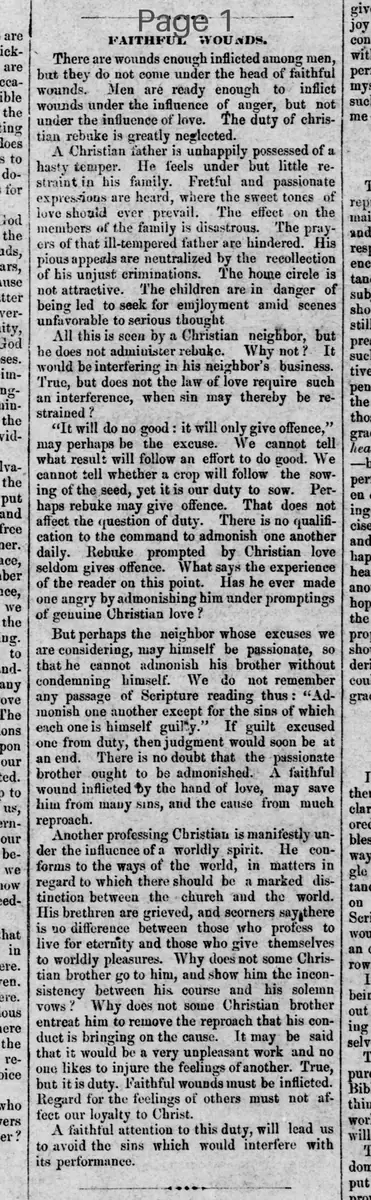
FAITHFUL WOUNDS.
There are wounds enough inflicted among men,
but they do not come under the head of faithful
wounds. Men are ready enough to inflict
wounds under the influence of anger, but not
under the influence of love. The duty of chris-
tian rebuke is greatly neglected.
A Christian father is unhappily possessed of a
hasty temper. He feels under but little re-
straint in his family. Fretful and passionate
expressions are heard, where the sweet tones of
love should ever prevail. The effect on the
members of the family is disastrous. The pray-
ers of that ill-tempered father are hindered. His
pious appeals are neutralized by the recollection
of his unjust criminations. The home circle is
not attractive. The children are in danger of
being led to seek for employment amid scenes
unfavorable to serious thought
All this is seen by a Christian neighbor, but
he does not administer rebuke. Why not? It
would be interfering in his neighbor's business.
True, but does not the law of love require such
an interference, when sin may thereby be re-
strained?
"It will do no good: it will only give offence,"
may perhaps be the excuse. We cannot tell
what results will follow an effort to do good. We
cannot tell whether a crop will follow the sow.
ing of the seed, yet it is our duty to sow. Per-
haps rebuke may give offence. That does not
affect the question of duty. There is no qualifi-
cation to the command to admonish one another
daily. Rebuke prompted by Christian love
seldom gives offence. What says the experience
of the reader on this point. Has he ever made
one angry by admonishing him under promptings
of genuine Christian love?
But perhaps the neighbor whose excuses we
are considering, may himself be passionate, so
that he cannot admonish his brother without
condemning himself. We do not remember
any passage of Scripture reading thus: "Ad-
monish one another except for the sins of which
each one is himself guilty." If guilt excused
one from duty, then judgment would soon be at
an end. There is no doubt that the passionate
brother ought to be admonished. A faithful
wound inflicted by the hand of love, may save
him from many sins, and the cause from much
reproach.
Another professing Christian is manifestly un-
der the influence of a worldly spirit. He con-
forms to the ways of the world, in matters in
regard to which there should be a marked dis-
tinction between the church and the world.
His brethren are grieved, and scorners say there
is no difference between those who profess to
live for eternity and those who give themselves
to worldly pleasures. Why does not some Chris-
tian brother go to him, and show him the incon-
sistency between his course and his solemn
vows? Why does not some Christian brother
entreat him to remove the reproach that his con-
duct is bringing on the cause. It may be said
that it would be a very unpleasant work and no
one likes to injure the feelings of another. True,
but it is duty. Faithful wounds must be inflicted.
Regard for the feelings of others must not af-
fect our loyalty to Christ.
A faithful attention to this duty. will lead us
to avoid the sins which would interfere with
its performance.
There are wounds enough inflicted among men,
but they do not come under the head of faithful
wounds. Men are ready enough to inflict
wounds under the influence of anger, but not
under the influence of love. The duty of chris-
tian rebuke is greatly neglected.
A Christian father is unhappily possessed of a
hasty temper. He feels under but little re-
straint in his family. Fretful and passionate
expressions are heard, where the sweet tones of
love should ever prevail. The effect on the
members of the family is disastrous. The pray-
ers of that ill-tempered father are hindered. His
pious appeals are neutralized by the recollection
of his unjust criminations. The home circle is
not attractive. The children are in danger of
being led to seek for employment amid scenes
unfavorable to serious thought
All this is seen by a Christian neighbor, but
he does not administer rebuke. Why not? It
would be interfering in his neighbor's business.
True, but does not the law of love require such
an interference, when sin may thereby be re-
strained?
"It will do no good: it will only give offence,"
may perhaps be the excuse. We cannot tell
what results will follow an effort to do good. We
cannot tell whether a crop will follow the sow.
ing of the seed, yet it is our duty to sow. Per-
haps rebuke may give offence. That does not
affect the question of duty. There is no qualifi-
cation to the command to admonish one another
daily. Rebuke prompted by Christian love
seldom gives offence. What says the experience
of the reader on this point. Has he ever made
one angry by admonishing him under promptings
of genuine Christian love?
But perhaps the neighbor whose excuses we
are considering, may himself be passionate, so
that he cannot admonish his brother without
condemning himself. We do not remember
any passage of Scripture reading thus: "Ad-
monish one another except for the sins of which
each one is himself guilty." If guilt excused
one from duty, then judgment would soon be at
an end. There is no doubt that the passionate
brother ought to be admonished. A faithful
wound inflicted by the hand of love, may save
him from many sins, and the cause from much
reproach.
Another professing Christian is manifestly un-
der the influence of a worldly spirit. He con-
forms to the ways of the world, in matters in
regard to which there should be a marked dis-
tinction between the church and the world.
His brethren are grieved, and scorners say there
is no difference between those who profess to
live for eternity and those who give themselves
to worldly pleasures. Why does not some Chris-
tian brother go to him, and show him the incon-
sistency between his course and his solemn
vows? Why does not some Christian brother
entreat him to remove the reproach that his con-
duct is bringing on the cause. It may be said
that it would be a very unpleasant work and no
one likes to injure the feelings of another. True,
but it is duty. Faithful wounds must be inflicted.
Regard for the feelings of others must not af-
fect our loyalty to Christ.
A faithful attention to this duty. will lead us
to avoid the sins which would interfere with
its performance.
What sub-type of article is it?
Moral Essay
Religious Instruction
What themes does it cover?
Moral Virtue
What keywords are associated?
Faithful Wounds
Christian Rebuke
Moral Duty
Loving Admonish
Sin Correction
Religious Ethics
Story Details
Story Details
The essay exhorts Christians to practice loving rebuke, or 'faithful wounds,' to correct sins in others, using hypothetical examples of a temperamental father and a worldly believer, and refuting common excuses for neglecting this duty.