Thank you for visiting SNEWPapers!
Sign up free
Gazette Of The United States
New York, New York County, New York
What is this article about?
Eyewitness account of the assassination of French General Theobald Dillon by mutinous troops in Lille on April 29, 1792, during a failed expedition to Tournay. Soldiers, crying treason, killed Dillon, an engineer officer, and Austrian prisoners amid revolutionary fervor.
Clipping
OCR Quality
Full Text
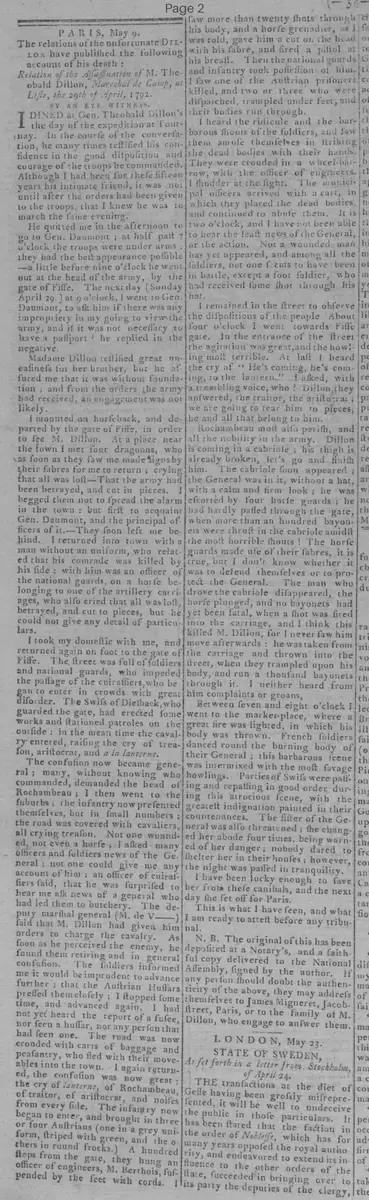
The relations of the unfortunate Dillon have published the following account of his death:
Relation of the Assassination of M. Theobald Dillon, Marechal de Camp, at Lille, the 29th of April, 1792.
BY AN EYE WITNESS.
I DINED at Gen. Theobald Dillon's the day of the expedition at Tournay. In the course of the conversation, he many times testified his confidence in the good disposition and courage of the troops he commanded. Although I had been for these fifteen years his intimate friend, it was not until after the orders had been given to the troops, that I knew he was to march the same evening. He quitted me in the afternoon to go to Gen. Daumont; at half past 7 o'clock the troops were under arms; they had the best appearance possible—a little before nine o'clock he went out at the head of the army, by the gate of Lille. The next day [Sunday April 29] at 9 o'clock, I went to Gen. Daumont, to ask him if there was any impropriety in my going to view the army, and if it was not necessary to have a passport he replied in the negative. Madame Dillon testified great uneasiness for her brother, but he assured me that it was without foundation; and from the orders the army had received, an engagement was not likely. I mounted on horseback, and departed by the gate of Lille in order to see M. Dillon. At a place near the town I met four dragoons, who as soon as they saw me made signs by their sabres for me to return; crying that all was lost—That the army had been betrayed, and cut in pieces. I begged them not to spread the alarm in the town: but first to acquaint Gen. Daumont, and the principal officers of it.—They soon let me be behind. I returned into town with a man without an uniform, who related that his comrade was killed by his side: with him was an officer of the national guards, on a horse belonging to one of the artillery carriages, who also cried that all was lost, betrayed, and cut to pieces, but he could not give any detail of particulars. I took my domestic with me, and returned again on foot to the gate of Lille. The street was full of soldiers and national guards, who impeded the passage of the cuirassiers, who began to enter in crowds with great disorder. The Swiss of Deiback, who guarded the gate, had erected some works and stationed patrols on the outside: in the mean time the cavalry entered, raising the cry of treason, aristocrat, and a la lanterne. The confusion now became general; many, without knowing who commanded, demanded the head of Rochambeau; I then went to the suburbs; the infantry now presented themselves, but in small numbers; the road was covered with cavaliers, all crying treason. Not one wounded, not even a horse; I asked many officers and soldiers news of the General; not one could give me any account of him; an officer of cuirassiers said, that he was surprised to hear me ask news of a general who had led them to butchery. The deputy marshal general (M. de V—) said that M. Dillon had given him orders to charge the cavalry. As soon as he perceived the enemy, he found them retiring and in general confusion. The soldiers informed me it would be imprudent to advance further; that the Austrian Hussars pressed them closely; I stopped some time, and advanced again. I had not yet heard the report of a fuse, nor seen a hussar, nor any person that had seen one. The road was now crowded with carts of baggage and peasantry, who fled with their movables into the town. I again returned, the confusion was now great; the cry of lanterne, of Rochambeau, of traitor, of aristocrat, and noises from every side. The infantry now began to enter, and brought in three or four Austrians (one in a grey uniform, striped with green, and the others in round frocks.) A hundred steps from the gate, they hung an officer of engineers, M. Berthois, suspended by the feet with cords. I saw more than twenty shots through his body, and a horse grenadier, as I was told, gave him a cut on the head with his sabre, and fired a pistol at his breast. Then the national guards and infantry took possession of him. I saw one of the Austrian prisoners killed, and two or three who were dispatched, trampled under feet, and their bodies run through. I heard the ridicule and the barbarous shouts of the soldiers, and saw them amuse themselves in striking the dead bodies with their bayonets. They were crowded in a wheel-barrow, with the officer of engineers. I shudder at the sight. The municipal officers arrived with a cart, in which they placed the dead bodies, and continued to abuse them. It is two o'clock, and I have not been able to hear the least news of the General, or the action. Not a wounded man has yet appeared, and among all the soldiers, not one seems to have been in battle, except a foot soldier, who had received some shot through his hat. I remained in the street to observe the dispositions of the people. About four o'clock I went towards Lille gate. In the entrance of the street the agitation was great, and the howling most terrible. At last I heard the cry of "He's coming, he's coming, to the lantern." I asked, with a trembling voice, who: Dillon, they answered, the traitor. the aristocrat; we are going to tear him to pieces, he and all that belong to him. Rochambeau must also perish, and all the nobility in the army. Dillon is coming in a cabriole; his thigh is already broken, let's go and finish him. The cabriole soon appeared; the General was in it, without a hat, with a calm and firm look; he was escorted by four horse guards; he had hardly passed through the gate, when more than an hundred bayonets were thrust in the cabriole amidst the most horrible shouts! The horse guards made use of their sabres, it is true, but I don't know whether it was to defend themselves or to protect the General. The man who drove the cabriole disappeared, the horse plunged, and no bayonets had yet been fatal, when a shot was fired into the carriage, and I think this killed M. Dillon, for I never saw him move afterwards: he was taken from the carriage and thrown into the street, when they trampled upon his body, and run a thousand bayonets through it. I neither heard from him complaints or groans. Between seven and eight o'clock I went to the market-place, where a great fire was lighted, in which his body was thrown. French soldiers danced round the burning body of their General; this barbarous scene was intermixed with the most savage howlings. Parties of Swiss were passing and repassing in good order during this atrocious scene, with the greatest indignation painted in their countenances. The sister of the General was also threatened; he changed her abode four times, being warned of her danger; nobody dared to shelter her in their houses; however, the night was passed in tranquility. I have been lucky enough to save her from these cannibals, and the next day she set off for Paris. This is what I have seen, and what I am ready to attest before any tribunal. N. B. The original of this has been deposited at a Notary's, and a faithful copy delivered to the National Assembly, signed by the author. If any person should doubt the authenticity of the above, they may address themselves to James Migneret, Jacob-street, Paris, or to the family of M. Dillon, who engage to answer them.
What sub-type of article is it?
What keywords are associated?
What entities or persons were involved?
Where did it happen?
Foreign News Details
Primary Location
Lille
Event Date
29th Of April, 1792
Key Persons
Outcome
general theobald dillon assassinated by mutinous troops; engineer officer m. berthois killed with multiple shots and sabre cut; several austrian prisoners killed and mutilated; dillon's body burned in marketplace.
Event Details
During an expedition to Tournay, French troops under General Dillon returned to Lille in disorder, crying treason and accusing Dillon and others of betrayal. No battle occurred, but mutineers killed Dillon upon his return in a cabriole, stabbing and shooting him, then burning his body. Other officers and prisoners were also lynched amid cries against aristocrats.