Thank you for visiting SNEWPapers!
Sign up free
Vermont Telegraph
Brandon, Rutland County, Vermont
What is this article about?
Parker Pillsbury's letter critiques New England clergy for hypocrisy, opposing capital punishment abolition, glorifying war via lectures on General Putnam, and inconsistent temperance views. He shares anecdotes from sermons by Elder Swan, a lecture by Rev. Thomas Williams, and a debate with a ministerial candidate on war, slavery, and alcohol.
Clipping
OCR Quality
Full Text
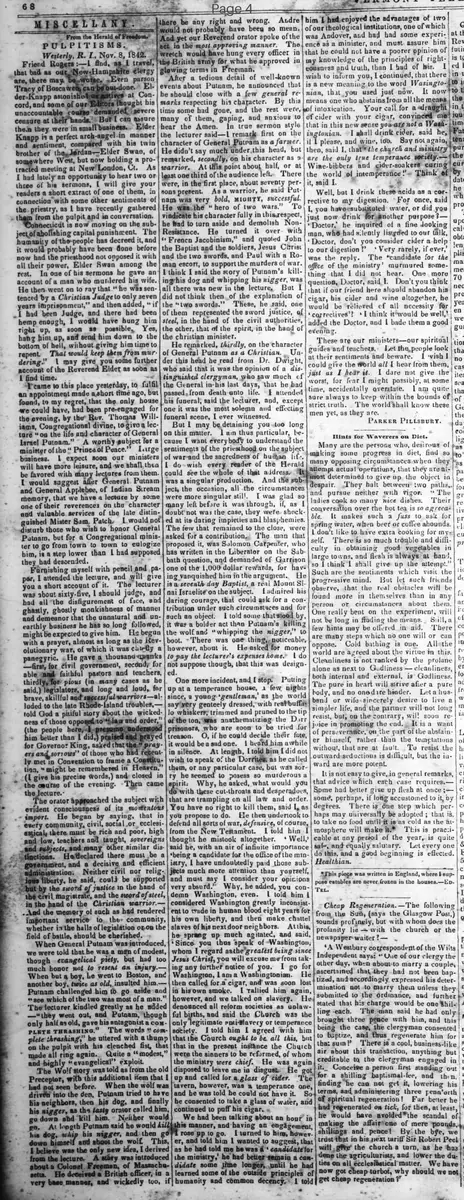
Connecticut is now moving on the subject of abolishing capital punishment. The humanity of the people has decreed it, and it would probably have been done before now had the priesthood not opposed it with all their power, Elder Swan among the rest. In one of his Sermons he gave an account of a man who murdered his wife. He then went on to say that "he was sentenced by a Christian Judge to only seven years imprisonment," and then added, "if I had been Judge, and there had been hemp enough, I would have hung him right up, as soon as possible. Yes, hang him up, and send him down to the bottom of hell, without giving him time to repent. That would keep them from murdering." I may give you some further account of the Reverend Elder as soon as I find time.
I came to this place yesterday, to fulfil an appointment made a short time ago, but found, to my regret, that the only house we could have, had been pre-engaged for the evening, by the Rev. Thomas Williams, Congregational divine, to give a lecture "on the life and character of General Israel Putnam." - A worthy subject for a minister of the "Prince of Peace." Large business. I expect soon our ministers will have more leisure, and we shall then be favored with many lectures from them. I would suggest after General Putnam and General Applebee, of Indian Stream memory, that we have a lecture by some one of their reverences on the character and valuable services of the late distinguished Mister Sam. Patch. I would not disturb those who wish to honor General Putnam, but for a Congregational minister to go from town to town to eulogize him, is a step lower than I had supposed they had descended.
Furnishing myself with pencil and paper, I attended the lecture, and will give you a short account of it. The lecturer was about sixty-five, I should judge, and had all the disfigurement of face, and ghastly, ghostly monkishness of manner and demeanor that the unnatural and unearthly business he has so long followed, might be expected to give him. He begun with a prayer, almost as long as the Revolutionary war, of which it was chiefly a panegyric. He gave a thousand thanks—first, for civil government, second, for able and faithful pastors and teachers, thirdly, for pious (in many cases as he said,) legislators, and long and loud, for brave, skillful and successful warriors—alluded to the late Rhode-Island troubles, told God a pitiful story about the wickedness of those opposed to "law and order." (the people here, I presume understood him better than I did,) praised and prayed for Governor King, asked that the "prayers and sorrows' of those who had recently met in Convention to frame a Constitution, "might be remembered in Heaven,' (I give his precise words,) and closed in the course of the evening. -Then came the lecture..
The orator approached the subject with evident consciousness of its momentous import. He began by saying, that in every community, civil, social or ecclesiastical, there must be rich and poor, high and low, teachers and taught, sovereigns and subjects, and many other similar distinctions. He declared there must be a government, and a decisive and efficient administration. Neither civil nor religious liberty, he said, could be supported but by the sword of justice in the hand of the civil magistrate, and the sword of steel, in the hand of the Christian warrior. -And the memory of such as had rendered important service to the community, whether in the halls of legislation or on the field of battle, should be cherished.
When General Putnam was introduced, we were told that he was a man of modest, though evangelical piety, but had too much honor not to resent an injury.- When but a boy, he went to Boston, and another boy, twice as old, insulted him.- Putnam challenged him to go aside and "see which of the two was most of a man." The lecturer kindled greatly as he added —"they went out, and Putnam, though only half as old, gave his antagonist a COMPLETE THRASHING." The words "complete thrashing," he uttered with a thump on the pulpit with his clenched fist, that made all ring again. Quite a "modest." and highly "evangelical" exploit.
The Wolf story was told as from the old Preceptor, with this additional item that I had not seen before. When the wolf was driven into the den, Putnam tried to have his neighbors, then his dog, and finally his nigger, as the orator called him, go down and kill him. Neither would go. At length Putnam said he would kill his dog, whip his nigger, and then go down himself and shoot the wolf This, I believe was the only new idea, I derived from the lecture. A story was introduced about a Colonel Freeman, of Massachusetts. He deceived a British officer, in a very base manner, and wickedly too, if there be any right and wrong. A Dorr would not probably have been so mean. And yet our Reverend orator spoke of the act in the most approving manner. The wretch would have hung every officer in the British army for what he approved in glowing terms in Freeman.
After a tedious detail of well-known events about Putnam, he announced that he should close with a few general remarks respecting his character. By this time some had gone, and the rest were, many of them, gaping, and anxious to hear the Amen. In true sermon style the lecturer said- I remark first on the character of General Putnam as a farmer. He didn't say much under this head, but remarked, secondly, on his character as a warrior. At this point about half, or at least one third of the audience left. There were, in the first place, about seventy persons present. As a warrior, he said Putnam was very bold, MIGHTY, successful. He was the "hero of two wars."
To vindicate his character fully in this respect, he had to turn aside and demolish Non-Resistance. He turned it over with "French Jacobinism," and quoted John the Baptist and the soldiers, Jesus Christ and the two swords, and Paul with a Roman escort, to support the murders of war. I think I said the story of Putnam's killing his dog and whipping his nigger, was all there was new in the lecture. But I did not think then of the explanation of the "two swords." These, he said, one of them represented the sword justice, of steel, in the hand of the civil authorities, the other, that of the spirit, in the hand of the christian minister.
He remarked, thirdly, on the character of General Putnam as a Christian. Under this head he read from Dr. Dwight, who said that it was the opinion of a distinguished clergyman, who saw much of the General in his last days, that he had passed from death unto life. I attended his funeral, said the lecturer, and, except one it was the most solemn and effecting funeral scene, I ever witnessed. But I may be detaining you too long on this matter. I am thus particular, because I want everybody to understand the sentiments of the priesthood on the subject of war and the sacredness of human life. I do wish every reader of the Herald could see the whole of that address. It was a singular production. And the subject, the occasion, all the circumstances were more singular still. I was glad so many left before it was through, if, as I doubt not was the case, they were shocked at its daring impieties and blasphemies. The few that remained to the close, were asked for a contribution. The man that proposed it, was Solomon Carpenter, who has written in the Liberator on the Sabbath question, and demanded of Garrison one of the 1,000 dollar rewards, for having vanquished him in the argument. He is a seventh day Baptist, a real Mount Sinai Israelite on the subject. I admired his daring courage, that could ask for a contribution under such circumstances and for such an object. I told some that stood by, it was a bolder act than Putnam's killing the wolf and "whipping the nigger," to boot. -There was one thing, noticeable, however, about it. He asked for money to pay the lecturer's expenses home." I do not suppose though, that this was designed.
One more incident, and I stop. Putting up at a temperance house, a few nights since, a young 'gentleman,' as the world says, very genteelly dressed, with real buffaloe whiskers, trimmed and pruned to the tip of the ton, was anathematizing the Dorr prisoners, who are soon to be tried for treason. O, if he could decide their fate, it would be a sad one. I heard him a while in silence. At length, I told him I did not wish to speak of the Dorrites, as he called them, or any particular case, but was sorry he seemed to possess so murderous a spirit: Why, he asked, what would you do with these cut-throats and desperadoes, that are trampling on all law and order. You have no right to kill them, said I, as you propose to do. He then undertook to defend all sorts of war, defensive, of course, from the New Testament. I told him I thought he mistook altogether. Well, said he, with an air of infinite importance 'being a candidate for the office of the ministry, I have undoubtedly paid those subjects much more attention than yourself, and must say I consider your opinions very absurd." Why, he added, you condemn Washington, even. I told him I considered Washington greatly inconsistent to wade in human blood eight years for his own liberty, and then make chattel slaves of his next door neighbors. At this, he sprang up much agitated, and said, Since you thus speak of Washington, whom I regard as the greatest being since Jesus Christ, you will excuse me from taking any further notice of you. I go for Washington, I am a Washingtonian. He then called for a cigar, and was soon lost in his own smoke. I rallied him again, however, and we talked on slavery. He denounced all reform societies as unlawful births, and said the Church was the only legitimate anti-slavery or temperance society. I told him I agreed with him that the Church ought to be all this, but that in the present instance the Church were the sinners to be reformed, of whom the ministry were chief. He was again disposed to leave me in disgust. He got up and called for a glass of cider. The tavern, however, was a temperance one, and he was told he could not have it. So he consented to take a glass of water, and continued to puff his cigar.
We had been talking about an hour in this manner, and having an engagement, I rose up to go. I turned to him, however, and told him I wanted to suggest, that as he had told me he was a 'candidate for the ministry,' he had better remain a candidate some time longer, until he had learned some of the outside principles of humanity and common decency. I told him I had enjoyed the advantages of two of our theological institutions, one of which was Andover, and had had some experience as a minister, and must assure him that he could not have a poorer opinion of my knowledge of the principles of righteousness and truth, than I had of his. I wish to inform you, I continued, that there is a new meaning to the word Washingtonian, that you used just now. It now means one who abstains from all the means of intoxication. Your call for a draught of cider with your cigar, convinced me that in this new sense you are not a Washingtonian. I shall drink cider, said he, if I please, and wine, too. Say not again, then, said I, that the church and ministry are the only true temperance society. Wine-bibbers and cider-soakers curing the world of intemperance!' Think of it, said I.
Well, but I drink these acids as a corrective to my digestion. -For once, said I, you have substituted water, or did you just now drink for another purpose?- Doctor,' he inquired of a fine looking man, who had silently listened to our talk, 'Doctor, don't you consider cider a help to our digestion?' 'Very rarely, if ever,' was the reply. The candidate for the office of the ministry 'murmured something that I did not hear. One more question, Doctor, said I. Don't you think that if our friend here should abandon his cigar, his cider and wine altogether, he would be relieved of all necessity for 'correctives'? I think it would be well.' added the Doctor, and I bade them a good evening.
These are our ministers—our spiritual guides and teachers.- Let the people look at their sentiments and beware. I wish I could give the world all I hear from them, just as I hear it. I dare not give the worst, for fear I might possibly, at some time, accidentally overstate. I am quite sure always to keep within the bounds of strict truth. The world shall know these men yet, as they are.
PARKER PILLSBURY.
What sub-type of article is it?
What themes does it cover?
What keywords are associated?
What entities or persons were involved?
Letter to Editor Details
Author
Parker Pillsbury
Recipient
Friend Rogers
Main Argument
the letter exposes the hypocrisy and pro-violence sentiments of new england clergy, who oppose abolishing capital punishment, glorify war through lectures on figures like general putnam, and fail to uphold temperance and anti-slavery principles, urging readers to recognize their true character.
Notable Details