Thank you for visiting SNEWPapers!
Sign up free
Daily National Intelligencer
Washington, District Of Columbia
What is this article about?
Post-War of 1812 correspondence reveals British Colonel Nicholls arming Seminole and Creek Indians in Florida, threatening US frontiers over alleged attacks, while US Agent Benjamin Hawkins demands justice and exposes unauthorized British treaties, prompting Georgia Governor Early's protest to Spanish authorities.
Clipping
OCR Quality
Full Text
From the Georgia Journal
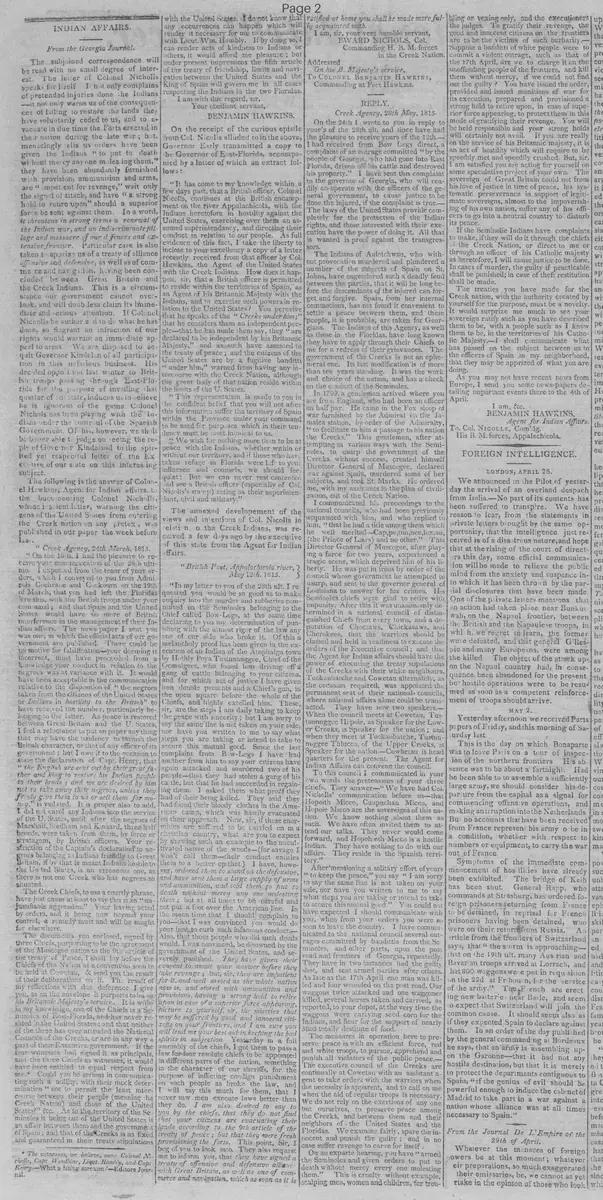
The subjoined correspondence will be read with no small degree of interest. The letter of Colonel Nicholls speaks for itself. It not only complains of pretended injuries done the Indians—it not only warns us of the consequences of failing to restore the lands they have voluntarily ceded to us, and to evacuate in due time the forts erected in their nation during the late war; but, menacingly tells us orders have been given the Indians "to put to death without mercy any one molesting them," they have been abundantly furnished with provisions, ammunition and arms, are "impatient for revenge," wait only the signal of attack, and have "a strong hold to retire upon" should a superior force be sent against them. In a word, it threatens in strong terms a renewal of the Indian war, and an indiscriminate pillage and massacre of our defenceless and extensive frontier. Particular care is also taken to apprise us of a treaty of alliance offensive and defensive, as well as of commerce and navigation, having been concluded between Great Britain and the Creek Indians. This is a circumstance our government cannot overlook, and will doubtless claim its immediate and serious attention. If Colonel Nicholls be authorized to do what he has done, so flagrant an infraction of our rights would warrant an immediate appeal to arms. We are disposed to acquit Governor Kindelan of all participation in this nefarious business. His decided opposition last winter to British troops passing through East-Florida for the purpose of invading that quarter of our state, induces us to believe he is ignorant of the game Colonel Nichols has been playing with the Indians under the controul of the Spanish Government. Of this, however, we shall be better able to judge on seeing the reply of Governor Kindelan to the spirited yet respectful letter of the Executive of our state on this interesting subject.
The following is the answer of Colonel Hawkins, Agent for Indian affairs, to the buccaneering Colonel Nicholls, whose insolent letter, warning the citizens of the United States from entering the Creek nation on any pretext, was published in our paper the week before last.
"Creek Agency, 24th March, 1815.
"On the 18th, I had the pleasure to receive your communication of the 28th ultimo. I expected from the tenor of your orders, which I conveyed to you from Admirals Cochrane and Cockburn on the 19th of March, that you had left the Floridas ere this, with the British troops under your command; and that Spain and the United States would have no more of British interference in the management of their Indian affairs. The news-paper I sent you was one, in which the official acts of our government are published. There could be no motive for falsification—your deeming it incorrect, must have proceeded from a knowledge your conduct in relation to the negroes was at variance with it. It would have been acceptable in the communication relative to the disposition of "the negroes taken from the citizens of the United States or Indians in hostility to the British" to have received the number, particularly belonging to the latter. As peace is restored between Great Britain and the U. States, I feel a reluctance to put on paper any thing that may have the tendency to tarnish the British character, or that of any officer of its government; but I owe it to the occasion to state the declaration of Capt. Henry, that "the English are sent out by their great father and king to restore his Indian neophytes to their lands; and we are desired by him not to take away their negroes, unless they freely give them to us or sell them for money," is violated. It is proper also to add, I did not enrol any Indians into the service of the U. States, until after the negroes of Marshall, Stedham and Kinnard, three half breeds, were taken from them, by force or stratagem, by British officers. Your restriction of the Captain's declaration to negroes belonging to Indians friendly to Great Britain, if by that is meant Indians hostile to the United States, is an erroneous one, as there is not one Creek who has negroes so situated.
The Creek Chiefs, to use a courtly phrase, have just cause at least to say this is an "unjustifiable aggression." Your having acted by orders, and it being now beyond your control, a remedy must and will be sought for elsewhere.
The documents you enclosed, signed by three Chiefs, purporting to be the agreement of the Muscogee nation to the 9th article of the treaty of Peace, I shall lay before the Chiefs of the Nation at a convention soon to be held at Cowetau, & send you the result of their deliberations on it. The result of my reflections with due deference I give you, as on the envelope it purports to be on his Britannic Majesty's service. It is within my knowledge, one of the Chiefs is a Seminole of East-Florida, and has never resided in the United States; and that neither of the three has ever attended the National Councils of the Creeks, or are in any way a part of their Executive government. If the four witnesses had signed it as principals, and the three Chiefs as witnesses, it would have been entitled to equal respect from me. Could you be serious in communicating such a nullity, with their mock determination "not to permit the least intercourse between their people (meaning the Creek Nation) and those of the United States?" &c. As to the territory of the Seminoles it being out of the United States is an affair between them and the government of Spain; and that of the Creeks is as fixed and guaranteed in their treaty stipulations
* The witnesses, we believe, were Colonel Nicholls, Capt Woodbine, Lieut. Hambly, and Capt Henry.—What a biting sarcasm!—Editors Journal.
with the United States. I do not know that any occurrences can happen which will render it necessary for me to communicate with Lieut. Wm. Hambly. If by doing so, I can render acts of kindness to Indians or others, it would afford me pleasure; but under present impressions the fifth article of the treaty of friendship, limits and navigation between the United States and the King of Spain will govern me in all cases respecting the Indians in the two Floridas.
I am with due regard, sir,
Your obedient servant,
BENJAMIN HAWKINS.
On the receipt of the curious epistle from Col. Nicholls alluded to in the above, Governor Early transmitted a copy to the Governor of East-Florida, accompanied by a letter of which an extract follows:
"It has come to my knowledge within a few days past, that a British officer, Colonel Nicholls, continues at the British encampment on the river Appalachicola, with the Indians heretofore in hostility against the United States, exercising over them an assumed superintendancy, and directing their conduct in relation to our people. As full evidence of this fact, I take the liberty to inclose to your excellency a copy of a letter recently received from that officer by Col. Hawkins, the Agent of the United States with the Creek Indians. How does it happen, sir, that a British officer is permitted to reside within the territories of Spain, as an Agent of his Britannic Majesty with the Indians, and to exercise such powers in relation to the United States? You perceive that he speaks of the "Creeks under him;" that he considers them an independent people—that he has made them say, they "are declared to be independent by his Britannic Majesty," and as such have assented to the treaty of peace; and the citizens of the United States are by a fugitive banditti "under him," warned from having any intercourse with the Creek Nation, although the great body of that nation reside within the limits of the U. States.
"This representation is made to you in the confident belief that you will not after this information suffer the territory of Spain within the Province under your command to be used for purposes which in their tendency must be most inimical to us
"We wish for nothing more than to be at peace with the Indians, whether within or without our territory, and if those who have taken refuge in Florida were left to your influence and counsels, we should feel quiet: But we can never rest contented and see a British officer (especially of Col. Nicholls's stamp) acting as their superintendent, civil and military."
The annexed developement of the views and intentions of Col. Nicholls in relation to the Creek Indians, was received a few days ago by the executive of this state from the Agent for Indian Affairs.
"British Post, Appalachicola river,
May 12th, 1815.
"In my letter to you of the 28th ult. I requested you would be so good as to make enquiry into the murder and robberies committed on the Seminoles belonging to the Chief called Bow-Legs, at the same time declaring to you my determination of punishing with the utmost rigor of the law any one of our side who broke it. Of this a melancholy proof has been given in the execution of an Indian of the Atophalga town by Hothly Poya Tustunnuggee, Chief of the Ocmulgees, who found him driving off a gang of cattle belonging to your citizens, and for which act of justice I have given him double presents and a Chief's gun, in the open square before the whole of the Chiefs, and highly extolled him. These, sir, are the steps I am daily taking to keep the peace with sincerity; but I am sorry to say the same line is not taken on your side, nor have you written to me to say what steps you are taking or intend to take to secure this mutual good. Since the last complaint from Bow-Legs I have had another from him to say your citizens have again attacked and murdered two of his people—that they had stolen a gang of his cattle, but that he had succeeded in regaining them. I asked them what proof they had of their being killed. They said they had found their bloody clothes in the American camp, which was hastily evacuated on their approach. Now, sir, if these enormities are suffered to be carried on in a christian country, what are you to expect by shewing such an example to the uncultivated native of the woods—for savage I won't call them—their conduct entitles them to a better epithet.) I have, however, ordered them to stand on the defensive, and have sent them a large supply of arms and ammunition, and told them to put to death without mercy any one molesting them: but at all times to be careful and not put a foot over the American line. In the mean time that I should complain to you—that I was convinced you would do your best to curb such infamous conduct.—Also, that those people who did such deeds would, I was convinced, be disowned by the government of the United States, and severely punished. They have given their consent to await your answer before they take revenge; but, sir, they are impatient for it, and well armed as the whole nation now is, and stored with ammunition and provisions, having a strong hold to retire upon in case of a superior force appearing. Picture to yourself, sir, the miseries that may be suffered by good and innocent citizens on your frontiers, and I am sure you will lend me your best aid in keeping the bad spirits in subjection. Yesterday in a full assembly of the chiefs, I got them to pass a law for four resolute chiefs to be appointed in different parts of the nation, something in the character of our sheriffs, for the purpose of inflicting condign punishment on such people as broke the law, and I will say this much for them, that I never saw men execute laws better than they do. I am also desired to say to you by the chiefs, that they do not find that your citizens are evacuating their lands according to the 9th article of the treaty of peace; but that they were fresh provisioning the forts. This point, Sir, I beg of you to look into. They also request me to inform you, that they have signed a treaty of offensive and defensive alliance with Great Britain, as well as one of commerce and navigation, which as soon as it is ratified at home you shall be made more fully acquainted with
I am, sir, your very humble servant,
EDWARD NICHOLS. Col.
Commanding H. B. M. forces
in the Creek Nation.
Addressed
On his B. Majesty's service,
To Colonel Benjamin Hawkins,
Commanding at Fort Hawkins.
REPLY.
Creek Agency, 28th May, 1815.
On the 24th I wrote to you in reply to yours of the 28th ult. and since have had the pleasure to receive yours of the 12th.—I had received from Bow Legs direct, a complaint of an outrage committed "by the people of Georgia, who had gone into East Florida, driven off his cattle and destroyed his property." I have sent this complaint to the governor of Georgia, who will readily co-operate with the officers of the general government, to cause justice to be done the injured, if the complaint is true.—The laws of the United States provide completely for the protection of the Indian rights, and those interested with their execution have the power of doing it. All that is wanted is proof against the transgressors.
The Indians of Aulotchwau, who without provocation murdered and plundered a number of the subjects of Spain on St. Johns, have engendered such a deadly feud between the parties, that it will be long before the descendants of the injured can forget and forgive. Spain, from her internal commotions, has not found it convenient to settle a peace between them, and these people, it is probable, are taken for Georgians. The Indians of this Agency, as well as those in the Floridas, have long known they have to apply through their Chiefs to me for a redress of their grievances. The government of the Creeks is not an ephemeral one. Its last modification is of more than ten years standing. It was the work and choice of the nation, and has a check on the conduct of the Seminoles.
In 1799, a gentleman arrived where you are from England, who had been an officer on half pay. He came in the Fox sloop of war furnished by the Admiral on the Jamaica station, by order of the Admiralty. "to facilitate to him a passage to his nation the Creeks." This gentleman, after attempting in various ways with the Seminoles, to usurp the government of the Creeks without success, created himself Director General of Muscogee, declared war against Spain, murdered some of her subjects, and took St. Marks. He ordered me, with my assistants in the plan of civilization, out of the Creek Nation, I communicated his proceedings to the national councils, who had been previously acquainted with him, and who replied to him, "that he had a title among them which he well merited—Cap,pe,tun,nee,lox,au, (the Prince of Liars) and no other." This Director General of Muscogee, after playing a farce for two years, experienced a tragic scene, which deprived him of his liberty. He was put in irons by order of the Council whose government he attempted to usurp, and sent to the governor general of Louisiana to answer for his crimes. His Seminole chiefs were glad to retire with impunity. After this it was unanimously determined in a national council of distinguished Chiefs from every town, and a deputation of Choctaws, Chickasaws, and Cherokees, that the warriors should be classed and held in readiness to execute the orders of the Executive council: and that, the Agent for Indian affairs should have the power of executing the treaty stipulations of the Creeks with their white neighbours. Tookaubatche and Cowetau alternately, as the occasion required, was appointed the permanent seat of their national councils, where national affairs alone could be transacted. They have now two speakers.—When the council meets at Cowetau, Tustunnuggee Hopoie, as Speaker for the Lower Creeks, is Speaker for the nation; and when they meet at Tookaubatche, Tustunnuggee Thlucco, of the Upper Creeks, is Speaker for the nation.—Cowetau is head quarters for the present. The Agent for Indian Affairs can convene the council.
To this council I communicated in your own words the pretensions of your three chiefs. They answer—“We have had Col. Nicholls' communication before us—that Hopoith Micco, Caupuchau Micco, and Hopoie Micco are the sovereigns of this nation. We know nothing about them as such. We have often invited them to attend our talks. They never would come forward, and Hopoith Micco is a hostile Indian. They have nothing to do with our affairs. They reside in the Spanish territory."
After mentioning a solitary effort of yours "to keep the peace," you say "I am sorry to say the same line is not taken on your side, nor have you written to me to say what steps you are taking or intend to take to secure this mutual good." You could not have expected I should communicate with you, when from your orders you were so soon to leave the country. I have communicated to the national council several outrages committed by banditti from the Seminoles, and other parts, upon the post road and frontiers of Georgia, repeatedly. They have in two instances had the guilty shot, and sent armed parties after others. As late as the 17th April one man was killed and four wounded on the post road. Our waggons twice attacked and one waggoner killed, several horses taken and carried, as reported, to your depot, at the very time the waggons were carrying seed corn for the Indians, and flour for the support of nearly 5000 totally destitute of food.
The measures in operation here to preserve peace is with an efficient force, red and white troops, to pursue, apprehend and punish all violators of the public peace.—The executive council of the Creeks are continually at Cowetau with an assistant agent to take orders with the warriors when the necessity is apparent, and to call on me when the aid of regular troops is necessary. We do not rely on the exertions of any one but ourselves, to preserve peace among the Creeks, and between them and their neighbors of the United States and the Floridas. We examine fairly, spare the innocent and punish the guilty; and in no case suffer revenge to carve for itself.
On an exparte hearing, you have "armed the Seminoles and given orders to put to death without mercy every one molesting them." This is cruelty without example, scalping men, women and children, for troubling or vexing only, and the executioners the judges. To gratify their revenge, the good and innocent citizens on the frontiers are to be the victims of such barbarity.—Suppose a banditti of white people were to commit a violent outrage, such as that of the 17th April, are we to charge it on the unoffending people of the frontiers, and kill them without mercy, if we could not find out the guilty? You have issued the order, provided and issued munitions of war for its execution, prepared and provisioned a strong hold to retire upon, in case of superior force appearing, to protect them in this mode of gratifying their revenge. You will be held responsible and your strong holds will certainly not avail. If you are really on the service of his Britannic majesty, it is an act of hostility which will require to be speedily met and speedily crushed. But, sir, I am satisfied you are acting for yourself on some speculative project of your own. The sovereign of Great Britain could not from his love of justice in time of peace, his systematic perseverance in support of legitimate sovereigns, almost to the impoverishing of his own nation, suffer any of his officers to go into a neutral country to disturb its peace.
If the Seminole Indians have complaints to make, if they will do it through the chiefs of the Creek Nation, or direct to me or through an officer of his Catholic majesty as heretofore. I will cause justice to be done. In cases of murder, the guilty if practicable shall be punished; in case of theft restitution shall be made.
The treaties you have made for the Creek nation, with the authority created by yourself for the purpose, must be a novelty. It would surprize me much to see your sovereign ratify such as you have described them to be, with a people such as I know them to be, in the territories of his Catholic Majesty.—I shall communicate what has passed on the subject between us to the officers of Spain in my neighborhood, that they may be apprized of what you are doing.
As you may not have recent news from Europe, I send you some news-papers detailing important events there to the 4th of April.
I am, &c.
BENJAMIN HAWKINS,
Agent for Indian Affairs
To. Col. Nicholls, Com'dg.
His B. M. forces, Appalachicola.
What sub-type of article is it?
What themes does it cover?
What keywords are associated?
What entities or persons were involved?
Where did it happen?
Story Details
Key Persons
Location
Creek Agency, Appalachicola River, East Florida, Georgia
Event Date
1815
Story Details
British Colonel Nicholls arms Seminoles and threatens US citizens over alleged attacks, claims unauthorized treaties with Creeks; US Agent Hawkins refutes claims, demands justice for Indian raids, exposes Nicholls' unauthorized actions; Georgia Governor Early protests to Spanish Governor Kindelan about British interference in Florida.