Thank you for visiting SNEWPapers!
Sign up free
Republican Herald
Providence, Providence County, Rhode Island
What is this article about?
In the Revolutionary War, British Captain George Fudge, a boastful officer, stays at a Tory inn and schemes to secretly meet Miss Wheeler using a pulley basket, but the landlord Eliakim Ruggles tricks him, leaving him suspended overnight in the rain until American soldiers capture him.
Clipping
OCR Quality
Full Text
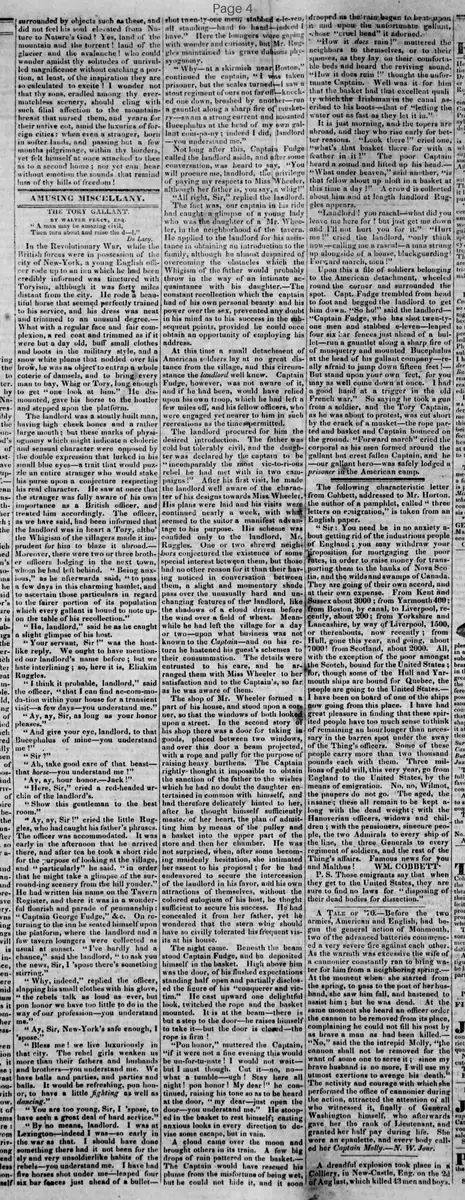
THE TORY GALLANT.
BY WALTER PERCY, ESQ.
"A man may be amazing civil,
Then turn about and raise the d—l."
De Lacy.
In the Revolutionary War, while the British forces were in possession of the city of New-York, a young English officer rode up to an inn which he had been credibly informed was tinctured with Toryism, although it was forty miles distant from the city. He rode a beautiful horse that seemed perfectly trained to his service, and his dress was neat and trimmed to an unusual degree. What with a regular face and fair complexion, a red coat and trimmed as if it were but a day old, buff small clothes and boots in the military style, and a snow white plume that nodded over his brow, he was an object to entrap a whole coterie of damsels, and to bring every man to bay, Whig or Tory, long enough to get "one look at him." He dismounted, gave his horse to the hostler and stepped upon the platform.
The landlord was a stoutly built man, having high cheek bones and a rather large mouth; but these marks of physiognomy which might indicate a choleric and sensual character were opposed by the double expression that lurked in his small blue eyes—a trait that would puzzle an entire stranger who would stake his purse upon a conjecture respecting his real character. He saw at once that the stranger was fully aware of his own importance as a British officer, and treated him accordingly. The officer, as we have said, had been informed that the landlord was in heart a Tory, altho the Whigism of the villagers made it imprudent for him to blaze it abroad. Moreover, there were two or three brother officers lodging in the next town, whom he had left behind. "Being anxious," as he afterwards said, "to pass a few days in this charming hamlet, and to ascertain those particulars in regard to the fairer portion of its population which every gallant is bound to note upon the table of his recollection."
"Ha, landlord," said he as he caught a slight glimpse of his host.
"Your servant, Sir!" was the host-like reply. We ought to have mentioned our landlord's name before; but we hate interlining; so, here it is, Eliakim Ruggles.
"I think it probable, landlord," said the officer, "that I can find accommodation within your house for a transient visit—a few days—you understand me."
"Ay, ay, Sir, as long as your honor pleases."
"And give your eye, landlord, to that Bucephalus of mine—you understand me?"
"Sir?"
"Ah, take good care of that beast—that horse—you understand me?"
"Ay, ay, your honor.—Jack!"
"Here, Sir," cried a red-headed urchin of the landlord's.
"Show this gentleman to the best room."
"Ay, ay, Sir!" cried the little Ruggles, who had caught his father's phrases.
The officer was accommodated. It was early in the afternoon that he arrived there, and after tea he took a short ride for the purpose of looking at the village, and "particularly" he said, "in order that he might take a glimpse of the surrounding scenery from the hill yonder."
He had written his name on the Tavern Register, and there it was in a wonderful flourish and parade of penmanship: "Captain George Fudge," &c. On returning to the inn he seated himself upon the platform, where the landlord and a few tavern loungers were collected as usual at sunset. "I've hardly had a chance," said the landlord, "to ask you the news, Sir, I 'spose there's something stirring."
"Why, indeed," replied the officer, slapping his small clothes with his glove, "the rebels talk as loud as ever, but pon honor we have too little to do in the way of our profession—you understand me."
"Ay, Sir, New-York's safe enough, I 'spose."
"Bless me! we live luxuriously in that city. The rebel girls weaken us more than their fathers and husbands and brothers—you understand me. We have balls and parties, and parties and balls. It would be refreshing, pon honor, to have a little fighting as well as dancing."
"You are too young, Sir, I 'spose, to have seen a great deal of hard service."
"By no means, landlord. I was at Lexington—indeed I was—so early in the war as that. I should have done something there had it not been for the sly and very unsoldierlike habits of the rebels—you understand me. I have had five horses shot under me—leaped four six bar fences just ahead of a bullet—shot twenty-one men; stabbed eleven, all standing—hand to hand—indeed I have."
Here the loungers were gaping with wonder and curiosity, but Mr. Ruggles maintained his grave dubious physiognomy.
"Why—at a skirmish near Boston," continued the captain, "I was taken prisoner, but the scales turned—I saw a stout regiment of ours not far off—knocked one down, brushed by another—run a gauntlet along a sharp fire of musketry—swam a strong current and mounted Bucephalus at the head of my own gallant company; indeed I did, landlord—you understand me."
Not long after this, Captain Fudge called the landlord aside, and after some conversation, was heard to say, "You will procure me, landlord, the privilege of paying my respects to Miss Wheeler, although her father is, you say, a whig?"
"All right, Sir," replied the landlord.
The fact was, our captain in his ride had caught a glimpse of a young lady who was the daughter of a Mr. Wheeler, in the neighborhood of the tavern. He applied to the landlord for his assistance in obtaining an introduction to the family, although he almost despaired of overcoming the obstacles which the Whigism of the father would probably throw in the way of an intimate acquaintance with his daughter. The constant recollection which the captain had of his own personal beauty and his power over the sex, prevented any doubt in his mind as to his success in the subsequent points, provided he could once obtain an opportunity of employing his address.
At this time a small detachment of American soldiers lay at no great distance from the village, and this circumstance the landlord well knew. Captain Fudge, however, was not aware of it, and if he had been, would have relied upon his own troop, which he had left a few miles off, and his fellow officers, who were engaged yet nearer to him in such recreations as the times permitted.
The landlord procured for him the desired introduction. The father was cold but tolerably civil, and the daughter was declared by the captain to be "incomparably the most victorious rebel he had met with in two campaigns!" After his first visit, he made the landlord well aware of the character of his designs towards Miss. Wheeler. His plans were laid and his visits were continued nearly a week, with what seemed to the suitor a manifest advantage to his purpose. His scheme was confided only to the landlord, Mr. Ruggles. One or two shrewd neighbors conjectured the existence of some special interest between them, but those had no other reason for it than their having noticed in conversation between them, a slight and momentary shade pass over the unusually hard and unchanging features of the landlord, like the shadows of a cloud driven before the wind over a field of wheat. Meanwhile he had left the village for a day or two—upon what business was not known to the Captain—and on his return he hastened his guest's schemes to their consummation. The details were entrusted to his care, and he arranged them with Miss Wheeler to her satisfaction and to the Captain's, so far as he was aware of them.
The shop of Mr. Wheeler formed a part of his house, and stood upon a corner, so that the windows of both looked upon a street. In the second story of his shop there was a door for taking in goods, placed between two windows, and over this door a beam projected, with a rope and pulley for the purpose of raising heavy burdens. The Captain rightly thought it impossible to obtain the sanction of the father to the wishes which he had no doubt the daughter entertained in common with himself, and had therefore delicately hinted to her, after he thought himself sufficiently master of her heart, the plan of admitting him by means of the pulley and a basket into the upper part of the store and then her chamber. He was not surprised, when, after some becoming maidenly hesitation, she intimated her assent to his proposal; for he had endeavored to secure the intercession of the landlord in his favor, and his own attractions of themselves, without the colored eulogium of his host, he thought sufficient to secure his success. He had concealed it from her father, yet he wondered that the stern whig should have so civilly tolerated his frequent visits at his house.
The night came. Beneath the beam stood Captain Fudge, and he deposited himself in the basket. High above him was the door, of his flushed expectations standing half open and partially disclosed the figure of his "conqueror and victim." He cast upward one delightful look, twitched the rope and the basket mounted. It is at the beam—there is but a step to the door—he raises himself to take it—but the door is closed—the rope is firm!
"Pon honor," muttered the Captain, "if it were not a fine evening this would be unfortunate! I would not wait—but I must though. Cut it—no, no—what a tumble—ugh! Stay here all night! pon honor! My dear!" he continued, raising his tone so as to be heard at the door, "my dear—just open the door—you understand me." He stooped in the basket to rest himself; casting anxious looks in every direction to devise some escape, but in vain.
A cloud came over the moon and brought others in its train. A few big drops of rain pattered on the basket. The Captain would have rescued his plume from the misfortune of being wet, but he could not hide it, and it soon drooped as the rain began to beat upon its and upon the unfortunate gallant, whose "cruel head" it adorned.
"How it does rain!" muttered the neighbors to themselves, or to their spouses, as they lay on their comfortable beds and heard the reviving sound.
"How it does rain!" thought the unfortunate Captain. Well was it for him that the basket had that excellent quality which the Irishman in the canal ascribed to his boots—that of "letting the water out as fast as they let it in."
It is just morning, and the topers are abroad, and they who rise early for better reasons. "Look there!" cried one, "what's that basket there—or with a feather in it?" The poor Captain heard a sound and lifted up his head.
"What under heaven," said another, "is that fellow about up almost in a basket at this time o' day?" A crowd is collected about him and at length landlord Ruggles appears.
"Landlord! you rascal—what did you leave me here for? but just get me down and I'll not hurt you or it." "Hurt me!" cried the landlord, "only think now—calling me a rascal—a man strung up alongside of a house, blackguarding! Forward march, men!"
Upon this a file of soldiers belonging to the American detachment, wheeled round the corner and surrounded the spot. Capt. Fudge trembled from head to foot and begged the landlord to get him down. "So ho!" said the landlord—"Captain Fudge, who has shot twenty-one men and stabbed eleven—leaped four six bar fences just ahead of a bullet—run a gauntlet along a sharp fire of musquetry and mounted Bucephalus at the head of his gallant company—really afraid to jump down fifteen feet!—But stand upon your own feet, for you may as well come down at once. I had a good hand at a trigger in the old French war." So saying he took a gun from a soldier, and the Tory Captain, as he was about to protest, was cut short by the crack of a musket—the rope parted and basket and Captain bounced on the ground. "Forward march" cried the corporal as his men formed around the gallant but crest-fallen Captain, and he—our gallant hero—was safely lodged a prisoner in the American camp.
What sub-type of article is it?
What themes does it cover?
What keywords are associated?
What entities or persons were involved?
Where did it happen?
Story Details
Key Persons
Location
Village Inn Forty Miles From New York
Event Date
Revolutionary War
Story Details
Boastful British Captain Fudge stays at Tory landlord Ruggles' inn, boasts of exploits, woos Miss Wheeler with Ruggles' help, attempts secret entry via pulley basket but is tricked and left suspended overnight in rain, discovered and captured by American soldiers after rope is shot.