Thank you for visiting SNEWPapers!
Sign up free
Editorial
January 8, 1867
The Daily Dispatch
Richmond, Virginia
What is this article about?
The Richmond Dispatch editorial praises President Johnson's veto message against extending suffrage to male negroes in the District of Columbia, lauding its arguments on government separation of powers and attributing authorship to Secretary Stanton while criticizing Congress as fanatics.
Clipping
OCR Quality
98%
Excellent
Full Text
Richmond Dispatch.
TUESDAY....JANUARY 8 1867.
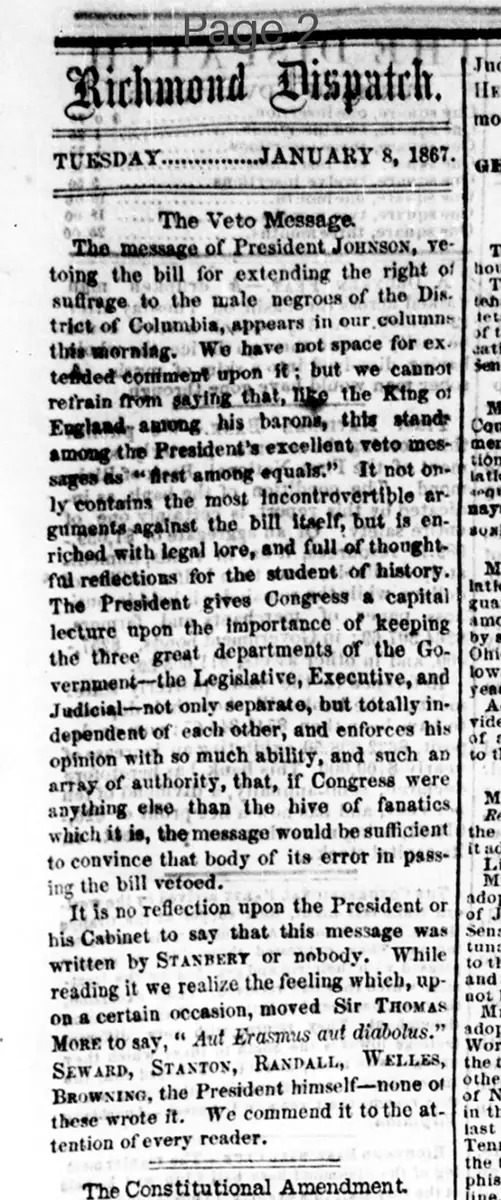
The Veto Message
The message of the President returning the bill for extending the right of suffrage to the male negroes of the District of Columbia, appears in our columns this morning. We have not space for extended comment upon it; but we cannot refrain from saying that, like the King of England among his yeomen, this stands among the President's excellent veto messages first among equals. It not only contains the most incontrovertible arguments against the bill itself, but is enriched with legal lore, and full of thought and reflections for the student of history. The President gives Congress a capital lecture upon the importance of keeping the three great departments of the Government--the Legislative, Executive, and Judicial--not only separate, but totally independent of each other, and enforces his opinion with so much ability, and such an array of authority, that, if Congress were anything else than the hive of fanatics which it is, the message would be sufficient to convince that body of its error in passing the bill vetoed.
It is no reflection upon the President or his Cabinet to say that this message was written by Stanton or nobody. While reading it we realize the feeling which, upon a certain occasion, moved Sir Thomas More to say, 'Aut Erasmus aut diabolus.' Seward, Stanton, Randall, Welles, Browning, the President himself--none of these wrote it. We commend it to the attention of every reader.
TUESDAY....JANUARY 8 1867.
The Veto Message
The message of the President returning the bill for extending the right of suffrage to the male negroes of the District of Columbia, appears in our columns this morning. We have not space for extended comment upon it; but we cannot refrain from saying that, like the King of England among his yeomen, this stands among the President's excellent veto messages first among equals. It not only contains the most incontrovertible arguments against the bill itself, but is enriched with legal lore, and full of thought and reflections for the student of history. The President gives Congress a capital lecture upon the importance of keeping the three great departments of the Government--the Legislative, Executive, and Judicial--not only separate, but totally independent of each other, and enforces his opinion with so much ability, and such an array of authority, that, if Congress were anything else than the hive of fanatics which it is, the message would be sufficient to convince that body of its error in passing the bill vetoed.
It is no reflection upon the President or his Cabinet to say that this message was written by Stanton or nobody. While reading it we realize the feeling which, upon a certain occasion, moved Sir Thomas More to say, 'Aut Erasmus aut diabolus.' Seward, Stanton, Randall, Welles, Browning, the President himself--none of these wrote it. We commend it to the attention of every reader.
What sub-type of article is it?
Suffrage
Constitutional
Partisan Politics
What keywords are associated?
Veto Message
Suffrage Extension
District Of Columbia
Male Negroes
Separation Of Powers
Congress Fanatics
President Johnson
What entities or persons were involved?
President Johnson
Congress
Edwin Stanton
William Seward
Alexander Randall
Gideon Welles
Orville Browning
Editorial Details
Primary Topic
Praise For President Johnson's Veto Of The District Of Columbia Negro Suffrage Bill
Stance / Tone
Strongly Supportive Of The Veto And Critical Of Congress
Key Figures
President Johnson
Congress
Edwin Stanton
William Seward
Alexander Randall
Gideon Welles
Orville Browning
Key Arguments
The Veto Message Presents Incontrovertible Arguments Against The Suffrage Bill
It Emphasizes The Separation And Independence Of Government Departments
The President Lectures Congress On Constitutional Principles
The Message Is Enriched With Legal Lore And Historical Reflections
Authorship Attributed To Stanton Due To Its Style