Thank you for visiting SNEWPapers!
Sign up free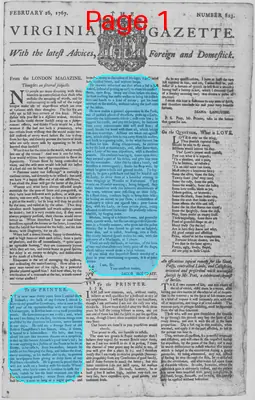
Letter to Editor
February 26, 1767
The Virginia Gazette
Richmond, Williamsburg, Richmond County, Virginia
What is this article about?
An elderly retiree shares his grandson's account of modern London apprentices' shift from diligent habits to vanity, extravagance, and vice, using the ruinous life of Simon Ploughshare as a cautionary example, and offers the sketch for publication.
Clipping
OCR Quality
98%
Excellent
Full Text
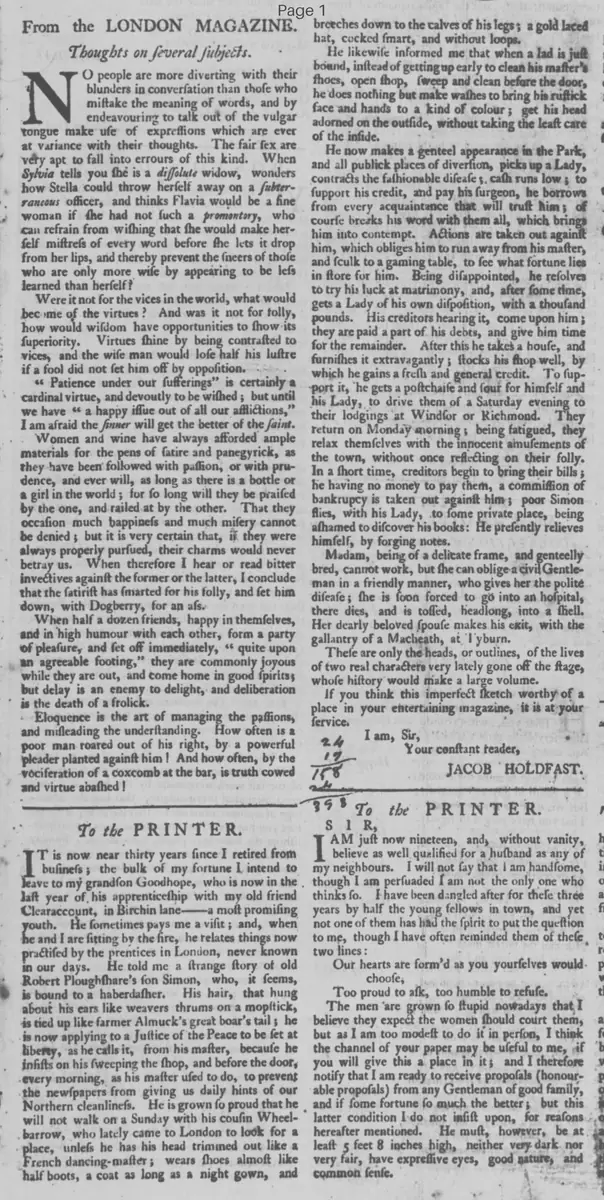
To the PRINTER.
It is now near thirty years since I retired from business; the bulk of my fortune I intend to leave to my grandson Goodhope, who is now in the last year of his apprenticeship with my old friend Clearaccount, in Birchin lane—a most promising youth. He sometimes pays me a visit; and, when he and I are sitting by the fire, he relates things now practised by the prentices in London, never known in our days. He told me a strange story of old Robert Ploughshare's son Simon, who, it seems, is bound to a haberdasher. His hair, that hung about his ears like weavers thrums on a mopstick, is tied up like farmer Almuck's great boar's tail; he is now applying to a Justice of the Peace to be set at liberty, as he calls it, from his master, because he insists on his sweeping the shop, and before the door, every morning, as his master used to do, to prevent the newspapers from giving us daily hints of our Northern cleanliness. He is grown so proud that he will not walk on a Sunday with his cousin Wheelbarrow, who lately came to London to look for a place, unless he has his head trimmed out like a French dancing-master; wears shoes almost like half boots, a coat as long as a night gown, and breeches down to the calves of his legs; a gold laced hat, cocked smart, and without loops.
He likewise informed me that when a lad is just bound, instead of getting up early to clean his master's shoes, open shop, sweep and clean before the door, he does nothing but make washes to bring his rustick face and hands to a kind of colour: get his head adorned on the outside, without taking the least care of the inside.
He now makes a genteel appearance in the Park, and all publick places of diversion, picks up a Lady, contracts the fashionable disease. Cash runs low; to support his credit, and pay his surgeon, he borrows from every acquaintance that will trust him; of course breaks his word with them all, which brings him into contempt. Actions are taken out against him, which obliges him to run away from his master and skulk to a gaming table, to see what fortune lies in store for him. Being disappointed, he resolves to try his luck at matrimony, and, after some time, gets a Lady of his own disposition, with a thousand pounds. His creditors hearing it, come upon him; they are paid a part of his debts, and give him time for the remainder. After this he takes a house, and furnishes it extravagantly; stocks his shop well, by which he gains a fresh and general credit. To support it, he gets a postchaise and pair for himself and his Lady, to drive them off a Saturday evening to their lodgings at Windsor or Richmond. They return on Monday morning; being fatigued, they relax themselves with the innocent amusements of the town, without once reflecting on their folly.
In a short time, creditors begin to bring their bills; he having no money to pay them, a commission of bankruptcy is taken out against him; poor Simon flies, with his Lady, to some private place, being ashamed to discover his books: He presently relieves himself, by forging notes.
Madam, being of a delicate frame, and genteelly bred, cannot work, but she can oblige a civil Gentleman in a friendly manner, who gives her the polite disease; she is soon forced to go into an hospital, there dies, and is tossed, headlong, into a shell.
Her dearly beloved spouse makes his exit, with the gallantry of a Macheath, at Tyburn.
These are only the heads, or outlines, of the lives of two real characters very lately gone off the stage, whose history would make a large volume.
If you think this imperfect sketch worthy of a place in your entertaining magazine, it is at your service.
I am, Sir,
Your constant reader,
JACOB HOLDFAST.
It is now near thirty years since I retired from business; the bulk of my fortune I intend to leave to my grandson Goodhope, who is now in the last year of his apprenticeship with my old friend Clearaccount, in Birchin lane—a most promising youth. He sometimes pays me a visit; and, when he and I are sitting by the fire, he relates things now practised by the prentices in London, never known in our days. He told me a strange story of old Robert Ploughshare's son Simon, who, it seems, is bound to a haberdasher. His hair, that hung about his ears like weavers thrums on a mopstick, is tied up like farmer Almuck's great boar's tail; he is now applying to a Justice of the Peace to be set at liberty, as he calls it, from his master, because he insists on his sweeping the shop, and before the door, every morning, as his master used to do, to prevent the newspapers from giving us daily hints of our Northern cleanliness. He is grown so proud that he will not walk on a Sunday with his cousin Wheelbarrow, who lately came to London to look for a place, unless he has his head trimmed out like a French dancing-master; wears shoes almost like half boots, a coat as long as a night gown, and breeches down to the calves of his legs; a gold laced hat, cocked smart, and without loops.
He likewise informed me that when a lad is just bound, instead of getting up early to clean his master's shoes, open shop, sweep and clean before the door, he does nothing but make washes to bring his rustick face and hands to a kind of colour: get his head adorned on the outside, without taking the least care of the inside.
He now makes a genteel appearance in the Park, and all publick places of diversion, picks up a Lady, contracts the fashionable disease. Cash runs low; to support his credit, and pay his surgeon, he borrows from every acquaintance that will trust him; of course breaks his word with them all, which brings him into contempt. Actions are taken out against him, which obliges him to run away from his master and skulk to a gaming table, to see what fortune lies in store for him. Being disappointed, he resolves to try his luck at matrimony, and, after some time, gets a Lady of his own disposition, with a thousand pounds. His creditors hearing it, come upon him; they are paid a part of his debts, and give him time for the remainder. After this he takes a house, and furnishes it extravagantly; stocks his shop well, by which he gains a fresh and general credit. To support it, he gets a postchaise and pair for himself and his Lady, to drive them off a Saturday evening to their lodgings at Windsor or Richmond. They return on Monday morning; being fatigued, they relax themselves with the innocent amusements of the town, without once reflecting on their folly.
In a short time, creditors begin to bring their bills; he having no money to pay them, a commission of bankruptcy is taken out against him; poor Simon flies, with his Lady, to some private place, being ashamed to discover his books: He presently relieves himself, by forging notes.
Madam, being of a delicate frame, and genteelly bred, cannot work, but she can oblige a civil Gentleman in a friendly manner, who gives her the polite disease; she is soon forced to go into an hospital, there dies, and is tossed, headlong, into a shell.
Her dearly beloved spouse makes his exit, with the gallantry of a Macheath, at Tyburn.
These are only the heads, or outlines, of the lives of two real characters very lately gone off the stage, whose history would make a large volume.
If you think this imperfect sketch worthy of a place in your entertaining magazine, it is at your service.
I am, Sir,
Your constant reader,
JACOB HOLDFAST.
What sub-type of article is it?
Social Critique
Ethical Moral
Reflective
What themes does it cover?
Social Issues
Morality
What keywords are associated?
London Apprentices
Youth Extravagance
Moral Decline
Apprenticeship Changes
Social Folly
What entities or persons were involved?
Jacob Holdfast
The Printer
Letter to Editor Details
Author
Jacob Holdfast
Recipient
The Printer
Main Argument
the letter contrasts the diligent practices of past apprentices with the extravagant, idle, and morally corrupt behaviors of modern london youth, illustrating how such folly leads to financial ruin, disease, and criminal ends through the cautionary tale of simon ploughshare.
Notable Details
Story Of Simon Ploughshare, Apprentice To A Haberdasher
References To Old Friend Clearaccount In Birchin Lane
Cautionary Outline Of Simon's Life Ending In Forgery, His Wife's Death In Hospital, And His Execution At Tyburn
Offer Of The Sketch For The Magazine