Thank you for visiting SNEWPapers!
Sign up free
Staunton Spectator
Staunton, Virginia
What is this article about?
The National Republican Convention in Staunton, Virginia, July 16-19, 1832, nominated Henry Clay for President and John Sergeant for Vice President unanimously. It adopted resolutions on constitutional issues, criticized the Jackson administration, appointed committees, and selected an electoral ticket for Virginia.
Merged-components note: Sequential components forming the complete report of the National Republican Convention proceedings in Staunton.
Clipping
OCR Quality
Full Text
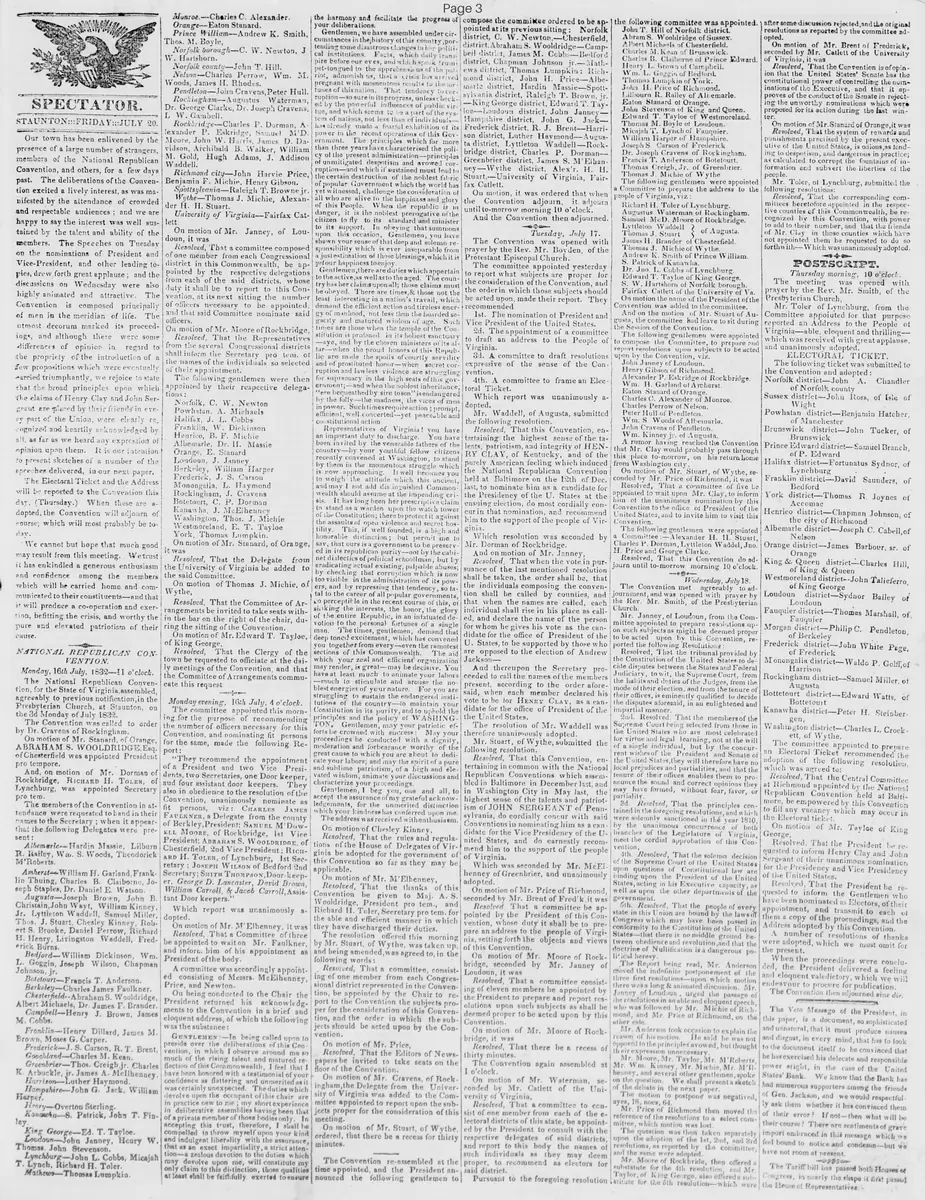
STAUNTON, FRIDAY, JULY 20.
Our town has been enlivened by the presence of a large number of strangers, members of the National Republican Convention, and others, for a few days past. The deliberations of the Convention excited a lively interest, as was manifested by the attendance of crowded and respectable audiences; and we are happy to say the interest was well sustained by the talent and ability of the members. The Speeches on Tuesday on the nominations of President and Vice-President, and other leading topics, drew forth great applause; and the discussions on Wednesday were also highly animated and attractive. The Convention is composed principally of men in the meridian of life. The utmost decorum marked its proceedings. and although there were some differences of opinion in regard to the propriety of the introduction of a few propositions which were eventually carried triumphantly, we rejoice to state that the broad principles upon which the claims of Henry Clay and John Sergeant are placed by their friends in every part of the Union, were clearly recognized and heartily acknowledged by all, as far as we heard any expression of opinion upon them. It is our intention to present sketches of a number of the speeches delivered, in our next paper.
The Electoral Ticket and the Address will be reported to the Convention this day, (Thursday.) When these are adopted, the Convention will adjourn of course; which will most probably be to-day.
We cannot but hope that much good may result from this meeting. We trust it has enkindled a generous enthusiasm and confidence among the members which will be carried home and communicated to their constituents--and that it will produce a co-operation and exertion, befitting the crisis, and worthy the pure and elevated patriotism of their cause.
NATIONAL REPUBLICAN CONVENTION.
Monday, 16th July, 1832--11 o'clock.
The National Republican Convention, for the State of Virginia, assembled, agreeably to previous notification, in the Presbyterian Church, at Staunton, on the 3d Monday of July 1832.
The Convention was called to order by Br. Cravens of Rockingham.
On motion of Mr. Stanard, of Orange, ABRAHAM S. WOOLDRIDGE, Esq. of Chesterfield was appointed President pro tempore.
And, on motion of Mr. Dorman of Rockbridge. Richard H. Toler, of Lynchburg, was appointed Secretary pro tem.
The members of the Convention in attendance were requested to hand in their names to the Secretary ; when it appeared that the following Delegates were present:
Albemarle--Hardin Massie, Lilburn R. Railey. Wm. S. Woods, Theodorick M'Roberts.
Amherst--William H. Garland. Franklin Thwing, Charles B. Claiborne, Joseph Staples, Dr. Daniel E. Watson.
Augusta--Joseph Brown, John B. Christian, John Wayt, William Kinney, Jr. Lyttleton Waddell, Samuel Miller, Thos. J. Stuart, Chesley Kinney, Robert S. Brooke. Daniel Perrow, Richard H. Henry, Livingston Waddell, Frederick Burns.
Bedford--William Dickinson, Wm. L. Goggin, Joseph Wilson, Chapman Johnson, jr.
Botetourt--Francis T. Anderson.
Berkeley--Charles J. Faulkner.
Chesterfield--Abraham S. Wooldridge, Albert Michaels, Dr. James F. Brander.
Campbell--Henry J. Brown, James M. Cobbs.
Franklin--Henry Dillard, James M. Brown, Moses G. Carper.
Frederick--J. S. Carson, R. T. Brent,
Goochland--Charles M. Kean.
Greenbrier--Thos. Creigh, jr. Charles K. Arbuckle, jr. James A. McIlhenney.
Harrison--Luther Haymond.
Hampshire--John G. Jack, William Harper.
Henry--Overton Sterling.
Kanawha--S. Patrick, John T. Finley:
King George--Ed. T. Tayloe.
Loudoun--John Janney, Henry W. Thomas. John Stevenson.
Lynchburg--John L. Cobbs, Micajah T. Lynch, Richard H. Toler.
Mathews--Thomas Lumpkin.
Monroe.--Charles C. Alexander.
Orange--Eaton Stanard.
Prince William--Andrew K. Smith, Thos. M. Boyle,
Norfolk borough--C. W. Newton, J. W. Hartshorn.
Norfolk county--John T. Hill.
Nelson--Charles Perrow, Wm. M. Woods. James H. Rhodes.
Pendleton--John Cravens, Peter Hull.
Rockingham--Augustus Waterman, Dr. George Clarke, Dr. Joseph Cravens, L. W. Gambill.
Rockbridge--Charles P. Dorman, Alexander P. Eskridge, Samuel M'D. Moore, John W. Harris, James D. Davidson, Archibald B. Walker, William M. Gold, Hugh Adams, J. Addison Waddell.
Richmond city--John Harvie Price, Benjamin F. Michie. Henry Gibson.
Spotsylvania--Raleigh T. Brown, jr.
Wythe--Thomas J. Michie, Alexander H. H. Stuart.
University of Virginia--Fairfax Catlett
On motion of Mr. Janney, of Loudoun, it was
Resolved, That a committee composed of one member from each Congressional district in this Commonwealth, be appointed by the respective delegations from each of the said districts, whose duty it shall be to report to this Convention, at its next sitting the number of officers necessary to be appointed, and that said Committee nominate said officers.
On motion of Mr. Moore of Rockbridge,
Resolved, That the Representatives from the several Congressional districts shall inform the Secretary pro tem. of the names of the individuals so selected of their appointment.
The following gentlemen were then appointed by their respective delegations:
Norfolk. C. W. Newton
Powhatan, A. Michaels
Halifax, J. L. Cobbs .
Franklin, W. Dickinson
Henrico, B. F. Michie
Albemarle, Dr. H. Massie
Orange. E. Stanard
Loudoun, J. Janney
Berkeley, William Harper
Frederick, J. S. Carson
Monongalia, L. Haymond
Rockingham, J. Cravens
Botetourt, C. P. Dorman
Kanawha, J. McElhenney
Washington, Thos. J. Michie
Westmoreland, F. T. Tayloe
York, Thomas Lumpkin.
On motion of Mr. Stanard, of Orange,
it was
Resolved, That the Delegate from the University of Virginia be added to the said Committee.
On motion of Thomas J. Michie, of Wythe,
Resolved, That the Committee of Arrangements be invited to take seats within the bar on the right of the chair, during the sitting of the Convention.
On motion of Mr. Edward T. Tayloe,
of King George,
Resolved, That the Clergy of the town be requested to officiate at the daily meetings of the Convention, and that the Committee of Arrangements communicate this request
to
ose
Monday evening, 16th July, 4 o'clock.
The committee appointed this morning for the purpose of recommending the number of officers necessary for this Convention, and nominating fit persons for the same, made the following Report:
"They recommend the appointment of a President and two Vice Presidents, two Secretaries, one Doorkeeper, and four assistant door keepers.
They also in obedience to the resolution of the Convention, unanimously nominate as fit persons, viz: Charles James Faulkner, a Delegate from the county of Berkeley, President: Samuel M'Dowell Moore, of Rockbridge, 1st Vice President: Abraham S. Wooldridge, of Chesterfield, 2nd Vice President: Richard H. Toler, of Lynchburg, 1st Secretary; Joseph Wilson of Bedford 2nd Secretary; Smith Thompson, Doorkeeper. George D. Lancaster, David Brown, William Carroll, & Jacob Carroll, Assistant Doorkeepers."
Which report was unanimously adopted.
On motion of Mr. M'Elhenney, it was
Resolved, That a Committee of three be appointed to wait on Mr. Faulkner,
and inform him of his appointment as President of the body.
A committee was accordingly appointed consisting of Messrs. McElhenney, Price, and Newton.
On being conducted to the Chair the President returned his acknowledgments to the Convention in a brief and eloquent address, of which the following was the substance:
Gentlemen:--In being called upon to preside over the deliberations of this Convention, in which I observe around me so much of the rising talent and matured reflection of this Commonwealth, I feel that I have been honored with a testimonial of your confidence as flattering and unmerited as it was certainly unexpected. The duties which devolve upon the occupant of this chair are in practice new to me; my short experience in deliberative assemblies having been that of a private member of those bodies only. In accepting this trust, therefore, I shall be compelled to throw myself upon your kind and indulgent liberality with the assurance, that as an exact impartiality, a strict attention--a zealous devotion to the duties which may devolve upon me, will constitute my only claim to this distinction, those qualities at least shall be faithfully exerted to ensure
the harmony and facilitate the progress of your deliberations.
Gentlemen, we have assembled under circumstances in the history of this country, portending some disastrous changes in her political institutions. Facts, which daily transpire before our eyes, and which speak trumpet-tongued to the apprehensions of the patriot, admonish us, that a crisis has arrived pregnant with momentous results to the fortunes of this nation. That tendency to corruption--so sure in its progress, unless checked by the powerful influences of public virtue, and which seems to be a part of the system of nations, not less than of individuals-- has already made a fearful exhibition of its power in the recent operations of this Government. The principles which for more than three years have characterised the policy of the present administration--principles of unmitigated despotism and avowed corruption--and which if sustained must lead to the certain destruction of the noblest fabric of popular Government which the world has yet witnessed, challenge the consideration of all who are alive to the happiness and glory of this People. When the republic is in danger, it is the noblest prerogative of the citizen to fly to its standard and minister to its support. In obeying that summons upon this occasion, Gentlemen, you have shewn your sense of that deep and solemn responsibility which is ever inseparable from a just estimation of those blessings, which it is yet our happiness to enjoy.
Gentlemen, there are duties which appertain to the active, as well as to the aged. The country has her claims upon all: those claims must be obeyed. There are times, & those not the least interesting in a nation's travail, which demand the efficient action and tireless energy of manhood, not less than the hoarded sagacity and matured wisdom of age. Such times are those when the temple of the Constitution is profaned in its holiest sanctuary --aye, and by the chosen ministers of its altar--when the proud honors of this Republic are made the spoils of courtly servility and of prostituted honor--when secret corruption and lawless violence are struggling for supremacy in the high seats of this government;--and when the noblest inheritance, "ere bequeathed by sire to son" is endangered by the folly--the madness, the vices of men in power. Such times require action; prompt, efficient, well concerted--yet peaceable and constitutional action
Representatives of Virginia! you have an important duty to discharge. You have been invited by the venerable fathers of the country--by your youthful fellow citizens recently convened at Washington, to stand by them in the momentous struggle which is now approaching. It well becomes you to weigh the attitude which this ancient, and may I not add distinguished Commonwealth should assume at the impending crisis. It has long been her prescriptive claim to stand as a warden upon the watch tower of the Constitution; there to protect it against the assaults of open violence and secret hostility. This, if well founded, is a high and honorable distinction; but permit me to say, that ours is a government to be preserved in its republican purity--not by the cabinet dialectics of political schoolman, but by eradicating actual existing, palpable abuses; by checking that corruption which is now too visible in the administration of its powers, and by repressing that tendency, so fatal to the career of all popular governments, so perceptible in the recent course of this, sinking the interests, the honor, the glory of the entire Republic, in an infatuated devotion to the personal fortunes of a single man. The times, gentlemen, demand that deep toned excitement, which has convened you together from every--even the remotest sections of this Commonwealth. The aid which your zeal and efficient organization may render, is great--may be decisive. You have at least much to animate your labors --much to stimulate and arouse the noblest energies of your nature. For you are struggling to sustain the endangered institutions of the country--to maintain your Constitution in its purity, and to uphold the principles and the policy of WASHINGTON. Gentlemen, may your patriotic efforts be crowned with success: May your proceedings be conducted with a dignity, moderation and forbearance worthy of the great cause to which you are about to dedicate your labors; and may the spirit of a pure and sublime patriotism, of a high and elevated wisdom, animate your discussions and characterize your proceedings.
Gentlemen, I beg you, one and all, to accept the assurance of my grateful acknowledgements, for the unmerited distinction which your kindness has conferred upon me.
The address was received with enthusiasm.
On motion of Chesley Kinney,
Resolved, That the rules and regulations of the House of Delegates of Virginia be adopted for the government of this Convention so far as they may be applicable.
On motion of Mr. M'Elhenney,
Resolved, That the thanks of this Convention be given to Maj. A. S. Wooldridge, President pro tem., and Richard H. Toler, Secretary pro tem. for the able and efficient manner in which they have discharged their duties.
The resolution offered this morning by Mr. Stuart, of Wythe, was taken up, and being amended, was agreed to, in the following words:
Resolved, That a committee, consisting of one member from each Congressional district represented in the Convention, be appointed by the Chair to report to the Convention the subjects proper for the consideration of this Convention, and the order in which the subjects should be acted upon by the Convention.
On motion of Mr. Price,
Resolved, That the Editors of Newspapers be invited to take seats on the floor of the Convention.
On motion of Mr. Cravens, of Rockingham, the Delegate from the University of Virginia was added to the Committee appointed to report upon the subjects proper for the consideration of this meeting.
On motion of Mr. Stuart, of Wythe,
ordered, that there be a recess for thirty minutes.
The Convention re-assembled at the time appointed, and the President announced the following gentlemen to
pointed at its previous sitting: Norfolk district, C. W. Newton,--Chesterfield district, Abraham S. Wooldridge--Campbell district. James M. Cobbs--Bedford district, Chapman Johnson jr.--Mathews district. Thomas Lumpkin: Richmond district, John H. Price--Albemarle district, Hardin Massie--Spotsylvania district, Raleigh T. Brown, jr. --King George district, Edward T. Tayloe--Loudoun district, John Janney--Hampshire district, John G. Jack--Frederick district. R. J. Brent--Harrison district, Luther Haymond--Augusta district, Lyttleton Waddell--Rockbridge district, Charles P. Dorman--Greenbrier district, James S. M'Elhenney--Wythe district, Alex'r. H. H. Stuart,--University of Virginia, Fairfax Catlett.
On motion, it was ordered that when the Convention adjourn. it adjourn until to-morrow morning 10 o'clock.
And the Convention then adjourned.
Tuesday, July 17.
The Convention was opened with prayer by the Rev. Mr. Boyden, of the Protestant Episcopal Church.
The committee appointed yesterday to report what subjects are proper for the consideration of the Convention. and the order in which those subjects should be acted upon, made their report. They recommended
1st. The nomination of President and Vice President of the United States.
2d. The appointment of a committee to draft an address to the People of Virginia.
3d. A committee to draft resolutions expressive of the sense of the Convention.
4th. A committee to frame an Electoral Ticket.
Which report was unanimously adopted.
Mr. Waddell, of Augusta, submitted the following resolution.
Resolved, That this Convention, entertaining the highest sense of the talents, patriotism, and integrity of HENRY CLAY, of Kentucky, and of the purely American feeling which induced the National Republican Convention held at Baltimore on the 12th of Dec. last, to nominate him as a candidate for the Presidency of the U. States at the ensuing election, do most cordially concur in that nomination, and recommend him to the support of the people of Virginia.
Which resolution was seconded by Mr. Dorman of Rockbridge.
And on motion of Mr. Janney,
Resolved, That when the vote in pursuance of the last mentioned resolution shall be taken, the order shall be, that the individuals composing the convention shall be called by counties, and that when the names are called. each individual shall rise in his place as called, and declare the name of the person for whom he gives his vote as the candidate for the office of President of the U. States, to be supported by those who are opposed to the election of Andrew Jackson--
And thereupon the Secretary proceeded to call the names of the members present, according to the order aforesaid, when each member declared his vote to be for Henry Clay, as a candidate for the office of President of the United States.
The resolution of Mr. Waddell was therefore unanimously adopted.
Mr. Stuart, of Wythe, submitted the following resolution.
Resolved, That this Convention, entertaining in common with the National Republican Conventions which assembled in Baltimore in December last, and in Washington City in May last, the highest sense of the talents and patriotism of JOHN SERGEANT of Pennsylvania, do cordially concur with said Conventions in nominating him as a candidate for the Vice Presidency of the United States, and do earnestly recommend him to the support of the people of Virginia.
Which was seconded by Mr. McElhenney of Greenbrier, and unanimously adopted.
On motion of Mr. Price of Richmond seconded by Mr. Brent of Fred'k, it was
Resolved That a committee be appointed by the President of this Convention, whose duty it shall be to prepare an address to the people of Virginia, setting forth the objects and views of this Convention.
On motion of Mr. Moore of Rockbridge, seconded by Mr. Janney of Loudoun, it was
Resolved, That a committee consisting of eleven members be appointed by the President to prepare and report resolutions upon such subjects as shall be deemed proper to be acted upon by this Convention.
On motion of Mr. Moore of Rockbridge, it was
Resolved, That there be a recess of thirty minutes.
The Convention again assembled at 1 o'clock.
On motion of Mr. Waterman, seconded by Mr. Catlett of the University of Virginia,
Resolved, That a committee to consist of one member from each of the electoral districts of this state, be appointed by the President to consult with the respective delegates of said districts. and report to this body the names of such individuals as they may deem proper, to recommend as electors for said district.
Pursuant to the foregoing resolution
John T. Hill of Norfolk district.
Abram S. Wooldridge of Sussex
Albert Michaels of Chesterfield.
Charles M. Kean of Brunswick.
Charles B. Claiborne of Prince Edward.
Henry L. Brown of Campbell.
Wm. L. Goggin of Bedford.
Thomas Lumpkin of York.
John H. Price of Richmond.
Lilbourn R. Railey of Albemarle.
Eaton Stanard of Orange.
John Stevenson of King and Queen.
Edward T. Tayloe of Westmoreland
Thomas M. Boyle of Loudoun.
Micajah T. Lynch of Fauquier.
William Harper of Hampshire.
Joseph S. Carson of Frederick
Dr. Joseph Cravens of Rockingham.
Francis T. Anderson of Botetourt.
Thomas Creigh, Jr. of Greenbrier
Thomas J. Michie of Wythe
The following gentlemen were appointed a Committee to prepare the address to the people of Virginia, viz:
Richard H. Toler of Lynchburg
Augustus Waterman of Rockingham.
Samuel McD. Moore of Rockbridge.
Lyttleton Waddell of Augusta.
Thomas J. Stuart
James F. Brander of Chesterfield.
Thomas J. Michie of Wythe
Andrew K. Smith of Prince William.
S. Patrick of Kanawha.
Dr. Jno L. Cobbs of Lynchburg
Edward T. Tayloe of King George
S. W. Hartshorn of Norfolk borough.
Fairfax Catlett of the University of Va.
On motion the name of the President of the Convention was added to the committee.
And on the motion of Mr. Stuart of Augusta, the committee had leave to sit during the Session of the Convention.
The following gentlemen were appointed to compose the Committee, to prepare and report resolutions upon subjects to be acted upon by the Convention, viz.
John Janney of Loudoun.
Henry Gibson of Richmond
Alexander P. Eskridge of Rockbridge
Wm. H. Garland of Amherst.
Eaton Stanard of Orange.
Charles C. Alexander of Monroe
Charles Perrow of Nelson.
Peter Hull of Pendleton.
Wm. S. Woods of Albemarle
John Cravens of Pendleton.
Wm. Kinney jr. of Augusta.
A rumor having reached the Convention that Mr. Clay would probably pass through this place to-morrow, on his return home from Washington city.
On motion of Mr. Stuart, of Wythe, seconded by Mr. Price of Richmond, it was
Resolved, That a committee of five be appointed to wait upon Mr. Clay, to inform him of the unanimous nomination by this Convention to the office of President of the United States, and to invite him to visit this Convention.
The following gentlemen were appointed a Committee:--Alexander H. H. Stuart, Charles P. Dorman, Lyttleton Waddell, Jno. H. Price and George Clarke.
Resolved, That this Convention do adjourn until to-morrow morning 10 o'clock.
Wednesday, July 18.
The Convention met agreeably to adjournment, and was opened with prayer by the Rev. Mr. Smith, of the Presbyterian Church.
Mr. Janney, of Loudoun, from the Committee appointed to prepare resolutions upon such subjects as might be deemed proper to be acted upon by this Convention, reported the following Resolutions :
Resolved, That the tribunal provided by the Constitution of the United States to decide disputes between the States and Federal Judiciary, to wit, the Supreme Court, from the habits and duties of the Judges, from the mode of their election, and from the tenure of their offices, is eminently qualified to decide the disputes aforesaid, in an enlightened and impartial manner.
2nd. Resolved. That the members of the Supreme Court being selected from those in the United States who are most celebrated for virtue and legal learning, not at the will of a single individual, but by the concurrent wishes of the President and Senate of the United States, they will therefore have no local prejudices and partialities, and that the tenure of their offices enables them to pronounce the sound and correct opinions they may have formed, without fear, favor, or partiality.
3d. Resolved, That the principles contained in the foregoing resolutions, and which were solemnly sanctioned in the year 1810, by the unanimous concurrence of both branches of the Legislature of Virginia,
meet the cordial approbation of this Convention,
4th. Resolved, That the solemn decision of the Supreme Court of the United States upon questions of Constitutional law are binding upon the President of the United States, acting in his Executive capacity, as well as upon the other departments of the government.
5th. Resolved, That the people of every state in this Union are bound by the laws of Congress which may have been passed in conformity to the Constitution of the United States--that there is no middle ground between obedience and revolution, and that the doctrine of Nullification is a dangerous political heresy.
The Report being read, Mr. Anderson moved the indefinite postponement of the three first resolutions--upon which motion there was a long & animated discussion. Mr. Janney of Loudoun , urged the passage of the resolutions in an able and eloquent speech, who was followed by Mr. Michie of Richmond, and Mr. Price of Richmond, on the other side.
Mr. Anderson took occasion to explain the reason of his motion. He said he was not opposed to the principles avowed, but thought their expression unnecessary
Mr. Moore, Mr. Taylor, Mr. M'Roberts Mr. Wm. Kinney, Mr. Michie, Mr. M'Elhenney, and several other gentlemen, spoke on the question. We shall present a sketch of the debate in the next paper.
The motion to postpone was negatived, ayes, 18, noes, 64.
Mr. Price of Richmond then moved the reference of the resolutions to a select committee, which motion was lost.
The question was then taken separately upon the adoption of the 1st, 2nd, and 3rd resolutions, as reported by the committee, and the same were adopted.
Mr. Moore of Rockbridge. then offered a substitute for the 4th resolution, and Mr Taylor, of King George, also offered a substitute for the 5th resolution--which were after some discussion rejected, and the original resolutions as reported by the committee adopted.
On motion of Mr. Brent of Frederick, seconded by Mr. Catlett of the University of Virginia, it was
Resolved, That the Convention is of opinion that the United States' Senate has the constitutional power of controlling the nominations of the Executive, and that it approves of the Conduct of the Senate in rejecting the unworthy nominations which were proposed for its action during the last winter.
On motion of Mr. Stanard of Orange, it was
Resolved, That the system of rewards and punishments practised by the present executive of the United States, is odious, as tending to despotism, and dangerous in practice; as calculated to corrupt the fountains of information and subvert the liberties of the people.
Mr. Toler, of Lynchburg, submitted the following resolutions:
Resolved, That the corresponding committees heretofore appointed in the respective counties of this Commonwealth, be recognized by this Convention, with power to add to their number, and that the friends of Mr. Clay in those counties which have not appointed them be requested to do so forthwith-- Which was unanimously adopted.
POSTSCRIPT.
Thursday morning, 10 o'clock:.
The meeting was opened with prayer by the Rev. Mr. Smith, of the Presbyterian Church,
Mr. Toler of Lynchburg, from the Committee appointed for that purpose reported an Address to the People of Virginia--able, eloquent and thrilling-- which was received with great applause, and unanimously adopted.
ELECTORAL TICKET.
The following ticket was submitted to the Convention and adopted :
Norfolk district--John A. Chandler of Norfolk county
Sussex district--John Ross, of Isle of Wight
Powhatan district--Benjamin Hatcher of Manchester
Brunswick district--John Tucker, of Brunswick
Prince Edward district--Samuel Branch of P. Edward
Halifax district--Fortunatus Sydnor, of Lynchburg
Franklin district--David Saunders, of Bedford
York district--Thomas R. Joynes of Accomac
Henrico district--Chapman Johnson, of the city of Richmond
Albemarle district--Joseph C. Cabell, of Nelson
Orange district--James Barbour, sr. of Orange
King & Queen district--Charles Hill, of King & Queen
Westmoreland district--John Taliaferro, of King George
Loudoun district--Sydnor Bailey of Loudoun
Fauquier district--Thomas Marshall, of Fauquier
Morgan district--Philip C. Pendleton, of Berkeley
Frederick district--John White Page, of Frederick
Monongalia district--Waldo P. Goff, of Harrison
Rockingham district--Samuel Miller, of Augusta
Botetourt district--Edward Watts, of Botetourt
Kanawha district--Peter H. Steenbergen,
Washington district--Charles L. Crockett, of Wythe.
The committee appointed to prepare an Electoral Ticket recommended the adoption of the following resolution, which was agreed to:
Resolved. That the Central Committee at Richmond appointed by the National Republican Convention held at Baltimore, be empowered by this Convention to fill any vacancy which may occur in the Electoral ticket.
On motion of Mr. Tayloe of King George,
Resolved, That the President be requested to inform Henry Clay and John Sergeant of their unanimous nomination for the Presidency and Vice Presidency of the United States.
Resolved, That the President be requested to inform the Gentlemen who have been nominated as Electors, of their appointment, and transmit to each of them a copy of the proceedings, and the Address adopted by this Convention.
A number of resolutions of thanks were adopted, which we must omit for the present.
When the proceedings were concluded. the President delivered a feeling and eloquent valedictory, which we will endeavour to procure for publication.
The Convention then adjourned sine die.
What sub-type of article is it?
What themes does it cover?
What keywords are associated?
What entities or persons were involved?
Where did it happen?
Story Details
Key Persons
Location
Staunton, Virginia, Presbyterian Church
Event Date
July 16 19, 1832
Story Details
The National Republican Convention for Virginia assembled in Staunton, nominated Henry Clay for President and John Sergeant for Vice President unanimously, debated and adopted resolutions affirming the Supreme Court's role in constitutional disputes, rejecting nullification, criticizing the Jackson administration's corruption and despotism, appointed an electoral ticket, and adopted an address to the people.