Thank you for visiting SNEWPapers!
Sign up free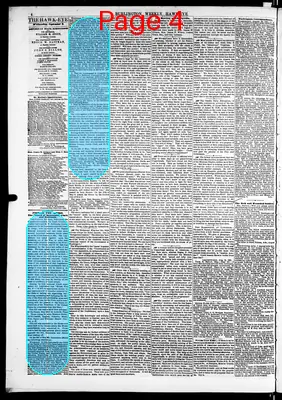
Story
September 5, 1863
The Burlington Weekly Hawk Eye
Burlington, Des Moines County, Iowa
What is this article about?
Criticism of Iowa politicians Duncombe, Justus Clark, and M. W. Robinson for voting against bills to fund and equip troops during the 1861 Extra Session of the Eighth General Assembly, amid the Civil War outbreak. Duncombe introduced peace resolutions opposing war and emancipation.
Clipping
OCR Quality
98%
Excellent
Full Text
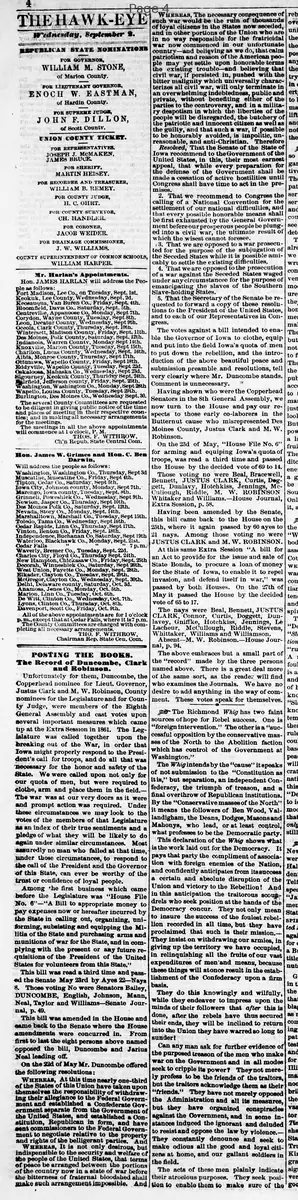
POSTING THE BOOKS.
The Record of Duncombe, Clark and Robinson.
Unfortunately for them, Duncombe, the Copperhead nominee for Lieut. Governor, Justus Clark and M. W. Robinson, County nominees for the Legislature and for County Judge, were members of the Eighth General Assembly and cast votes upon several important measures which came up at the Extra Session in 1861. The Legislature was called together upon the breaking out of the War, in order that Iowa might properly respond to the President's call for troops, and do all that was necessary for the honor and safety of the State. We were called upon not only for our quota of men, but were required to clothe, arm and place them in the field. The war was at our very doors as it were and prompt action was required. Under these circumstances we may look to the votes of the members of that Legislature as an index of their true sentiments and a pledge of what they will be likely to do again under similar circumstances. Most assuredly no man who failed at that time, under those circumstances, to respond to the call of the President and the Governor of this State, can ever be worthy of the trust or confidence of loyal people.
Among the first business which came before the Legislature was "House File No. 6"-"A Bill to appropriate money to pay expenses now or hereafter incurred by the State in calling out, organizing, uniforming, subsisting and equipping the Militia of the State and purchasing arms and munitions of war for the State, and in complying with the present or any future requisitions of the President of the United States for volunteers from this State."
This bill was read a third time and passed the Senate May 23rd by Ayes 22-Nays 8. Those voting No were Senators Bailey, DUNCOMBE, English, Johnson, Mann, Neal, Taylor and Williams-Senate Journal, p. 49.
This bill was amended in the House and came back to the Senate where the House amendments were concurred in. From first to last the eight persons above named opposed the bill, Duncombe and Jarius Neal leading off.
On the 22d of May Mr. Duncombe offered the following resolutions:
WHEREAS, At this time nearly one-third of the States of this Union have taken upon themselves the responsibility of withdrawing their allegiance to the Federal Government and established a Confederate Government separate from the Government of the United States, and established a Constitution, Republican in form, and have sent commissioners to the Federal Government to negotiate relative to the property and rights of the belligerent parties and,
WHEREAS, It is not only desirable, but indispensable to the security and welfare of the people of the United States, that terms of peace be arranged between the portions of the country now in a state of war before the bitterness of fraternal bloodshed shall make such arrangement impossible. And
WHEREAS, The necessary consequence of such war would be the ruin of thousands of loyal citizens in the States now seceded, and in other portions of the Union who are in no way responsible for the fratricidal war now commenced in our unfortunate country-and believing as we do, that calm patriotism and reason of the American people may yet settle upon honorable terms the existing trouble and believing that civil war, if persisted in, pushed with the bitter malignity which universally characterizes all civil war, will only terminate in an overwhelming indebtedness, public and private, without benefiting either of the parties to the controversy, and in a military despotism in which the liberties of the people will be disregarded, the butchery of the patriotic and innocent citizen as well as the guilty, and that such a war, if possible to be honorably avoided, is impolitic, unreasonable, and anti-Christian. Therefore
Resolved, That the Senate of the State of Iowa recommend to the Government of the United States, in this, their most earnest appeal, that while every preparation for the defense of the Government shall be made a cessation of active hostilities until Congress shall have time to act in the premises.
2. That we recommend to Congress the calling of a National Convention for the settlement of our national difficulties, and that every possible honorable means shall be first exhausted by the General Government before our prosperous people be plunged into a civil war, the ultimate result of which the wisest cannot foresee.
3. That we are opposed to a war prosecuted for the purpose of the subjugation of the Seceded States while it is possible amicably to settle the existing difficulties.
4. That we are opposed to the prosecution of a war against the Seceded States waged under any circumstances for the purpose of emancipating the slaves of the Southern Slave-holding States.
5. That the Secretary of the Senate be requested to forward a copy of these resolutions to the President of the United States, and to each of our Representatives in Congress.
The votes against a bill intended to enable the Governor of Iowa to clothe, equip and put into the field Iowa's quota of men to put down the rebellion, and the introduction of the above beautiful peace and submission preamble and resolutions, tell very clearly where Mr. Duncombe stands.
Comment is unnecessary.
Having shown who were the Copperhead Senators in the 8th General Assembly, we now turn to the House and pay our respects to those early co-laborers in the Butternut cause who misrepresented Des Moines County, Justus Clark and M. W. ROBINSON.
On the 23d of May, "House File No. 6" for arming and equipping Iowa's quota of troops, was read a third time and passed the House by the decided vote of 69 to 14.
Those voting no were Beal, Bracewell, Bennett, JUSTUS CLARK, Curtis, Doggett, Dunlavy, Hotchkiss, Jennings, McCuliough, Riddle, M. W. ROBINSON, Whitaker and Williams.-House Journal Extra Session, p. 58.
Having been amended by the Senate, this bill came back to the House on the 25th, where it again passed by 60 ayes to 21 nays. Among those voting no were JUSTUS CLARK and M. W. ROBINSON.
At this same Extra Session "A bill for an Act to provide for the issue and sale of State Bonds, to procure a loan of money for the State of Iowa, to enable it to repel invasion, and defend itself in war," was passed by both Houses. On the 27th of May it passed the House by the decided vote of 65 to 17.
The nays were Beal, Bennett, JUSTUS CLARK, Connor, Curtis, Doggett, Dunlavy, Gniffke, Hotchkiss, Jennings, Le Lacheur, McCullough, Riddle, Stevens, Whittaker, Williams and Williamson.
Absent-M. W. Robinson.-House Journal, p. 94.
The above embraces but a small part of the "record" made by the three persons named above. There is a great deal more of the same sort, as the reader will find who examines the Journals. We have no desire to add anything in the way of comment. These votes speak for themselves.
The Record of Duncombe, Clark and Robinson.
Unfortunately for them, Duncombe, the Copperhead nominee for Lieut. Governor, Justus Clark and M. W. Robinson, County nominees for the Legislature and for County Judge, were members of the Eighth General Assembly and cast votes upon several important measures which came up at the Extra Session in 1861. The Legislature was called together upon the breaking out of the War, in order that Iowa might properly respond to the President's call for troops, and do all that was necessary for the honor and safety of the State. We were called upon not only for our quota of men, but were required to clothe, arm and place them in the field. The war was at our very doors as it were and prompt action was required. Under these circumstances we may look to the votes of the members of that Legislature as an index of their true sentiments and a pledge of what they will be likely to do again under similar circumstances. Most assuredly no man who failed at that time, under those circumstances, to respond to the call of the President and the Governor of this State, can ever be worthy of the trust or confidence of loyal people.
Among the first business which came before the Legislature was "House File No. 6"-"A Bill to appropriate money to pay expenses now or hereafter incurred by the State in calling out, organizing, uniforming, subsisting and equipping the Militia of the State and purchasing arms and munitions of war for the State, and in complying with the present or any future requisitions of the President of the United States for volunteers from this State."
This bill was read a third time and passed the Senate May 23rd by Ayes 22-Nays 8. Those voting No were Senators Bailey, DUNCOMBE, English, Johnson, Mann, Neal, Taylor and Williams-Senate Journal, p. 49.
This bill was amended in the House and came back to the Senate where the House amendments were concurred in. From first to last the eight persons above named opposed the bill, Duncombe and Jarius Neal leading off.
On the 22d of May Mr. Duncombe offered the following resolutions:
WHEREAS, At this time nearly one-third of the States of this Union have taken upon themselves the responsibility of withdrawing their allegiance to the Federal Government and established a Confederate Government separate from the Government of the United States, and established a Constitution, Republican in form, and have sent commissioners to the Federal Government to negotiate relative to the property and rights of the belligerent parties and,
WHEREAS, It is not only desirable, but indispensable to the security and welfare of the people of the United States, that terms of peace be arranged between the portions of the country now in a state of war before the bitterness of fraternal bloodshed shall make such arrangement impossible. And
WHEREAS, The necessary consequence of such war would be the ruin of thousands of loyal citizens in the States now seceded, and in other portions of the Union who are in no way responsible for the fratricidal war now commenced in our unfortunate country-and believing as we do, that calm patriotism and reason of the American people may yet settle upon honorable terms the existing trouble and believing that civil war, if persisted in, pushed with the bitter malignity which universally characterizes all civil war, will only terminate in an overwhelming indebtedness, public and private, without benefiting either of the parties to the controversy, and in a military despotism in which the liberties of the people will be disregarded, the butchery of the patriotic and innocent citizen as well as the guilty, and that such a war, if possible to be honorably avoided, is impolitic, unreasonable, and anti-Christian. Therefore
Resolved, That the Senate of the State of Iowa recommend to the Government of the United States, in this, their most earnest appeal, that while every preparation for the defense of the Government shall be made a cessation of active hostilities until Congress shall have time to act in the premises.
2. That we recommend to Congress the calling of a National Convention for the settlement of our national difficulties, and that every possible honorable means shall be first exhausted by the General Government before our prosperous people be plunged into a civil war, the ultimate result of which the wisest cannot foresee.
3. That we are opposed to a war prosecuted for the purpose of the subjugation of the Seceded States while it is possible amicably to settle the existing difficulties.
4. That we are opposed to the prosecution of a war against the Seceded States waged under any circumstances for the purpose of emancipating the slaves of the Southern Slave-holding States.
5. That the Secretary of the Senate be requested to forward a copy of these resolutions to the President of the United States, and to each of our Representatives in Congress.
The votes against a bill intended to enable the Governor of Iowa to clothe, equip and put into the field Iowa's quota of men to put down the rebellion, and the introduction of the above beautiful peace and submission preamble and resolutions, tell very clearly where Mr. Duncombe stands.
Comment is unnecessary.
Having shown who were the Copperhead Senators in the 8th General Assembly, we now turn to the House and pay our respects to those early co-laborers in the Butternut cause who misrepresented Des Moines County, Justus Clark and M. W. ROBINSON.
On the 23d of May, "House File No. 6" for arming and equipping Iowa's quota of troops, was read a third time and passed the House by the decided vote of 69 to 14.
Those voting no were Beal, Bracewell, Bennett, JUSTUS CLARK, Curtis, Doggett, Dunlavy, Hotchkiss, Jennings, McCuliough, Riddle, M. W. ROBINSON, Whitaker and Williams.-House Journal Extra Session, p. 58.
Having been amended by the Senate, this bill came back to the House on the 25th, where it again passed by 60 ayes to 21 nays. Among those voting no were JUSTUS CLARK and M. W. ROBINSON.
At this same Extra Session "A bill for an Act to provide for the issue and sale of State Bonds, to procure a loan of money for the State of Iowa, to enable it to repel invasion, and defend itself in war," was passed by both Houses. On the 27th of May it passed the House by the decided vote of 65 to 17.
The nays were Beal, Bennett, JUSTUS CLARK, Connor, Curtis, Doggett, Dunlavy, Gniffke, Hotchkiss, Jennings, Le Lacheur, McCullough, Riddle, Stevens, Whittaker, Williams and Williamson.
Absent-M. W. Robinson.-House Journal, p. 94.
The above embraces but a small part of the "record" made by the three persons named above. There is a great deal more of the same sort, as the reader will find who examines the Journals. We have no desire to add anything in the way of comment. These votes speak for themselves.
What sub-type of article is it?
Historical Event
What themes does it cover?
Betrayal
Justice
What keywords are associated?
Iowa Legislature
Civil War Votes
Copperhead Nominees
Anti War Resolutions
Troop Funding Opposition
What entities or persons were involved?
Duncombe
Justus Clark
M. W. Robinson
Where did it happen?
Iowa
Story Details
Key Persons
Duncombe
Justus Clark
M. W. Robinson
Location
Iowa
Event Date
Extra Session In 1861
Story Details
Duncombe, Clark, and Robinson voted against bills to appropriate money for equipping militia and issuing state bonds for war defense during the 1861 Extra Session; Duncombe introduced resolutions advocating peace negotiations and opposing subjugation or emancipation.