Thank you for visiting SNEWPapers!
Sign up free
Editorial
September 8, 1802
The Recorder, Or, Lady's And Gentleman's Miscellany
Richmond, Virginia
What is this article about?
A response in the Virginia Gazette to William Duane's Aurora article on Tories, criticizing Duane's views, contrasting them with Jefferson's definitions of Tory as supporter of administration, and accusing Duane of unethical journalism, signed Trueman.
Clipping
OCR Quality
95%
Excellent
Full Text
From the Virginia Gazette.
ANSWER
TO WILLIAM DUANE
CONCERNING TORIES.
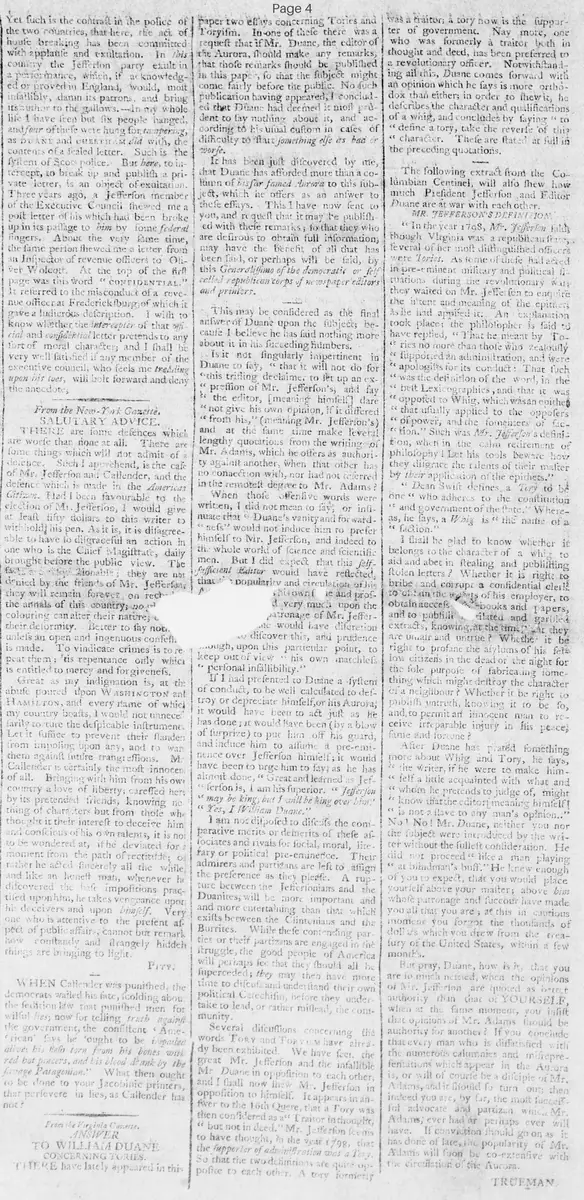
THERE have lately appeared in this paper two essays concerning Tories and Toryism. In one of these there was a request that if Mr. Duane, the editor of the Aurora, should make any remarks, that those remarks should be published in this paper, so that the subject might come fairly before the public. No such publication having appeared, I concluded that Duane had deemed it not prudent to say nothing about it, and according to his usual custom in cases of difficulty to 'start something else as bad or worse. It has been just discovered by me, that Duane has afforded more than a column of his far famed Aurora to this subject, which he offers as an answer to these essays. This I have now sent to you, and request that it may be re-published with these remarks: so that they who are desirous to obtain full information, may have the benefit of all that has been said, or perhaps will be said, by this Generalissimo of the democratic or self-called republican corps of newspaper editors and printers. This may be considered as the final answer of Duane upon the subject; because I believe he has said nothing more about it in his succeeding numbers. Is it not singularly impertinent in Duane to say, "that it will not do for this trifling declaimer to set up an expression of Mr. Jefferson's, and say to the editor, [meaning himself] dare not give his own opinion, if it differed from his," (meaning Mr. Jefferson's) and at the same time make several lengthy quotations from the writing of Mr. Adams, which he offers as authority against another, when that other has no connection with, nor had not referred in the remotest degree to Mr. Adams? When those offensive words were written, I did not mean to say: or insinuate that Duane's vanity and forwardness would not induce him to prefer himself to Mr. Jefferson, and indeed to the whole world of science and scientific men. But I did expect that this self-sufficient Editor would have reflected, that the popularity and circulation of his Aurora, depends very much upon the patronage of Mr. Jefferson and would have discretion to discover this, and prudence enough, upon this particular point, to keep out of view "his own matchless personal infallibility." If I had presented to Duane a system of conduct, to be well calculated to destroy or depreciate himself, or his Aurora, it would have been to act just as he has done; it would have been (by a blow of surprise) to put him off his guard, and induce him to assume a pre-eminence over Jefferson himself; it would have been to urge him to say; as he has almost done, "Great and learned as Jefferson is, I am his superior." Jefferson may be king, but I will be king over him." Yes, I William Duane. I am not disposed to discuss the comparative merits or demerits of these associates and rivals for social, moral, literary or political pre-eminence. Their admirers and partisans are left to assign the preference as they please. A rupture between the Jeffersonians and the Duanites, will be more important and more entertaining than that which exists between the Clintonians and the Burrites. While these contending parties or their partisans are engaged in the struggle, the good people of America will perhaps see that they should all be superseded; they may then have more time to discuss and understand their own political Catechism, before they undertake to lead, or rather mislead, the community. Several discussions concerning the words Tory and Toryism have already been exhibited. We have seen the great Mr. Jefferson and the infallible Mr. Duane in opposition to each other, and I shall now show Mr. Jefferson in opposition to himself. It appears in answer to the 10th Query, that a Tory was then considered as a "traitor in thought, but not in deed." Mr. Jefferson seems to have thought, in the year 1708, that the supporter of administration was a Tory. So that the two definitions are quite opposite to each other. A tory formerly was a traitor; a tory now is the supporter of government. Nay more, one who was formerly a traitor both in thought and deed, has been preferred to a revolutionary officer. Notwithstanding all this, Duane comes forward with an opinion which he says is more orthodox than either: in order to show it, he describes the character and qualifications of a whig, and concludes by saying "to define a tory, take the reverse of this character. These are stated as follows in the preceding quotations. The following extract from the Columbian Centinel, will also show how much President Jefferson and Editor Duane are at war with each other.
MR. JEFFERSON'S DEFINITION.
"In the year 1708, Mr. Jefferson said though Virginia was a republican state, several of her most distinguished officers were Tories. As some of these had acted in pre-eminent military and political situations during the revolutionary war: they waited on Mr. Jefferson to enquire the intent and meaning of the epithet, as he had applied it: An explanation took place; the philosopher is said to have replied. "That he meant by Tories no more than those who zealously supported an administration, and were its apologists for its conduct: That such was the definition of the word, in the best Lexicographies, and that it was opposed to Whig, which was an epithet that usually applied to the opposers of power, and the fomenters of faction." Such was Mr. Jefferson's definition, when in the calm retirement of philosophy. Let his tools beware how they disgrace the talents of their master by their application of the epithets." Dean Swift defines a Tory to be one "who adheres to the constitution and government of the state." Whereas, he says, a Whig is "the name of a faction." I shall be glad to know whether it belongs to the character of a whig to aid and abet in stealing and publishing stolen letters? Whether it is right to bribe and corrupt a confidential clerk, to obtain the fruits of his employer, to obtain access to books and papers, and to publish garbled and mutilated extracts, knowing, at the time right they are unfair and untrue? Whether it be right to profane the asylums of his fellow citizens in the dead of the night for the sole purpose of fabricating something which might destroy the character of a neighbour? Whether it be right to publish untruth, knowing it to be so, and to permit an innocent man to receive irreparable injury in his peace, fame and fortune? After Duane has prated something more about Whig and Tory, he says, "the writer, if he were to make himself a little acquainted with what and whom he pretends to judge of, might know that the editor [meaning himself] is not a slave to any man's opinion." No! No! Mr. Duane, neither you nor the subject were introduced by the writer without the fullest consideration. He did not proceed "like a man playing at blindman's buff." He knew enough of you to expect, that you would place yourself above your master; above him whose patronage and succour have made you all that you are; at this curious moment you forgot the thousands of dollars which you drew from the treasury of the United States, within a few months. But pray, Duane, how is it, that you are so much nettled, when the opinions of Mr. Jefferson are quoted as greater authority than that of YOURSELF. when at the same moment, you insist that Opinions of Mr. Adams should be authority for another? If you conclude that every man who is dissatisfied with the numerous calumnies and misinterpretations which appear in the Aurora is, or will of course be a disciple of Mr. Adams, and it should so turn out; then indeed you are, by far, the most successful advocate and partisan whig Mr. Adams; ever had or perhaps ever will have. If conviction should go on as it has done of late, the popularity of Mr. Adams will soon be co-extensive with the circulation of the Aurora.
TRUEMAN
ANSWER
TO WILLIAM DUANE
CONCERNING TORIES.
THERE have lately appeared in this paper two essays concerning Tories and Toryism. In one of these there was a request that if Mr. Duane, the editor of the Aurora, should make any remarks, that those remarks should be published in this paper, so that the subject might come fairly before the public. No such publication having appeared, I concluded that Duane had deemed it not prudent to say nothing about it, and according to his usual custom in cases of difficulty to 'start something else as bad or worse. It has been just discovered by me, that Duane has afforded more than a column of his far famed Aurora to this subject, which he offers as an answer to these essays. This I have now sent to you, and request that it may be re-published with these remarks: so that they who are desirous to obtain full information, may have the benefit of all that has been said, or perhaps will be said, by this Generalissimo of the democratic or self-called republican corps of newspaper editors and printers. This may be considered as the final answer of Duane upon the subject; because I believe he has said nothing more about it in his succeeding numbers. Is it not singularly impertinent in Duane to say, "that it will not do for this trifling declaimer to set up an expression of Mr. Jefferson's, and say to the editor, [meaning himself] dare not give his own opinion, if it differed from his," (meaning Mr. Jefferson's) and at the same time make several lengthy quotations from the writing of Mr. Adams, which he offers as authority against another, when that other has no connection with, nor had not referred in the remotest degree to Mr. Adams? When those offensive words were written, I did not mean to say: or insinuate that Duane's vanity and forwardness would not induce him to prefer himself to Mr. Jefferson, and indeed to the whole world of science and scientific men. But I did expect that this self-sufficient Editor would have reflected, that the popularity and circulation of his Aurora, depends very much upon the patronage of Mr. Jefferson and would have discretion to discover this, and prudence enough, upon this particular point, to keep out of view "his own matchless personal infallibility." If I had presented to Duane a system of conduct, to be well calculated to destroy or depreciate himself, or his Aurora, it would have been to act just as he has done; it would have been (by a blow of surprise) to put him off his guard, and induce him to assume a pre-eminence over Jefferson himself; it would have been to urge him to say; as he has almost done, "Great and learned as Jefferson is, I am his superior." Jefferson may be king, but I will be king over him." Yes, I William Duane. I am not disposed to discuss the comparative merits or demerits of these associates and rivals for social, moral, literary or political pre-eminence. Their admirers and partisans are left to assign the preference as they please. A rupture between the Jeffersonians and the Duanites, will be more important and more entertaining than that which exists between the Clintonians and the Burrites. While these contending parties or their partisans are engaged in the struggle, the good people of America will perhaps see that they should all be superseded; they may then have more time to discuss and understand their own political Catechism, before they undertake to lead, or rather mislead, the community. Several discussions concerning the words Tory and Toryism have already been exhibited. We have seen the great Mr. Jefferson and the infallible Mr. Duane in opposition to each other, and I shall now show Mr. Jefferson in opposition to himself. It appears in answer to the 10th Query, that a Tory was then considered as a "traitor in thought, but not in deed." Mr. Jefferson seems to have thought, in the year 1708, that the supporter of administration was a Tory. So that the two definitions are quite opposite to each other. A tory formerly was a traitor; a tory now is the supporter of government. Nay more, one who was formerly a traitor both in thought and deed, has been preferred to a revolutionary officer. Notwithstanding all this, Duane comes forward with an opinion which he says is more orthodox than either: in order to show it, he describes the character and qualifications of a whig, and concludes by saying "to define a tory, take the reverse of this character. These are stated as follows in the preceding quotations. The following extract from the Columbian Centinel, will also show how much President Jefferson and Editor Duane are at war with each other.
MR. JEFFERSON'S DEFINITION.
"In the year 1708, Mr. Jefferson said though Virginia was a republican state, several of her most distinguished officers were Tories. As some of these had acted in pre-eminent military and political situations during the revolutionary war: they waited on Mr. Jefferson to enquire the intent and meaning of the epithet, as he had applied it: An explanation took place; the philosopher is said to have replied. "That he meant by Tories no more than those who zealously supported an administration, and were its apologists for its conduct: That such was the definition of the word, in the best Lexicographies, and that it was opposed to Whig, which was an epithet that usually applied to the opposers of power, and the fomenters of faction." Such was Mr. Jefferson's definition, when in the calm retirement of philosophy. Let his tools beware how they disgrace the talents of their master by their application of the epithets." Dean Swift defines a Tory to be one "who adheres to the constitution and government of the state." Whereas, he says, a Whig is "the name of a faction." I shall be glad to know whether it belongs to the character of a whig to aid and abet in stealing and publishing stolen letters? Whether it is right to bribe and corrupt a confidential clerk, to obtain the fruits of his employer, to obtain access to books and papers, and to publish garbled and mutilated extracts, knowing, at the time right they are unfair and untrue? Whether it be right to profane the asylums of his fellow citizens in the dead of the night for the sole purpose of fabricating something which might destroy the character of a neighbour? Whether it be right to publish untruth, knowing it to be so, and to permit an innocent man to receive irreparable injury in his peace, fame and fortune? After Duane has prated something more about Whig and Tory, he says, "the writer, if he were to make himself a little acquainted with what and whom he pretends to judge of, might know that the editor [meaning himself] is not a slave to any man's opinion." No! No! Mr. Duane, neither you nor the subject were introduced by the writer without the fullest consideration. He did not proceed "like a man playing at blindman's buff." He knew enough of you to expect, that you would place yourself above your master; above him whose patronage and succour have made you all that you are; at this curious moment you forgot the thousands of dollars which you drew from the treasury of the United States, within a few months. But pray, Duane, how is it, that you are so much nettled, when the opinions of Mr. Jefferson are quoted as greater authority than that of YOURSELF. when at the same moment, you insist that Opinions of Mr. Adams should be authority for another? If you conclude that every man who is dissatisfied with the numerous calumnies and misinterpretations which appear in the Aurora is, or will of course be a disciple of Mr. Adams, and it should so turn out; then indeed you are, by far, the most successful advocate and partisan whig Mr. Adams; ever had or perhaps ever will have. If conviction should go on as it has done of late, the popularity of Mr. Adams will soon be co-extensive with the circulation of the Aurora.
TRUEMAN
What sub-type of article is it?
Partisan Politics
What keywords are associated?
Tories
Whigs
William Duane
Thomas Jefferson
Partisan Politics
Aurora
Jefferson Definition
What entities or persons were involved?
William Duane
Thomas Jefferson
John Adams
Aurora
Editorial Details
Primary Topic
Criticism Of William Duane's Views On Tories And Whigs
Stance / Tone
Strongly Critical Of Duane, Contrasting With Jefferson's Definitions
Key Figures
William Duane
Thomas Jefferson
John Adams
Aurora
Key Arguments
Duane's Impertinence In Claiming Superiority Over Jefferson
Jefferson's 1708 Definition Of Tory As Supporter Of Administration
Criticism Of Duane's Unethical Journalistic Practices Like Publishing Stolen Letters
Duane's Reliance On Adams' Opinions While Dismissing Jefferson's
Potential Rupture Between Jeffersonians And Duanites