Thank you for visiting SNEWPapers!
Sign up free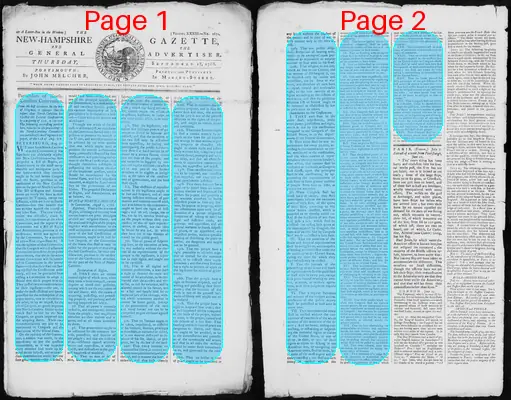
The New Hampshire Gazette And General Advertiser
Portsmouth, Rockingham County, New Hampshire
What is this article about?
The North Carolina Convention did not reject the U.S. Constitution but proposed a Bill of Rights and amendments to be considered before ratification. They voted 184-82 in favor, similar to Virginia's proposals, and made recommendations on paper money and imposts. Details include the full Declaration of Rights and specific amendments.
Merged-components note: This is a continuation of the detailed article on the North-Carolina Convention proceedings, including the Declaration of Rights and Amendments, split across pages due to page boundary; the second part was mislabeled as notice but is narrative reporting, so merged under story label.
Clippings
1 of 2
OCR Quality
Full Text
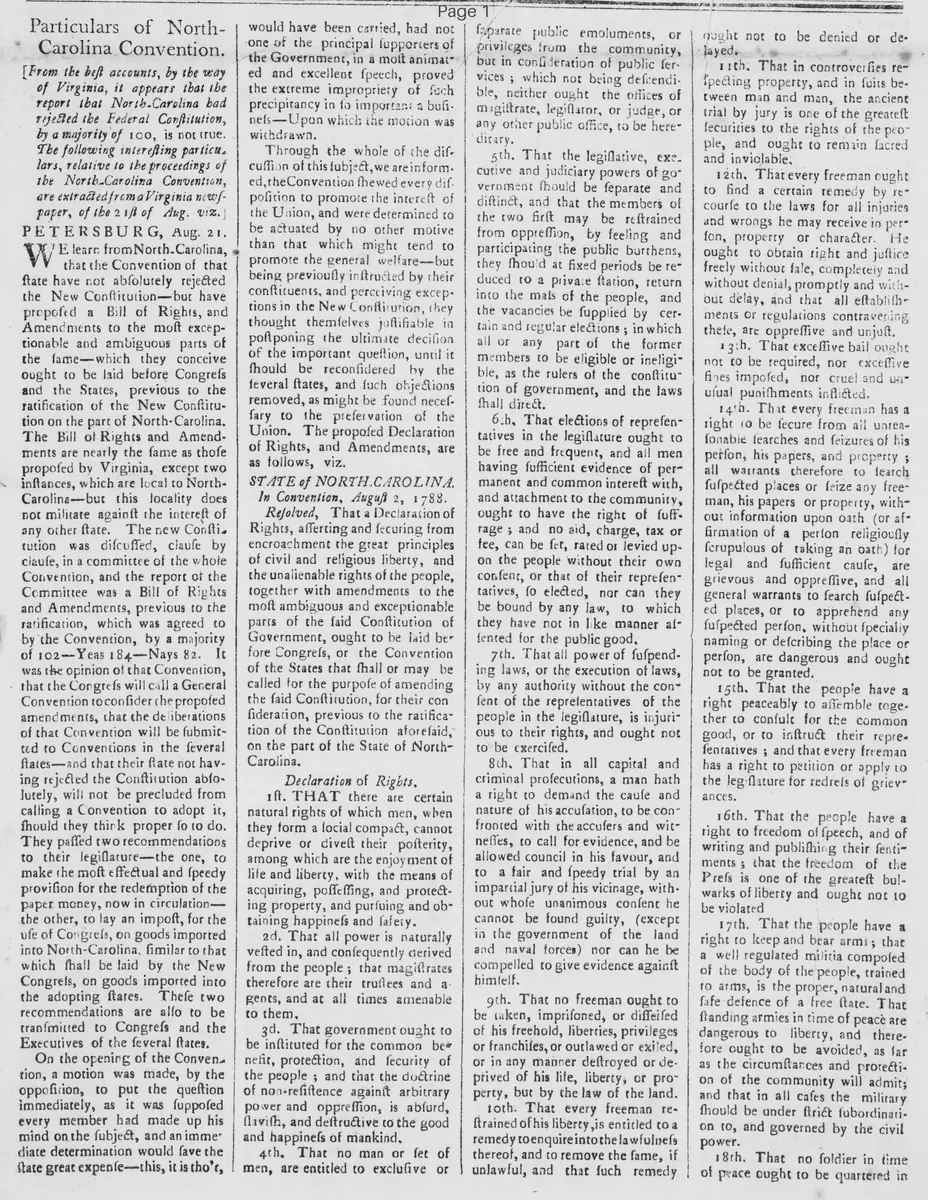
[From the best accounts, by the way of Virginia, it appears that the report that North-Carolina had rejected the Federal Constitution, by a majority of 100, is not true. The following interesting particulars, relative to the proceedings of the North Carolina Convention, are extracted from a Virginia newspaper, of the 21st of Aug. Viz.]
PETERSBURG, Aug. 21.
We learn from North-Carolina, that the Convention of that state have not absolutely rejected the New Constitution--but have proposed a Bill of Rights, and Amendments to the most exceptionable and ambiguous parts of the same--which they conceive ought to be laid before Congress and the States, previous to the ratification of the New Constitution on the part of North-Carolina. The Bill of Rights and Amendments are nearly the same as those proposed by Virginia, except two instances, which are local to North-Carolina--but this locality does not militate against the interest of any other state. The new Constitution was discussed, clause by clause, in a committee of the whole Convention, and the report of the Committee was a Bill of Rights and Amendments, previous to the ratification, which was agreed to by the Convention, by a majority of 102--Yeas 184--Nays 82. It was the opinion of that Convention, that the Congress will call a General Convention to consider the proposed amendments, that the deliberations of that Convention will be submitted to Conventions in the several states--and that their state not having rejected the Constitution absolutely, will not be precluded from calling a Convention to adopt it, should they think proper so to do. They passed two recommendations to their legislature--the one, to make the most effectual and speedy provision for the redemption of the paper money, now in circulation-- the other, to lay an impost, for the use of Congress, on goods imported into North-Carolina, similar to that which shall be laid by the New Congress, on goods imported into the adopting states. These two recommendations are also to be transmitted to Congress and the Executives of the several states.
On the opening of the Convention, a motion was made, by the opposition, to put the question immediately, as it was supposed every member had made up his mind on the subject, and an immediate determination would save the state great expense--this, it is thought, would have been carried, had not one of the principal supporters of the Government, in a most animated and excellent speech, proved the extreme impropriety of such precipitancy in so important a business--Upon which the motion was withdrawn.
Through the whole of the discussion of this subject, we are informed, the Convention showed every disposition to promote the interest of the Union, and were determined to be actuated by no other motive than that which might tend to promote the general welfare--but being previously instructed by their constituents, and perceiving exceptions in the New Constitution, they thought themselves justifiable in postponing the ultimate decision of the important question, until it should be reconsidered by the several states, and such objections removed, as might be found necessary to the preservation of the Union. The proposed Declaration of Rights, and Amendments, are as follows, viz.
STATE of NORTH-CAROLINA.
In Convention, August 2, 1788.
Resolved, That a Declaration of Rights, asserting and securing from encroachment the great principles of civil and religious liberty, and the unalienable rights of the people, together with amendments to the most ambiguous and exceptionable parts of the said Constitution of Government, ought to be laid before Congress, or the Convention of the States that shall or may be called for the purpose of amending the said Constitution, for their consideration, previous to the ratification of the Constitution aforesaid, on the part of the State of North-Carolina.
Declaration of Rights,
1st. THAT there are certain natural rights of which men, when they form a social compact, cannot deprive or divest their posterity, among which are the enjoyment of life and liberty, with the means of acquiring, possessing, and protecting property, and pursuing and obtaining happiness and safety.
2d. That all power is naturally vested in, and consequently derived from the people; that magistrates therefore are their trustees and agents, and at all times amenable to them.
3d. That government ought to be instituted for the common benefit, protection, and security of the people; and that the doctrine of non-resistance against arbitrary power and oppression, is absurd, slavish, and destructive to the good and happiness of mankind.
4th. That no man or set of men, are entitled to exclusive or separate public emoluments, or privileges from the community, but in consideration of public services: which not being descendible, neither ought the offices of magistrate, legislator, or judge, or any other public office, to be hereditary.
5th. That the legislative, executive and judiciary powers of government should be separate and distinct, and that the members of the two first may be restrained from oppression, by feeling and participating the public burdens, they should at fixed periods be reduced to a private station, return into the mass of the people, and the vacancies be supplied by certain and regular elections; in which all or any part of the former members to be eligible or ineligible, as the rules or the constitution of government, and the laws shall direct.
6th. That elections of representatives in the legislature ought to be free and frequent, and all men having sufficient evidence of permanent and common interest with, and attachment to the community, ought to have the right of suffrage; and no aid, charge, tax or fee, can be set, rated or levied upon the people without their own consent, or that of their representatives, so elected, nor can they be bound by any law, to which they have not in like manner assented for the public good.
7th. That all power of suspending laws, or the execution of laws, by any authority without the consent of the representatives of the people in the legislature, is injurious to their rights, and ought not to be exercised.
8th. That in all capital and criminal prosecutions, a man hath a right to demand the cause and nature of his accusation, to be confronted with the accusers and witnesses, to call for evidence, and be allowed council in his favour, and to a fair and speedy trial by an impartial jury of his vicinage, without whose unanimous consent he cannot be found guilty, (except in the government of the land and naval forces) nor can he be compelled to give evidence against himself.
9th. That no freeman ought to be taken, imprisoned, or disseised of his freehold, liberties, privileges or franchises, or outlawed or exiled, or in any manner destroyed or deprived of his life, liberty, or property, but by the law of the land.
10th. That every freeman restrained of his liberty, is entitled to a remedy to enquire into the lawfulness thereof, and to remove the same, if unlawful, and that such remedy ought not to be denied or delayed.
11th. That in controversies respecting property, and in suits between man and man, the ancient trial by jury is one of the greatest securities to the rights of the people, and ought to remain sacred and inviolable.
12th. That every freeman ought to find a certain remedy by recourse to the laws for all injuries and wrongs he may receive in person, property or character. He ought to obtain right and justice freely without sale, completely and without denial, promptly and without delay, and that all establishments or regulations contravening these, are oppressive and unjust.
13th. That excessive bail ought not to be required, nor excessive fines imposed, nor cruel and unusual punishments inflicted.
14th. That every freeman has a right to be secure from all unreasonable searches and seizures of his person, his papers, and property; all warrants therefore to search suspected places or seize any freeman, his papers or property, without information upon oath (or affirmation of a person religiously scrupulous of taking an oath) for legal and sufficient cause, are grievous and oppressive, and all general warrants to search suspected places, or to apprehend any suspected person, without specially naming or describing the place or person, are dangerous and ought not to be granted.
15th. That the people have a right peaceably to assemble together to consult for the common good, or to instruct their representatives; and that every freeman has a right to petition or apply to the legislature for redress of grievances.
16th. That the people have a right to freedom of speech, and of writing and publishing their sentiments; that the freedom of the press is one of the greatest bulwarks of liberty and ought not to be violated.
17th. That the people have a right to keep and bear arms; that a well regulated militia composed of the body of the people, trained to arms, is the proper, natural and safe defence of a free state. That standing armies in time of peace are dangerous to liberty, and therefore ought to be avoided, as far as the circumstances and protection of the community will admit; and that in all cases the military should be under strict subordination to, and governed by the civil power.
18th. That no soldier in time of peace ought to be quartered in any house without the consent of the owner, and in time of war in such manner only as the laws shall direct.
19th. That any person religiously scrupulous of bearing arms, ought to be exempted upon payment of an equivalent to employ another to bear arms in his stead.
20th. That religion, or the duty which we owe to our Creator, and the manner of discharging it, can be directed only by reason and conviction, not by force or violence, and therefore all men have an equal, natural and unalienable right, to the free exercise of religion according to the dictates of conscience, and that no particular religious sect or society ought to be favoured or established by law in preference to others.
Amendments to the Constitution.
I. THAT each state in the union shall, respectively, retain every power, jurisdiction and right, which is not by this constitution delegated to the Congress of the United States, or to the departments of the Federal Government,
II. That there shall be one representative for every 30,000, according to the enumeration or census, mentioned in the constitution, until the whole number of representatives amounts to two hundred. after which, that number shall be continued or increased, as Congress shall direct, upon the principles fixed in the constitution, by apportioning the representatives of each state to some greater number of people from time to time, as population increases.
III. When Congress Shall lay direct taxes or excises. they shall immediately inform the executive power of each state, of the quota of such state. according to the census herein directed. which is proposed to be thereby raised :-
And if the legislature of any state shall pass a law, which shall be effectual for raising such quota at the time required by Congress, the taxes and excises laid by Congress shall not be collected in such state.
IV, That the members of the Senate and house of representatives shall be ineligible to, and incapable of holding any civil office under the authority of the United States, during the time for which they shall respectively be elected.
V. That the journals of the proceedings of the senate and house of representatives shall be published at least once in every year, except such parts thereof relating to treaties, alliances, or military operations, as in their judgment require secrecy.
VI. That a regular Statement and account of the receipts and expenditures of the public money shall be published at least once in every year.
VII. That no commercial treaty shall be ratified without the concurrence of two thirds of the whole number of the members of the senate ; And no treaty, ceding contracting, or restraining or suspending the territorial rights or claims of the United States, or any of them, or their, or any of their rights or claims to fishing in the American seas, or navigating the American rivers, shall be made, but in cases of the most urgent and extreme necessity ; nor shall any such treaty be ratified without the
What sub-type of article is it?
What themes does it cover?
What keywords are associated?
Where did it happen?
Story Details
Location
North Carolina
Event Date
August 2, 1788
Story Details
The North Carolina Convention proposed a Declaration of Rights and amendments to the U.S. Constitution for consideration before ratification, voting 184-82 in favor. They recommended provisions for paper money redemption and an impost on imports, while expressing intent to promote the Union.