Thank you for visiting SNEWPapers!
Sign up free
Alexandria Gazette & Daily Advertiser
Alexandria, Virginia
What is this article about?
A U.S. Senate committee report from February 24, 1819, criticizes General Andrew Jackson for disregarding orders, violating the Constitution during the Seminole War, unauthorized appointments, planning an invasion of St. Augustine, and executing British subjects Arbuthnot and Ambrister without due process.
Clipping
OCR Quality
Full Text
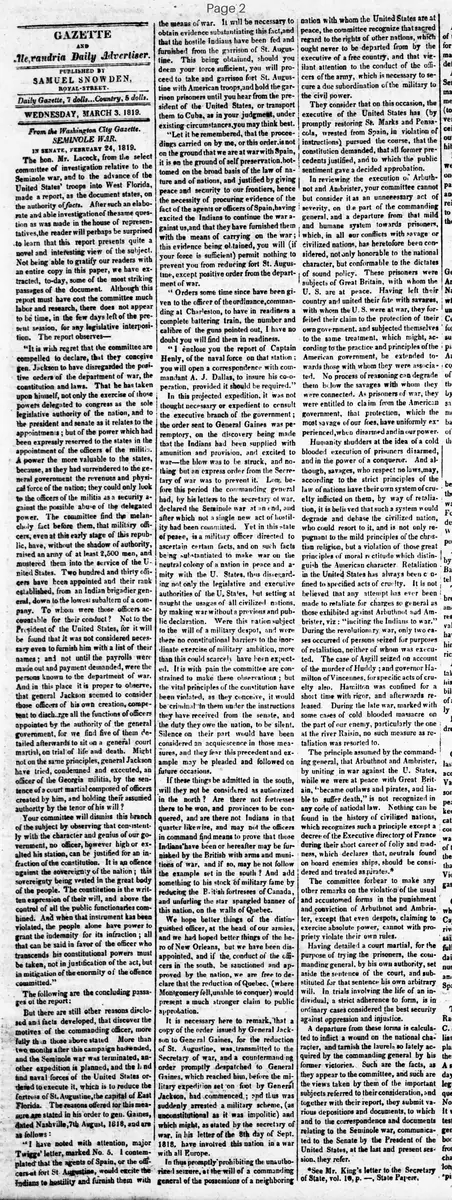
SEMINOLE WAR.
In SENATE, FEBRUARY 24, 1819.
The hon. Mr. Lacock, from the select committee of investigation relative to the Seminole war, and to the advance of the United States' troops into West Florida, made a report, as the document states, on the authority of facts. After such an elaborate and able investigation of the same question as was made in the house of representatives, the reader will perhaps be surprised to learn that this report presents quite a novel and interesting view of the subject. Not being able to gratify our readers with an entire copy in this paper, we have extracted, to-day, some of the most striking passages of the document. Although this report must have cost the committee much labor and research, there does not appear to be time, in the few days left of the present session, for any legislative interposition. The report observes—
"It is with regret that the committee are compelled to declare, that they conceive gen. Jackson to have disregarded the positive orders of the department of war, the constitution and laws. That he has taken upon himself, not only the exercise of those powers delegated to congress as the sole legislative authority of the nation, and to the president and senate as it relates to the appointments; but of the power which had been expressly reserved to the states in the appointment of the officers of the militia. A power the more valuable to the states, because, as they had surrendered to the general government the revenues and physical force of the nation; they could only look to the officers of the militia as a security against the possible abuse of the delegated power. The committee find the melancholy act before them, that military officers, even at this early stage of this republic, have, without the shadow of authority, raised an army of at least 2,500 men, and mustered them into the service of the United States. Two hundred and thirty officers have been appointed and their rank established, from an Indian brigadier general, down to the lowest subaltern of a company. To whom were those officers accountable for their conduct? Not to the President of the United States, for it will be found that it was not considered necessary even to furnish him with a list of their names; and not until the payrolls were made out and payment demanded, were the persons known to the department of war. And in this place it is proper to observe, that general Jackson seemed to consider those officers of his own creation, competent to discharge all the functions of officers appointed by the authority of the general government, for we find five of them detailed afterwards to sit on a general court martial, on trial of life and death. Might not on the same principles, general Jackson have tried, condemned and executed, an officer of the Georgia militia, by the sentence of a court martial composed of officers created by him, and holding their assumed authority by the tenor of his will? Your committee will dismiss this branch of the subject by observing that consistently with the character and genius of our government, no officer, however high or exalted his station, can be justified for an infraction of the constitution. It is an offence against the sovereignty of the nation; this sovereignty being vested in the great body of the people. The constitution is the written expression of their will, and above the control of all the public functionaries combined. And when that instrument has been violated, the people alone have power to grant the indemnity for its infraction; all that can be said in favor of the officer who transcends his constitutional powers must be taken, not in justification of the act, but in mitigation of the enormity of the offence committed."
The following are the concluding passages of the report:
But there are still other reasons disclosed and facts developed, that discover the motives of the commanding officer, more fully than those above stated. More than two months after this campaign had ended, and the Seminole war was terminated, another expedition is planned, and the land and naval forces of the United States ordered to execute it, which is to reduce the fortress of St. Augustine, the capital of East Florida. The reasons offered for this measure are stated in his order to gen. Gaines, dated Nashville, 7th August, 1818, and are as follows:
"I have noted with attention, major Twiggs' letter, marked No. 5. I contemplated that the agents of Spain, or the officers at fort St. Augustine, would excite the Indians to hostility and furnish them with the means of war. It will be necessary to obtain evidence substantiating this fact, and that the hostile Indians have been fed and furnished from the garrison of St. Augustine. This being obtained, should you deem your force sufficient, you will proceed to take and garrison fort St. Augustine with American troops, and hold the garrison prisoners until you hear from the president of the United States, or transport them to Cuba, as in your judgment, under existing circumstances, you may think best.
"Let it be remembered, that the proceedings carried on by me, or this order, is not on the ground that we are at war with Spain. It is on the ground of self preservation, bottomed on the broad basis of the law of nature and of nations, and justified by giving peace and security to our frontiers, hence the necessity of procuring evidence of the fact of the agents or officers of Spain, having excited the Indians to continue the war against us, and that they have furnished them with the means of carrying on the war; this evidence being obtained, you will (if your force is sufficient) permit nothing to prevent you from reducing fort St. Augustine, except positive order from the department of war.
"Orders some time since have been given to the officer of the ordinance, commanding at Charleston, to have in readiness a complete battering train, the number and calibre of the guns pointed out, I have no doubt you will find them in readiness.
"I enclose you the report of Captain Henly, of the naval force on that station; you will open a correspondence with commandant A. J. Dallas, to insure his co-operation, provided it should be required."
In this projected expedition, it was not thought necessary or expedient to consult the executive branch of the government; the order sent to General Gaines was peremptory, on the discovery being made that the Indians had been supplied with ammunition and provision, and excited to war—the blow was to be struck, and nothing but an express order from the Secretary of war was to prevent it. Long before this period the commanding general had, by his letters to the secretary of war, declared the Seminole war at an end, and after which not a single new act of hostility had been committed. Yet in this state of peace, is a military officer directed to ascertain certain facts, and on such facts being substantiated to make war on the neutral colony of a nation in peace and amity with the U. States, thus disregarding not only the legislative and executive authorities of the U. States, but setting at naught the usages of all civilized nations, by making war without a previous and public declaration. Were this nation subject to the will of a military despot, and were there no constitutional barriers to the inordinate exercise of military ambition, more than this could scarcely have been expected. It is with pain the committee are constrained to make these observations: but the vital principles of the constitution have been violated, as they conceive. It would be criminal in them under the instructions they have received from the senate, and the duty they owe the nation, to be silent. Silence on their part would have been considered an acquiescence in those measures, and they fear this precedent and example may be pleaded and followed on future occasions.
If these things be admitted in the south, will they not be considered as authorized in the north? Are there not fortresses there to be won, and provinces to be conquered, and are there not Indians in that quarter likewise, and may not the officers in command find means to prove that those Indians have been or hereafter may be furnished by the British with arms and munitions of war, and if so, may be not follow the example set in the south? And add something to his stock of military fame by reducing the British fortresses of Canada, and unfurling the star spangled banner of this nation, on the walls of Quebec.
We hope better things of the distinguished officer, at the head of our armies, and we had hoped better things of the hero of New Orleans, but we have been disappointed, and if the conduct of the officers in the south, be sanctioned and approved by the nation, we are free to declare that the reduction of Quebec, (where Montgomery fell, unable to conquer) would present a much stronger claim to public approbation.
It is necessary here to remark, That a copy of the order issued by General Jackson to General Gaines, for the reduction of St. Augustine, was transmitted to the Secretary of war, and a countermanding order promptly despatched to General Gaines, which reached him, before the military expedition set on foot by General Jackson, had commenced; and thus was suddenly arrested a military scheme, (as unconstitutional as it was impolitic and which might, as stated by the secretary of war, in his letter of the 8th day of Sept. 1818, have involved this nation in a war with all Europe.
In thus promptly prohibiting the unauthorized seizure, at the will of a commanding general of the possessions of a neighboring nation with whom the United States are at peace, the committee recognize that sacred regard to the rights of other nations, which ought never to be departed from by the executive of a free country, and that vigilant attention to the conduct of the officers of the army, which is necessary to secure a due subordination of the military to the civil power.
They consider that on this occasion, the executive of the United States has (by promptly restoring St. Marks and Pensacola, wrested from Spain, in violation of instructions) pursued the course, that the constitution demanded, that all former precedents justified, and to which the public sentiment gave a decided approbation.
In reviewing the execution of Arbuthnot and Ambrister, your committee cannot but consider it as an unnecessary act of severity, on the part of the commanding general, and a departure from that mild and humane system towards prisoners, which, in all our conflicts with savage or civilized nations, has heretofore been considered, not only honorable to the national character, but conformable to the dictates of sound policy. These prisoners were subjects of Great Britain, with whom the U. S. are at peace. Having left their country and united their fate with savages, with whom the U. S. were at war, they forfeited their claim to the protection of their own government, and subjected themselves to the same treatment, which might, according to the practice and principles of the American government, be extended towards those with whom they were associated. No process of reasoning can degrade them by low the savages with whom they were connected. As prisoners of war, they were entitled to claim from the American government, that protection, which the most savage of our foes, have uniformly experienced, when disarmed and in our power. Humanity shudders at the idea of a cold blooded execution of prisoners disarmed, and in the power of a conqueror. And although, savages, who respect no laws, may, according to the strict principles of the law of nations have their own system of cruelty inflicted on them, by way of retaliation, it is believed that such a system would degrade and debase the civilized nation, who could resort to it, and is not only repugnant to the mild principles of the christian religion, but a violation of those great principles of moral rectitude which distinguish the American character. Retaliation in the United States has always been confined to specified acts of cruelty. It is not believed that any attempt has ever been made to retaliate for charges so general as those exhibited against Arbuthnot and Ambrister, viz: "inciting the Indians to war."
During the revolutionary war, only two cases occurred of persons seized for purposes of retaliation, neither of whom was executed. The case of Asgill seized on account of the murder of Huddy; and governor Hamilton of Vincennes, for specific acts of cruelty also. Hamilton was confined for a short time with rigor, and afterwards released. During the late war, marked with some cases of cold blooded massacre on the part of our enemy, particularly the one at the river Raisin, no such measure as retaliation was resorted to.
The principle assumed by the commanding general, that Arbuthnot and Ambrister, by uniting in war against the U. States, while we were at peace with Great Britain," became outlaws and pirates, and liable to suffer death," is not recognized in any code of national law. Nothing can be found in the history of civilized nations, which recognizes such a principle except a decree of the Executive directory of France during their short career of folly and madness, which declares that, neutrals found on board enemies ships, should be considered and treated as pirates.*
The committee forbear to make any other remarks on the violation of the usual and accustomed forms in the punishment and conviction of Arbuthnot and Ambrister, except that even despots, claiming to exercise absolute power, cannot with propriety violate their own rules.
Having detailed a court martial, for the purpose of trying the prisoners, the commanding general, by his own authority, set aside the sentence of the court, and substituted for that sentence his own arbitrary will. In trials involving the life of an individual, a strict adherence to form, is in ordinary cases considered the best security against oppression and injustice.
A departure from these forms is calculated to inflict a wound on the national character, and tarnish the laurel, so lately acquired by the commanding general by his former victories.— Such are the facts, as they appear to the committee, and such are the views taken by them of the important subjects referred to their consideration, and together with their report, they submit various depositions and documents, to which and to the correspondence and documents relating to the Seminole war, communicated to the Senate by the President of the United States, at the last and present session, they refer.
*See Mr. King's letter to the Secretary of State, vol. 10, p. --, State Papers.
What sub-type of article is it?
What keywords are associated?
What entities or persons were involved?
Where did it happen?
Domestic News Details
Primary Location
Washington
Event Date
February 24, 1819
Key Persons
Outcome
execution of arbuthnot and ambrister; planned but countermanded expedition to st. augustine; restoration of st. marks and pensacola; committee criticism of jackson's actions as unconstitutional.
Event Details
Senate select committee report by Mr. Lacock investigates Seminole War, criticizes Gen. Jackson for disregarding orders, unauthorized militia appointments, planning invasion of St. Augustine without executive approval, and executing British traders Arbuthnot and Ambrister via irregular court martial, violating constitutional principles and international norms.