Thank you for visiting SNEWPapers!
Sign up free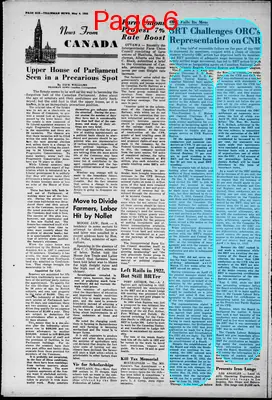
Trainman News
Indianapolis, Marion County, Indiana
What is this article about?
The Brotherhood of Railroad Trainmen (BRT) challenges the Order of Railway Conductors (ORC) for failing to represent CNR conductors adequately in wage negotiations, leading BRT to seek certification as bargaining agent for CNR's Atlantic, Central, and Western Regions in Canada. ORC's early 11% settlement disadvantaged BRT members.
Clipping
OCR Quality
Full Text
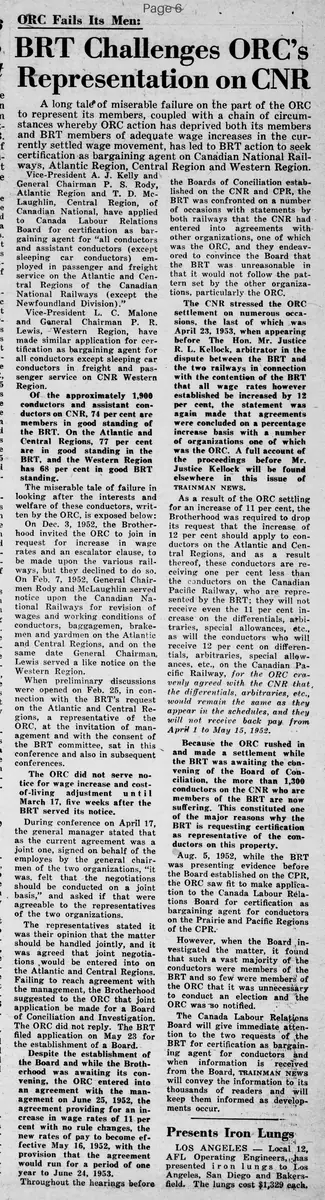
BRT Challenges ORC's
Representation on CNR
A long tale of miserable failure on the part of the ORC to represent its members, coupled with a chain of circumstances whereby ORC action has deprived both its members and BRT members of adequate wage increases in the currently settled wage movement, has led to BRT action to seek certification as bargaining agent on Canadian National Railways, Atlantic Region, Central Region and Western Region.
Vice-President A. J. Kelly and General Chairman P. S. Rody, Atlantic Region and T. D. McLaughlin, Central Region, of Canadian National, have applied to Canada Labour Relations Board for certification as bargaining agent for "all conductors and assistant conductors (except sleeping car conductors) employed in passenger and freight service on the Atlantic and Central Regions of the Canadian National Railways (except the Newfoundland Division)."
Vice-President L. C. Malone and General Chairman P. R. Lewis, Western Region, have made similar application for certification as bargaining agent for all conductors except sleeping car conductors in freight and passenger service on CNR Western Region.
Of the approximately 1,900 conductors and assistant conductors on CNR, 74 per cent are members in good standing of the BRT. On the Atlantic and Central Regions, 77 per cent are in good standing in the BRT, and the Western Region has 68 per cent in good BRT standing.
The miserable tale of failure in looking after the interests and welfare of these conductors, written by the ORC, is exposed below:
On Dec. 3, 1952, the Brotherhood invited the ORC to join in request for increase in wage rates and an escalator clause, to be made upon the various railways, but they declined to do so.
On Feb. 7, 1952, General Chairmen Rody and McLaughlin served notice upon the Canadian National Railways for revision of wages and working conditions of conductors, baggagemen, brakemen and yardmen on the Atlantic and Central Regions, and on the same date General Chairman Lewis served a like notice on the Western Region.
When preliminary discussions were opened on Feb. 25, in connection with the BRT's request on the Atlantic and Central Regions, a representative of the ORC, at the invitation of management and with the consent of the BRT committee, sat in this conference and also in subsequent conferences.
The ORC did not serve notice for wage increase and cost-of-living adjustment until March 17, five weeks after the BRT served its notice.
During conference on April 17, the general manager stated that as the current agreement was a joint one, signed on behalf of the employes by the general chairmen of the two organizations, it was felt that the negotiations should be conducted on a joint basis," and asked if that were agreeable to the representatives of the two organizations.
The representatives stated it was their opinion that the matter should be handled jointly, and it was agreed that joint negotiations would be entered into on the Atlantic and Central Regions.
Failing to reach agreement with the management, the Brotherhood suggested to the ORC that joint application be made for a Board of Conciliation and Investigation. The ORC did not reply. The BRT filed application on May 23 for the establishment of a Board.
Despite the establishment of the Board and while the Brotherhood was awaiting its convening, the ORC entered into an agreement with the management on June 25, 1952, the agreement providing for an increase in wage rates of 11 per cent with no rule changes, the new rates of pay to become effective May 16, 1952, with the provision that the agreement would run for a period of one year to June 24, 1953.
Throughout the hearings before the Boards of Conciliation established on the CNR and CPR, the BRT was confronted on a number of occasions with statements by both railways that the CNR had entered into agreements with other organizations, one of which was the ORC, and they endeavored to convince the Board that the BRT was unreasonable in that it would not follow the pattern set by the other organizations, particularly the ORC.
The CNR stressed the ORC settlement on numerous occasions, the last of which was April 23, 1953, when appearing before The Hon. Mr. Justice R. L. Kellock, arbitrator in the dispute between the BRT and the two railways in connection with the contention of the BRT that all wage rates however established be increased by 12 per cent, the statement was again made that agreements were concluded on a percentage increase basis with a number of organizations one of which was the ORC. A full account of the proceedings before Mr. Justice Kellock will be found elsewhere in this issue of TRAINMAN NEWS.
As a result of the ORC settling for an increase of 11 per cent, the Brotherhood was required to drop its request that the increase of 12 per cent should apply to conductors on the Atlantic and Central Regions, and as a result thereof, these conductors are receiving one per cent less than the conductors on the Canadian Pacific Railway, who are represented by the BRT; they will not receive even the 11 per cent increase on the differentials, arbitraries, special allowances, etc., as will the conductors who will receive 12 per cent on differentials, arbitraries, special allowances, etc., on the Canadian Pacific Railway, for the ORC cravenly agreed with the CNR that the differentials, arbitraries, etc., would remain the same as they appear in the schedules, and they will not receive back pay from April 1 to May 15, 1952.
Because the ORC rushed in and made a settlement while the BRT was awaiting the convening of the Board of Conciliation, the more than 1,300 conductors on the CNR who are members of the BRT are now suffering. This constituted one of the major reasons why the BRT is requesting certification as representative of the conductors on this property.
Aug. 5, 1952, while the BRT was presenting evidence before the Board established on the CPR, the ORC saw fit to make application to the Canada Labour Relations Board for certification as bargaining agent for conductors on the Prairie and Pacific Regions of the CPR.
However, when the Board investigated the matter, it found that such a vast majority of the conductors were members of the BRT and so few were members of the ORC that it was unnecessary to conduct an election and the ORC was so notified.
The Canada Labour Relations Board will give immediate attention to the two requests of the BRT for certification as bargaining agent for conductors and when information is received from the Board, TRAINMAN NEWS will convey the information to its thousands of readers and will keep them informed as developments occur.
What sub-type of article is it?
What keywords are associated?
What entities or persons were involved?
Where did it happen?
Foreign News Details
Primary Location
Canadian National Railways, Canada
Event Date
1952 1953
Key Persons
Outcome
orc settled for 11% wage increase effective may 16, 1952, without adjustments to differentials or back pay; brt conductors receive 1% less than cpr counterparts; brt applies for certification as bargaining agent, supported by 74% membership.
Event Details
BRT accuses ORC of failing to represent CNR conductors in wage negotiations, leading to inadequate increases. BRT served notices in February 1952, but ORC delayed and settled separately in June 1952 for 11%, undermining BRT's 12% claim. BRT now seeks certification from Canada Labour Relations Board for CNR regions, citing high membership.