Thank you for visiting SNEWPapers!
Sign up free
Richmond Enquirer
Richmond, Richmond County, Virginia
What is this article about?
A letter writer hopes for an English professorship at the new University to curb linguistic deviations, warning that future generations may struggle to read classics like Robinson Crusoe due to corrupted English in newspapers and public speech, with listed examples of errors.
Merged-components note: Continuation of the same letter on errors in English usage.
Clipping
OCR Quality
Full Text
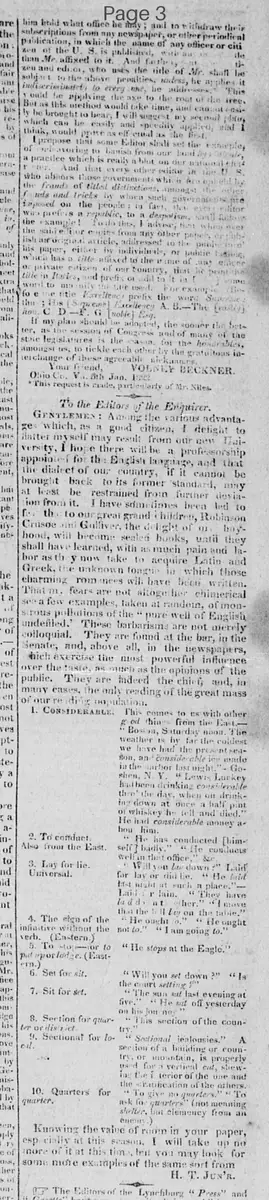
GENTLEMEN: Among the various advantages which, as a good citizen, I delight to flatter myself may result from our new University, I hope there will be a professorship appointed for the English language, and that the dialect of our country, if it cannot be brought back to its former standard, may at least be restrained from further deviation from it. I have sometimes been led to fear, that to our great grandchildren, Robinson Crusoe and Gulliver, the delight of boyhood, will become sealed books, until they shall have learned, with as much pain and labor as they now take to acquire Latin and Greek, the unknown tongue in which those charming romances will have been written.
That my fears are not altogether chimerical see a few examples, taken at random, of monstrous pollutions of the "pure well of English undefiled." These barbarisms are not merely colloquial. They are found at the bar, in the Senate, and, above all, in the newspapers, which exercise the most powerful influence over the taste, as much as the opinions of the public. They are indeed the chief, and, in many cases, the only reading of the great mass of our reading population.
1. CONSIDERABLE
This comes to us with other odd things from the East--Boston, Saturday noon. The weather is by far the coldest we have had the present season, and considerable ice made in the harbor last night."--Goshen, N. Y. "Lewis Luckey had been drinking considerable thro' the day, when on drinking down at once a half pint of whiskey he fell and died." He had considerable money about him.
2. To conduct.
"He has conducted [himself] badly." "He conducts well in that office." &c.
3. Lay for lie.
Will you lay down?" Laid for lay or did lie. "He laid last night at such a place."--Lay or lain. "They have laid down." I move that the [H] lay on the table."
4. The sign of the infinitive without the
erb. (Eastern.)
"He ought o." "He ought not to." "I am going to."
5. To stop--for to put up or lodge. (Eastern.)
"He stops at the Eagle."
6. Set for sit.
"Will you set down?" "Is the court setting?"
7. Sit for set.
"The sun sat last evening at five." "He sat off yesterday on his journey."
8. Section for quarter or district.
"This section of the country."
9. Sectional for local.
"Sectional jealousies."
A section of a building or country, is properly used for a vertical cut, shewing the interior of the one and the stratification of the other.
10. Quarters for quarter.
"To give no quarters." "To ask for quarters" (not meaning shelter, but clemency from an enemy).
Knowing the value of room in your paper, especially at this season, I will take up no more of it at this time, but you may look for some more examples of the same sort from
H. T. JUNIOR.
What sub-type of article is it?
What themes does it cover?
What keywords are associated?
What entities or persons were involved?
Letter to Editor Details
Author
H. T. Junior.
Recipient
Editors Of The Enquirer
Main Argument
advocates for a professorship in english at the new university to preserve the language from further deviation, fearing that classics like robinson crusoe and gulliver will become inaccessible to future generations without special study; provides examples of common linguistic errors in public discourse, especially newspapers.
Notable Details