Thank you for visiting SNEWPapers!
Sign up free
Richmond Enquirer
Richmond, Richmond County, Virginia
What is this article about?
On August 7, citizens of Richmond held a public meeting at the Capitol to discuss completing subscriptions for the James River and Kanawha Company stock. Resolutions were adopted to appoint a committee of seven, including Chief Justice Marshall, to secure additional subscriptions from interested regions. Chapman Johnson delivered a speech urging action.
Clipping
OCR Quality
Full Text
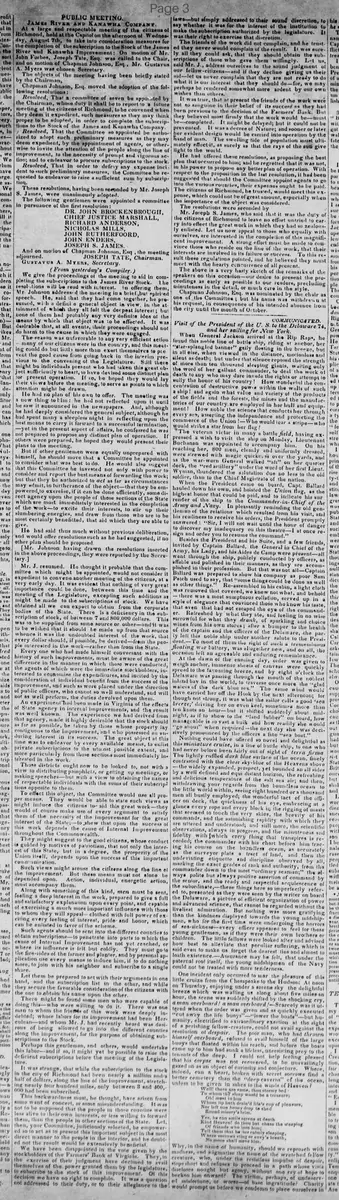
JAMES RIVER AND KANAWHA COMPANY.
At a large and respectable meeting of the citizens of Richmond, held at the Capitol on the afternoon of Wednesday, August 7th, to take into consideration measures for the completion of the subscription to the Stock of the James River and Kanawha Improvement: On motion of Mr. John Forbes, Joseph Tate, Esq. was called to the Chair, and on motion of Chapman Johnson, Esq., Mr. Gustavus A. Myers was chosen Secretary.
The objects of the meeting having been briefly stated by the Chairman, Chapman Johnson, Esq. moved the adoption of the following resolutions:
Resolved, That a committee of seven be appointed by the Chairman, whose duty it shall be to report to a future meeting of the citizens of Richmond, to be convened when they deem it expedient, such measures as they may think proper to be adopted, in order to complete the subscriptions to the Stock of the James and Kanawha Company.
Resolved, That the Committee so appointed be authorized to adopt such preliminary measures as they may deem expedient, by the appointment of agents, or otherwise to invite the attention of the people along the line of improvement, to the necessity of prompt and vigorous action; and to endeavor to procure subscriptions to the stock.
Resolved, That in order to defray any expense incident to such preliminary measures, the Committee be requested to endeavor to raise a sufficient sum by subscription.
These resolutions, having been seconded by Mr. Joseph S. James, were unanimously adopted.
The following gentlemen were appointed a committee in pursuance of the first resolution:
DR. JOHN BROCKENBROUGH,
CHIEF JUSTICE MARSHALL,
RICHARD ANDERSON,
NICHOLAS MILLS
JOHN RUTHERFOORD
JOHN ENDERS,
JOSEPH S. JAMES.
And on motion of Chapman Johnson, Esq., the meeting adjourned.
JOSEPH TATE, Chairman.
Gustavus A. Myers, Secretary.
(From yesterday's Compiler.)
We give the proceedings of the meeting to aid in completing the subscriptions to the James River Stock. The resolutions will be read with interest. In offering them, Mr. Johnson addressed the meeting in a brief but spirited speech. He said that they had come together, he presumed, with a definite general object in view, in the attainment of which they all felt the deepest interest; but none of them had probably any very definite idea of the means by which that object was to be effected. It was desirable that, at all events, their proceedings should not do harm to the cause in which they were engaged. The season was unfavorable to any very efficient action—many of our citizens were in the country, and this meeting could do but little more than exert themselves to prevent the good cause from going back in the interim previous to the convening of the Legislature. Still there might be individuals present who had taken this great object sufficiently to heart, to have devised some distinct plan for present operation. If so, he hoped they would lay their view before the meeting, to serve as points to which attention might be drawn.
He had no plan of his own to offer. The meeting was a new thing to him: he had not reflected upon it until he saw it announced in the newspapers. And, although he had deeply considered the general subject, although he had spent many a sleepless night in reflecting upon the best means to carry it forward to a successful termination,—yet in the present aspect of affairs, he confessed he was not prepared to propose any distinct plan of operation. If others were prepared, he hoped they would present their plans to the meeting.
But if other gentlemen were equally unprepared with himself, he should move that a Committee be appointed to consider what was best to do. He would also suggest that this Committee be invested not only with power to consider and report the best means of forwarding the work; but that they be authorized to act as far as circumstances may admit, in furtherance of the object—that they be empowered to exercise, if it can be done efficiently, some direct agency upon the people of those sections of the State which are most immediately interested in the completion of the work—to excite their interests, to stir up their slumbering energies, and draw from those who are to be most certainly benefitted, that aid which they are able to give.
He had said thus much without previous deliberation, and would offer resolutions such as he had suggested, if no other plan should be proposed.
[Mr. Johnson having drawn the resolutions inserted in the above proceedings, they were reported by the Secretary.]
Mr. J. resumed. He thought it probable that the committee which might be appointed, would not consider it expedient to convene another meeting of the citizens, at a very early day. It was evident that nothing of very great importance could be done, between this time and the meeting of the Legislature, excepting such additions as might be made to the subscriptions of stock. We have obtained all we can expect to obtain from the corporate bodies of the State. There is a deficiency in the subscription of stock, of between 700 and 800,000 dollars. This was to be supplied from some source or other—and it was to be wished that it should be made up from that source whence it was the undoubted interest of the work, that every dollar should, if possible, be derived—from the people interested in the work—rather than from the State.
Every one who had made himself conversant with the history of such improvements, must be aware of the great difference in the manner in which those were conducted, the agents of which were the immediate stockholders, interested to economise the expenditures, and incited by the consideration of individual benefit from the success of the improvement, and such as were placed under the direction of public officers, who cannot so well understand, and will not as well perform, the duties devolved upon them.
An experiment had been made in Virginia of the effects of State agency in internal improvements, and the result was well known. The experience we had derived from that agency, made it highly desirable that the stock should as far as possible, be taken by those whose property lay contiguous to the improvement, and who possessed an enduring interest in its success. The great object at this time was to endeavor by every available means, to enlist private subscriptions to the utmost possible extent, and more particularly from those sections most immediately interested in the work.
Those districts ought now to be looked to, not with a view to distributing pamphlets, or getting up meetings, or making speeches—but with a view to obtaining the names of respectable individuals with the sums of their subscriptions opposite to them.
To effect this object, the Committee would use all proper means. They would be able to state such views as might induce the citizens to aid this great work—they would of course make use of every argument to satisfy them of the necessity of the improvement for the great interest of the State; to shew that upon the success of this work depends the cause of Internal Improvement throughout the Commonwealth.
They might suggest to the good citizens, whose conduct is guided by motives of patriotism, that not only the interest of this State, but in a degree, the prosperity of the Union itself, depends upon the success of this important communication.
Such views might arouse the citizens along the line of the improvement. But these means must not alone be depended upon. Action, individual, energetic action, must accompany them.
Along with something of this kind, men must be sent, feeling a deep interest in the work, prepared to give a full and satisfactory explanation upon every point, and capable of exercising a much more important influence with those to whom they will appeal—clothed with full power of exciting every feeling of interest, pride—and honor, which can be enlisted in favor of the scheme.
Such agents should be sent into the different counties to obtain subscriptions—to penetrate into parts to which the cause of Internal Improvement has not yet reached, or where its influence is felt but coldly. They must go to the fire-sides of the farmer and planter, and by personal application use every means to induce him, if to do nothing more, to join with his neighbor and subscribe to a single share.
Let them be prepared to act with their arguments in one hand, and the subscription list in the other, and while they secure the favorable consideration of the citizens with the one to obtain his name upon the other.
There might be found some men who were capable of doing this—who were willing to do it. There was one man to whom the friends of this work were deeply indebted; whose labors for its improvement had been Herculean—and whom Mr. J. had recently heard was desirous of being allowed to go into the different counties along the improvement, for the purpose of obtaining subscriptions to the Stock.
Perhaps this gentleman, and others, would undertake this labor—and if so, it might yet be possible to raise the deficient subscriptions before the meeting of the Legislature.
It was strange, that while the subscription to the stock in the city of Richmond had been nearly a million and a half of dollars, along the line of the improvement, stretching nearly four hundred miles, only between 80 and 400,000 had been subscribed.
This backwardness must, be thought, have arisen from some want of concert, or some misunderstanding. It was not to be supposed that the people in those counties were less alive to their own interests, or less willing to forward them, than the people in other sections of the State. Let, then, your Committee, judiciously selected, be empowered so to act as to present this important subject in the most direct manner to the people in the interior, and he doubted not the result would be extensively beneficial.
We have been disappointed in the vote given by the stockholders of the Farmers' Bank of Virginia. They, in the exercise of their judgment have declined to avail themselves of the power granted them by the legislature, to subscribe to the stock of this improvement. Of this decision we have no right to complain. It was a question not addressed to their duty, or to their allegiance to the laws—but simply addressed to their sound discretion, to say whether it was for the interest of the institution to make the subscription authorized by the legislature. It was their right to exercise that discretion.
The friends of the work did not complain, and he trusted they never would complain of the result. It was surely all they could ask, that they should obtain the subscriptions of those who gave them willingly. Let us, said Mr. J., address ourselves to the sound judgment of our fellow-citizens—and if they decline giving us their aid—let us never complain that they are not ready to do what it is our interest that they should do—for, we may perhaps be rendered somewhat more ardent by our own wishes than others.
It was true, that at present the friends of the work were not so sanguine in their belief of its success as they had been previous to the decision of the Farmers' Bank. But they believed most firmly that the work would be—must be—completed. It might be delayed; but it could not be prevented. It was a decree of Nature; and sooner or later her evident design would be carried into operation by the hand of man. The swelling tide of population must ultimately effect it, as surely as that the rays of the sun give light to the world.
He had offered these resolutions, as proposing the best plan that occurred to him; and he regretted that it was not, in his power to propose any better plan of operation. With respect to the proposition in the last resolution, it had been suggested that should the Committee appoint agents to go into the various counties, their expenses ought to be paid. The citizens of Richmond, he trusted, would meet this expense, which could not be of great amount, especially when the importance of the object was considered.
The resolutions were seconded by Mr. Joseph S. James, who said that it was the duty of the citizens of Richmond to leave no effort untried to carry into effect the great work in which they had so zealously enlisted. Let us now appeal to those who equally with ourselves, are interested in the completion of this magnificent improvement. A strong effort must be made to convince those who reside on the line of the work, that their interests are involved in its failure or success. To this result these resolutions pointed, and he believed they must meet with the hearty concurrence of all present.
The above is a very hasty sketch of the remarks of the speakers on this occasion—our desire to present the proceedings as early as possible to our readers, precluding minuteness in the detail, or much care in the style.
Chapman Johnson, Esq. was nominated by the chair as one of the Committee; but his name was withdrawn at his request, in consequence of his intended absence from the city until the month of October.
What sub-type of article is it?
What keywords are associated?
What entities or persons were involved?
Where did it happen?
Domestic News Details
Primary Location
Richmond
Event Date
Wednesday, August 7th
Key Persons
Outcome
resolutions unanimously adopted; committee of seven appointed to secure additional stock subscriptions and report measures; meeting adjourned.
Event Details
Citizens of Richmond convened at the Capitol to address completing subscriptions to the James River and Kanawha Company stock. Chairman Joseph Tate presided, with Gustavus A. Myers as secretary. Chapman Johnson proposed and explained resolutions for appointing a committee to devise and implement measures, including appointing agents to solicit subscriptions along the improvement line and raising funds for expenses. The committee was appointed, excluding Chapman Johnson due to absence.