Thank you for visiting SNEWPapers!
Sign up free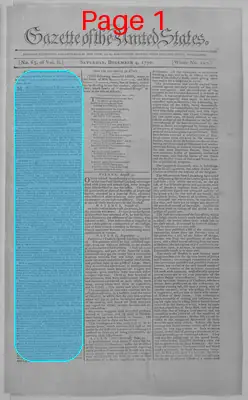
Literary
December 4, 1790
Gazette Of The United States
New York, New York County, New York
What is this article about?
Biographical account of Maurice Quentin de La Tour, French painter born in 1704 at St. Quentin. Details his early talent, studies, career in crayons due to health issues, portraits of royalty including Louis XV and Pompadour, independent spirit, philanthropy, and death at 84.
Clipping
OCR Quality
95%
Excellent
Full Text
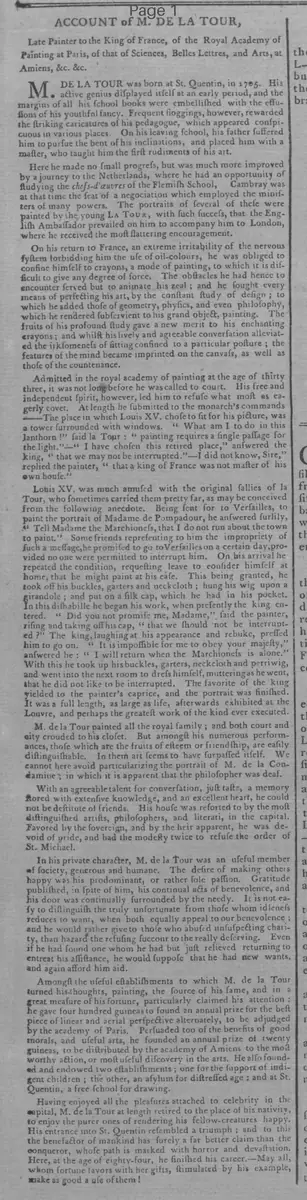
ACCOUNT of M. DE LA TOUR,
Late Painter to the King of France, of the Royal Academy of
Painting at Paris, of that of Sciences, Belles Lettres, and Arts, at
Amiens, &c. &c.
DE LA TOUR was born at St. Quentin, in 1704. His
active genius displayed itself at an early period, and the
margins of all his school books were embellished with the effusions
of his youthful fancy. Frequent floggings, however, rewarded
the striking caricatures of his pedagogue, which appeared conspicuous
in various places. On his leaving school, his father suffered
him to pursue the bent of his inclinations, and placed him with a
master, who taught him the first rudiments of his art.
Here he made no small progress, but was much more improved
by a journey to the Netherlands, where he had an opportunity of
studying the chefs-d'oeuvres of the Flemish School. Cambray was
at that time the seat of a negociation which employed the ministers
of many powers. The portraits of several of these were
painted by the young La Tour, with such success, that the English
Ambassador prevailed on him to accompany him to London,
where he received the most flattering encouragement.
On his return to France, an extreme irritability of the nervous
system forbidding him the use of oil-colours, he was obliged to
confine himself to crayons, a mode of painting, to which it is difficult
to give any degree of force. The obstacles he had hence to
encounter served but to animate his zeal; and he sought every
means of perfecting his art, by the constant study of design; to
which he added those of geometry, physics, and even philosophy,
which he rendered subservient to his grand object, painting. The
fruits of his profound study gave a new merit to his enchanting
crayons; and whilst his lively and agreeable conversation alleviated
the irksomeness of sitting confined to a particular posture; the
features of the mind became imprinted on the canvas, as well as
those of the countenance.
Admitted in the royal academy of painting at the age of thirty
three, it was not long before he was called to court. His free and
independent spirit, however, led him to refuse what most as eagerly
covet. At length he submitted to the monarch's commands.
The place in which Louis XV. chose to sit for his picture, was
a tower surrounded with windows. "What am I to do in this
lanthorn!" said la Tour: "painting requires a single passage for
the light." "I have chosen this retired place," answered the
king, "that we may not be interrupted."—I did not know, Sire,"
replied the painter, "that a king of France was not master of his
own house."
Louis XV. was much amused with the original sallies of la
Tour, who sometimes carried them pretty far, as may be conceived
from the following anecdote. Being sent for to Versailles, to
paint the portrait of Madame de Pompadour, he answered surlily,
"Tell Madame the Marchioness, that I do not run about the town
to paint." Some friends representing to him the impropriety of
such a message, he promised to go to Versailles on a certain day, provided
no one were permitted to interrupt him. On his arrival he
repeated the condition, requesting leave to consider himself at
home, that he might paint at his ease. This being granted, he
took off his buckles, garters and neck cloth; hung his wig upon a
girandole; and put on a silk cap, which he had in his pocket.
In this dishabille he began his work, when presently the king entered.
"Did you not promise me, Madame," said the painter,
rising and taking off his cap, "that we should not be interrupted?"
The king, laughing at his appearance and rebuke, pressed
him to go on. "It is impossible for me to obey your majesty,"
answered he: "I will return when the Marchioness is alone."
With this he took up his buckles, garters, neckcloth and perriwig,
and went into the next room to dress himself, muttering as he went,
that he did not like to be interrupted. The favorite of the king
yielded to the painter's caprice, and the portrait was finished.
It was a full length, as large as life, afterwards exhibited at the
Louvre, and perhaps the greatest work of the kind ever executed.
M. de la Tour painted all the royal family; and both court and
city crowded to his closet. But amongst his numerous performances,
those which are the fruits of esteem or friendship, are easily
distinguishable. In them art seems to have surpassed itself. We
cannot here avoid particularizing the portrait of M. de la Condamine;
in which it is apparent that the philosopher was deaf.
With an agreeable talent for conversation, just taste, a memory
stored with extensive knowledge, and an excellent heart, he could
not be destitute of friends. His house was resorted to by the most
distinguished artists, philosophers, and literati, in the capital.
Favored by the sovereign, and by the heir apparent, he was devoid
of pride, and had the modesty twice to refuse the order of
St. Michael.
In his private character, M. de la Tour was a useful member
of society, generous and humane. The desire of making others
happy was his predominant, or rather sole passion. Gratitude
published, in spite of him, his continual acts of benevolence, and
his door was continually surrounded by the needy. It is not easy
to distinguish the truly unfortunate from those whom idleness
reduces to want, when both equally appeal to our benevolence;
and he would rather give to those who abused unsuspecting charity,
than hazard the refusing succour to the really deserving.
Even
if he had found one whom he had but just relieved returning to
entreat his assistance, he would suppose that he had new wants,
and again afford him aid.
Amongst the useful establishments to which M. de la Tour
turned his thoughts, painting, the source of his fame, and in a
great measure of his fortune, particularly claimed his attention:
he gave four hundred guineas to found an annual prize for the best
piece of linear and aerial perspective alternately, to be adjudged
by the academy of Paris. Persuaded too of the benefits of good
morals, and useful arts, he founded an annual prize of twenty
guineas, to be distributed by the academy of Amiens to the most
worthy action, or most useful discovery in the arts. He also founded
and endowed two establishments; one for the support of indigent
children; the other, an asylum for distressed age: and at St.
Quentin, a free school for drawing.
Having enjoyed all the pleasures attached to celebrity in the
capital, M. de la Tour at length retired to the place of his nativity,
to enjoy the purer ones of rendering his fellow-creatures happy.
His entrance into St. Quentin resembled a triumph; and to this
the benefactor of mankind has surely a far better claim than the
conqueror, whose path is marked with horror and devastation.
Here, at the age of eighty-four, he finished his career. May all,
whom fortune favors with her gifts, stimulated by his example,
make as good a use of them!
Late Painter to the King of France, of the Royal Academy of
Painting at Paris, of that of Sciences, Belles Lettres, and Arts, at
Amiens, &c. &c.
DE LA TOUR was born at St. Quentin, in 1704. His
active genius displayed itself at an early period, and the
margins of all his school books were embellished with the effusions
of his youthful fancy. Frequent floggings, however, rewarded
the striking caricatures of his pedagogue, which appeared conspicuous
in various places. On his leaving school, his father suffered
him to pursue the bent of his inclinations, and placed him with a
master, who taught him the first rudiments of his art.
Here he made no small progress, but was much more improved
by a journey to the Netherlands, where he had an opportunity of
studying the chefs-d'oeuvres of the Flemish School. Cambray was
at that time the seat of a negociation which employed the ministers
of many powers. The portraits of several of these were
painted by the young La Tour, with such success, that the English
Ambassador prevailed on him to accompany him to London,
where he received the most flattering encouragement.
On his return to France, an extreme irritability of the nervous
system forbidding him the use of oil-colours, he was obliged to
confine himself to crayons, a mode of painting, to which it is difficult
to give any degree of force. The obstacles he had hence to
encounter served but to animate his zeal; and he sought every
means of perfecting his art, by the constant study of design; to
which he added those of geometry, physics, and even philosophy,
which he rendered subservient to his grand object, painting. The
fruits of his profound study gave a new merit to his enchanting
crayons; and whilst his lively and agreeable conversation alleviated
the irksomeness of sitting confined to a particular posture; the
features of the mind became imprinted on the canvas, as well as
those of the countenance.
Admitted in the royal academy of painting at the age of thirty
three, it was not long before he was called to court. His free and
independent spirit, however, led him to refuse what most as eagerly
covet. At length he submitted to the monarch's commands.
The place in which Louis XV. chose to sit for his picture, was
a tower surrounded with windows. "What am I to do in this
lanthorn!" said la Tour: "painting requires a single passage for
the light." "I have chosen this retired place," answered the
king, "that we may not be interrupted."—I did not know, Sire,"
replied the painter, "that a king of France was not master of his
own house."
Louis XV. was much amused with the original sallies of la
Tour, who sometimes carried them pretty far, as may be conceived
from the following anecdote. Being sent for to Versailles, to
paint the portrait of Madame de Pompadour, he answered surlily,
"Tell Madame the Marchioness, that I do not run about the town
to paint." Some friends representing to him the impropriety of
such a message, he promised to go to Versailles on a certain day, provided
no one were permitted to interrupt him. On his arrival he
repeated the condition, requesting leave to consider himself at
home, that he might paint at his ease. This being granted, he
took off his buckles, garters and neck cloth; hung his wig upon a
girandole; and put on a silk cap, which he had in his pocket.
In this dishabille he began his work, when presently the king entered.
"Did you not promise me, Madame," said the painter,
rising and taking off his cap, "that we should not be interrupted?"
The king, laughing at his appearance and rebuke, pressed
him to go on. "It is impossible for me to obey your majesty,"
answered he: "I will return when the Marchioness is alone."
With this he took up his buckles, garters, neckcloth and perriwig,
and went into the next room to dress himself, muttering as he went,
that he did not like to be interrupted. The favorite of the king
yielded to the painter's caprice, and the portrait was finished.
It was a full length, as large as life, afterwards exhibited at the
Louvre, and perhaps the greatest work of the kind ever executed.
M. de la Tour painted all the royal family; and both court and
city crowded to his closet. But amongst his numerous performances,
those which are the fruits of esteem or friendship, are easily
distinguishable. In them art seems to have surpassed itself. We
cannot here avoid particularizing the portrait of M. de la Condamine;
in which it is apparent that the philosopher was deaf.
With an agreeable talent for conversation, just taste, a memory
stored with extensive knowledge, and an excellent heart, he could
not be destitute of friends. His house was resorted to by the most
distinguished artists, philosophers, and literati, in the capital.
Favored by the sovereign, and by the heir apparent, he was devoid
of pride, and had the modesty twice to refuse the order of
St. Michael.
In his private character, M. de la Tour was a useful member
of society, generous and humane. The desire of making others
happy was his predominant, or rather sole passion. Gratitude
published, in spite of him, his continual acts of benevolence, and
his door was continually surrounded by the needy. It is not easy
to distinguish the truly unfortunate from those whom idleness
reduces to want, when both equally appeal to our benevolence;
and he would rather give to those who abused unsuspecting charity,
than hazard the refusing succour to the really deserving.
Even
if he had found one whom he had but just relieved returning to
entreat his assistance, he would suppose that he had new wants,
and again afford him aid.
Amongst the useful establishments to which M. de la Tour
turned his thoughts, painting, the source of his fame, and in a
great measure of his fortune, particularly claimed his attention:
he gave four hundred guineas to found an annual prize for the best
piece of linear and aerial perspective alternately, to be adjudged
by the academy of Paris. Persuaded too of the benefits of good
morals, and useful arts, he founded an annual prize of twenty
guineas, to be distributed by the academy of Amiens to the most
worthy action, or most useful discovery in the arts. He also founded
and endowed two establishments; one for the support of indigent
children; the other, an asylum for distressed age: and at St.
Quentin, a free school for drawing.
Having enjoyed all the pleasures attached to celebrity in the
capital, M. de la Tour at length retired to the place of his nativity,
to enjoy the purer ones of rendering his fellow-creatures happy.
His entrance into St. Quentin resembled a triumph; and to this
the benefactor of mankind has surely a far better claim than the
conqueror, whose path is marked with horror and devastation.
Here, at the age of eighty-four, he finished his career. May all,
whom fortune favors with her gifts, stimulated by his example,
make as good a use of them!
What sub-type of article is it?
Essay
What themes does it cover?
Moral Virtue
What keywords are associated?
Biography
Painter
Crayons
Louis Xv
Philanthropy
Portraiture
French Academy
Literary Details
Title
Account Of M. De La Tour,
Form / Style
Biographical Prose Account
Key Lines
"What Am I To Do In This Lanthorn!" Said La Tour: "Painting Requires A Single Passage For The Light."
"Did You Not Promise Me, Madame," Said The Painter, Rising And Taking Off His Cap, "That We Should Not Be Interrupted?"
The Desire Of Making Others Happy Was His Predominant, Or Rather Sole Passion.
May All, Whom Fortune Favors With Her Gifts, Stimulated By His Example, Make As Good A Use Of Them!