Thank you for visiting SNEWPapers!
Sign up free
Editorial
March 10, 1939
Clinch Valley News
Tazewell, Jeffersonville, Tazewell County, Virginia
What is this article about?
Editorial discusses Senator Wagner's National Health Bill, based on Technical Committee recommendations for expanding public health programs, hospital construction, medical care for needy, and wage loss insurance. Emphasizes fiscal considerations, preventive medicine, standards, and role of medical scientists over government control.
Clipping
OCR Quality
98%
Excellent
Full Text
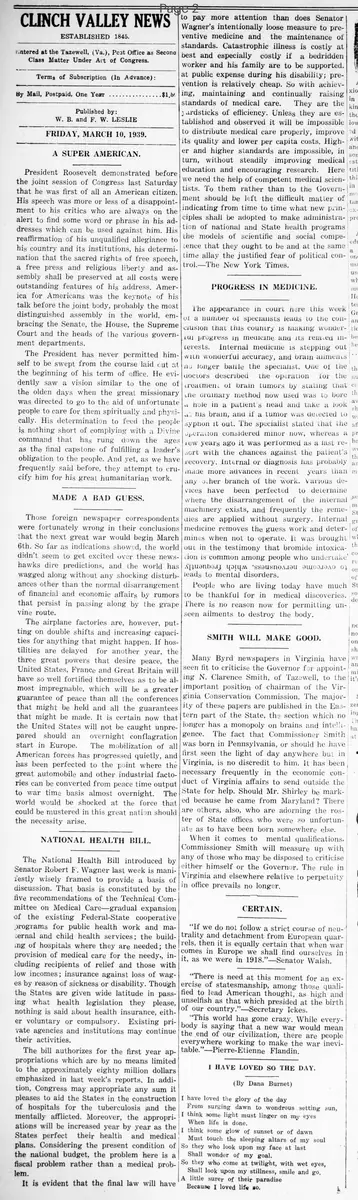
NATIONAL HEALTH BILL.
The National Health Bill introduced by Senator Robert F. Wagner last week is manifestly wisely framed to provide a basis of discussion.
That basis is constituted by the five recommendations of the Technical Committee on Medical Care—gradual expansion of the existing Federal-State cooperative programs for public health work and maternal and child health services; the building of hospitals where they are needed; the provision of medical care for the needy, including recipients of relief and those with low incomes; insurance against loss of wages by reason of sickness or disability.
Though the States are given wide latitude in passing what health legislation they please, nothing is said about health insurance, either voluntary or compulsory.
Existing private agencies and institutions may continue their activities.
The bill authorizes for the first year appropriations which are by no means limited to the approximately eighty million dollars emphasized in last week's reports.
In addition, Congress may appropriate any sum it pleases to aid the States in the construction of hospitals for the tuberculosis and the mentally afflicted.
Moreover, the appropriations will be increased year by year as the States perfect their health and medical plans.
Considering the present condition of the national budget, the problem here is a fiscal problem rather than a medical problem.
It is evident that the final law will have to pay more attention than does Senator Wagner's intentionally loose measure to preventive medicine and the maintenance of standards.
Catastrophic illness is costly at best and especially costly if a bedridden worker and his family are to be supported at public expense during his disability; prevention is relatively cheap.
So with achieving, maintaining and continually raising standards of medical care.
They are the yardsticks of efficiency.
Unless they are established and observed it will be impossible to distribute medical care properly, improve its quality and lower per capita costs.
Higher and higher standards are impossible, in turn, without steadily improving medical education and encouraging research.
Here we need the help of competent medical scientists.
To them rather than to the Government should be left the difficult matter of indicating from time to time what new principles shall be adopted to make administration of national and State health programs the models of scientific and social competence that they ought to be and at the same time allay the justified fear of political control.
The New York Times.
The National Health Bill introduced by Senator Robert F. Wagner last week is manifestly wisely framed to provide a basis of discussion.
That basis is constituted by the five recommendations of the Technical Committee on Medical Care—gradual expansion of the existing Federal-State cooperative programs for public health work and maternal and child health services; the building of hospitals where they are needed; the provision of medical care for the needy, including recipients of relief and those with low incomes; insurance against loss of wages by reason of sickness or disability.
Though the States are given wide latitude in passing what health legislation they please, nothing is said about health insurance, either voluntary or compulsory.
Existing private agencies and institutions may continue their activities.
The bill authorizes for the first year appropriations which are by no means limited to the approximately eighty million dollars emphasized in last week's reports.
In addition, Congress may appropriate any sum it pleases to aid the States in the construction of hospitals for the tuberculosis and the mentally afflicted.
Moreover, the appropriations will be increased year by year as the States perfect their health and medical plans.
Considering the present condition of the national budget, the problem here is a fiscal problem rather than a medical problem.
It is evident that the final law will have to pay more attention than does Senator Wagner's intentionally loose measure to preventive medicine and the maintenance of standards.
Catastrophic illness is costly at best and especially costly if a bedridden worker and his family are to be supported at public expense during his disability; prevention is relatively cheap.
So with achieving, maintaining and continually raising standards of medical care.
They are the yardsticks of efficiency.
Unless they are established and observed it will be impossible to distribute medical care properly, improve its quality and lower per capita costs.
Higher and higher standards are impossible, in turn, without steadily improving medical education and encouraging research.
Here we need the help of competent medical scientists.
To them rather than to the Government should be left the difficult matter of indicating from time to time what new principles shall be adopted to make administration of national and State health programs the models of scientific and social competence that they ought to be and at the same time allay the justified fear of political control.
The New York Times.
What sub-type of article is it?
Science Or Medicine
Economic Policy
Social Reform
What keywords are associated?
National Health Bill
Medical Care
Hospital Construction
Preventive Medicine
Health Standards
Medical Scientists
Federal Appropriations
What entities or persons were involved?
Senator Robert F. Wagner
Technical Committee On Medical Care
Congress
States
Medical Scientists
Editorial Details
Primary Topic
National Health Bill Introduced By Senator Wagner
Stance / Tone
Supportive With Emphasis On Standards And Prevention
Key Figures
Senator Robert F. Wagner
Technical Committee On Medical Care
Congress
States
Medical Scientists
Key Arguments
Bill Provides Basis For Discussion Based On Five Recommendations For Health Programs
Expands Federal State Cooperation In Public Health And Maternal/Child Services
Builds Hospitals Where Needed And Provides Care For Needy
Includes Insurance Against Wage Loss From Sickness
States Have Latitude In Health Legislation But No Mention Of Insurance
Appropriations Start Above $80 Million And Can Increase
Fiscal Challenges Due To Budget; Focus On Preventive Medicine
Maintain High Standards Of Medical Care For Efficiency And Cost Reduction
Improve Medical Education And Research With Scientists' Input
Avoid Political Control In Health Programs