Thank you for visiting SNEWPapers!
Sign up free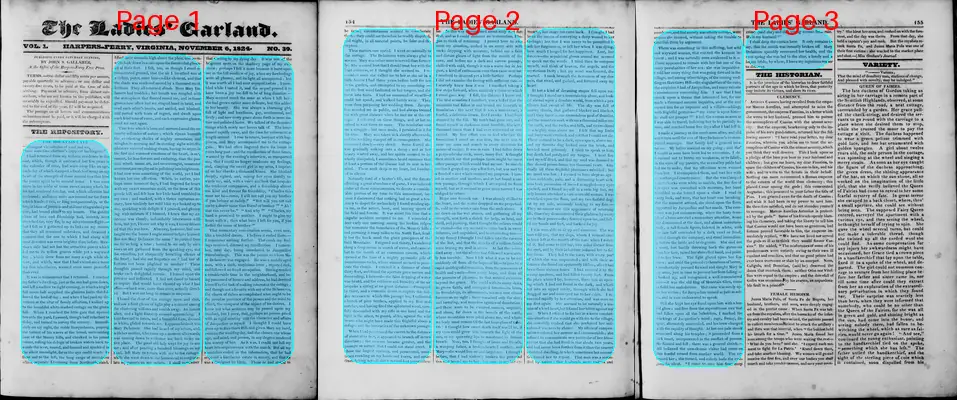
The Ladies' Garland
Harpers Ferry, Jefferson County, West Virginia
What is this article about?
A narrator returns from the East to his Pennsylvania home, reuniting with childhood love Mary Delamere, only to learn she is engaged to the suspicious Jacqueline Stromborough. Heartbroken, he explores the mountains, suffers a cave accident, and is rescued by a reclusive woman who later disrupts the wedding to curse Jacqueline, causing his collapse.
Merged-components note: These components form a single serialized literary fiction piece titled 'THE MOUNTAIN CAVE' that continues across pages 1-3. Changed label from 'story' to 'literary' for the third component to match the narrative fiction style.
Clippings
1 of 3
OCR Quality
Full Text
"Strangest vicissitudes of weal and wo,
Prove sometimes fortune's happiest harbingers."
I had returned from my tedious residence in the east, which, though it embraced but few years in the calendar of time, had worn away like an age, each day of which stamped a fresh testimony on my heart of the strength of those natural ties that bind the young spirit to its natural home. I was once more in the midst of those sweet scenes which habit had rendered familiar, and which affection had endeared; and once more saw around me the forms which kindred ties, or long companionship, or the bright blaze of juvenile and still unextinguished passion, had bound closer to my bosom. The golden chain of love and friendship had, indeed, been stretched far, very far, in my adventurous flight; but I felt as I gathered up its links on my return, that they all remained unbroken, and dreamed a moment that the one to which I had clung with most devotion was even brighter than before. Hawthorn side had not lost the attractive power which led me to its willow groves while yet a wayward boy; which drew from me many a sigh while absent, and which, now that I had visited once more my first inheritance, seemed even more powerful than ever.
It was in midsummer that I returned. I reached my father's dwelling, just as the sun had gone down, and left a mellow twilight evening, in which a bright full moon half supplied the glorious lustre that followed the lord of day; and when I had paid my devotions at the altar of family affection, I walked up to the beautiful white-washed cottage on the green hill. When I reached the little gate that opened towards the yard, I paused, though half reluctant to delay, and turned to survey the scenery. Immediately on my right, the noble Susquehanna, pouring the torrent of his waves at the broad, untrembling base of the Muncy hills, and checked in his proud career, rolling his deluge of broken waters backwards towards the west, roared, and foamed and sparkled in the silent moonlight, far as the eye could reach. In front and to the left, the long range of mountains which separate Lycoming from Northumberland, lifted their summits high above the plain, and seemed to look down in scorn upon the forests that gloomed at their feet. I felt, too, as though I stood on consecrated ground, that the air I breathed was of a richer, purer, more heaven-like element, and that the shade was rendered sacred by a thousand recollections. They all returned afresh. Here Mary Delamere had trodden; her breath was mingled with the atmosphere that floated round me, and in those groves how often had we strayed hand in hand, and read each other's hearts, and smiled, and blushed, and parted with tears of regret, and dwelt upon each kind tone of voice, and each expressive glance, until we met again.
That love which is born and nurtured amid the romantic solitudes of nature; which ripens beneath the everlasting shades of mighty mountains, and mingles its morning and its evening sighs with the plaintive voice of rushing rivers, having its origin in the first and warmest emotions of the heart, is not, cannot, be less fervent and enduring, than the passion which mimic art, and overwrought, unnatural sentiment, are employed in polishing into brightness. I had now seen something of the world, yet I had known but one affection. When, in earlier, perhaps more innocent days, I had lingered for hours with my sweet mountain maid, on the brow of this gentle hill, and felt how her little hand trembled in my own; and marked, with a thrice rapturous ecstasy, how tenderly her mild blue eye looked up to me, sparkling with delight if I praised, and glistening with moisture if I blamed, I knew that my existence was closely, indissolubly interwoven with hers, but yet, I know not why it was, I never dreamed that this was love. Absence, however, had now taught me the lesson I ought sooner to have learned. But was Mary Delamere the same? Separated from me for so long a time; bound to me only by such vows as are gathered from the speaking eye, and the voiceless, yet eloquently breathing silence of the heart; had she not forgotten me? had her affections not been plighted to another? These thoughts passed rapidly through my mind, and broke each delightful reverie. I leaned upon the gateway and reflected. I had not dared to hazard an inquiry that would have cleared up what I had often--what I now, more than ever, actually dreaded. But I was not long to remain in suspense.
I heard the door of the cottage open and shut, and saw a faint gleam of light play a moment among the clustering willows and vanish away. An instant after, and a light footstep seemed approaching. I bent forward to listen, and a beautiful form, dressed in white, glided towards me. I approached--it was Mary Delamere. She had heard of my return, and, with her mother, who came up a moment afterwards, was coming down to welcome me back to my native place. The good old lady wept for joy to see me; and after pouring a hundred blessings on my head, left Mary to return with me to the cottage, while she went down to the homestead to congratulate my parents on my return. I shall remember that evening to my dying day. It was one of the brightest spots on the shadowy page of my existence; perhaps I felt it more because it burst upon me in the full sunshine of joy, when my forebodings were all gloomy, and its light all unexpected; but it was worth all I had ever enjoyed before; I trembled while I tasted it, and the sequel proved it to have been a joy too full to be of long duration.--Mary seemed much the same as when I left her: she had grown rather more delicate, but this added to her beauty. She was always a charming girl, full of light and loveliness, gay, sentimental, and lively; and now every grace shone forth in more mature and polished lustre. We talked of the thousand things which newly met lovers talk of. The hours passed rapidly away, and the time for retirement at length arrived. I rose to return, buoyant with happiness, and Mary accompanied me to the cottage gate. We had often lingered there for hours in years long past; and the recollection of those times, warmed by the evening's interview, so transported me, that I could no longer moderate my feelings, and, clasping the sweet girl in my arms, I imprinted on her cheeks a thousand kisses. She blushed deeply, sighed, and, raising her eyes timidly towards me, said, with a voice and look that bespoke the tenderest compassion, and a friendship almost too kind and fervent for friendship, "Charles this must not be--come, I will not call you my brother if you behave so rudely." "But will you not call me by a dearer name than friend or brother?" "Ah! that can never be." "And why?" "Charles, my hand is promised to another. I ought to give my heart with it; then what have I left for you, if you forfeit the name of brother?"
That momentary conversation seems, even now, like a troubled dream. I believe it ended there.--I remember nothing further. The crush my feelings received, dimmed my recollection. I remember, next day, being introduced to Jacqueline Stromborough. This was the person to whom Mary Delamere was engaged. He was a middle aged man, with a dark, suspicious brow; reputed rich, and followed no fixed occupation. Having resided a considerable time in the neighborhood, and being possessed of leisure and address, he had devoted himself to the task of making interest at the cottage; and though not a favorite with any of the Delameres, the charm of riches accomplished what ought to be the peculiar province of the person and the mind to effect, the conquest of the object of his desires. I know not what sentence may be passed upon my conduct, but I avow, that, perhaps no person pried with as rigid scrutiny into the character and affairs of Jacqueline as myself. I thought I could have gone up to Hawthorn Hill, and given Mary my hand, even on the wedding day, had she chosen one whose age, and mind, and person, in any degree rendered him worthy of her. As it was, I could not lull my heart into acquiescence with the match. But all my researches ended in the information, that he had acquired a handsome estate in money, and that he was a foreigner by birth. These he had stated to be facts; circumstances seemed to corroborate them; they could not therefore be readily disputed, and might, in all material points, be false and deceptive.
Thus matters now rested. I went occasionally to the cottage. The Delameres were always glad to see me. Mary was rather more reserved than formerly: She seemed hurt that I should treat her with the least coldness, or I thought she seemed so. I remember once she called me to her as she sat in a little bower I had three years before built for her in the garden, and attempted to say something :-- but the first word faltered on her tongue, and she burst into tears. I had no command of myself--I could not speak, and walked hastily away. They were then preparing her wedding dress. Jacqueline avoided me in public, and had always treated me with great distance when he met me at the cottage. I reflected on these things, and at last resolved to visit there no more. The resolution cost me a struggle; but once made, I persisted in it for the time. Mary was taken sick shortly afterwards, and the wedding was put off in consequence. She recovered slowly--very slowly. Some feared she was gradually sinking into a decay; and as her beauty wasted away, and her spirits seemed to be wholly dissipated, I sometimes heard surmises that at least a portion of the disease had its seat in her mind. These sunk deep in my heart, but I endured in silence.
Naturally fond of a hunter's life, and the forests affording a great abundance of game, I was induced under all these circumstances, to devote a considerable portion of my time to this amusement, because I discovered that nothing had so great a tendency to dispel the melancholy I found stealing upon me, as the active, busy, and bracing sports of the field and forests. It was about this time that a singular accident occurred to me. I wounded a deer early one morning among the broken ridges that terminate the boundaries of the Muncey hills; and pursuing it many miles to the North East, finally lost the track amid the giant precipices of the Bald Mountains. Fatigued and thirsty, I wandered along a deep ravine in search of water, and came at last to the mouth of an enormous cavern, which opened at the base of a mighty pyramidic pile of mountainous rocks, whose summit seemed to penetrate the clouds. I entered it a distance of about thirty feet, and found the aperture grew narrow and descending, I listened--the faint dripping of water was heard, and the coldness and humidity of the air bespoke a spring at no great distance.--Prompted by thirst, and a romantic desire to explore the hidden recesses to which this passage led, I collected a bunch of pine torches, applied to my flint and matches, and having fired the splintered wood, carefully descended with my rifle in one hand and the light in the other, to guard, alike, against the wild beasts who might have made this frightful abode a refuge, and the intricacies of the unknown passage. When I had penetrated the cavern to the distance of about sixty feet, it appeared to branch off in two directions; the descent became greater, and the passage so narrow that I could not stand erect. I chose the largest opening, and persevered, sometimes crawling on my hands and knees, and sometimes letting myself down several feet perpendicularly. In this way I progressed about sixty feet further, and as I could discover no termination, I began to think of returning. I paused here to examine my situation, arched in on every side with rocks dripping with moisture, behind me a faint and distant gleam of light from the mouth of the cave, and before me a dark and narrow passage, chilled with cold, though it was a warm day in August, a kind of enthusiasm even then came over me. I resolved to descend yet a little further. Perhaps I did not examine the footing with sufficient care.-- I scarcely knew how it was. I recollect taking a few steps forward, when suddenly a stone on which I stood gave way. I fell, the distance I know not. The first sensation I recollect, was a belief that the mountain had fallen in and buried me beneath its foundation; the next that it was a momentary, a fearful, a delirious dream. But I awoke. I had been stunned by the fall. My torch had gone out, and I found myself in darkness most horrible, blacker a thousand times than I had ever witnessed or conceived. My first effort was to feel whether the foundation I stood on was firm. the next was to raise my arms and search in every direction for means of escape. It was in vain. I had fallen down a perpendicular rock, many, many feet. A thought then struck me that perhaps there might be some other passage which would lead me out. In one direction I groped my way a few feet, but was met by a flood of water which stopped my progress. I turned in another and another, and at last found a narrow passage, through which I attempted to force myself, but as it seemed to grow more narrow I was obliged to return. Hope now forsook me. I was already chilled to the heart, and the water dropped on me perpetually, cold as the winter rain from the arch above. I sat down on the wet stones, and gathering all my strength, sent forth a shriek for help, so loud, and shrill, and piercing, that I thought the echoes would be eternal--the cry seemed to come back in every dolorous, and anguished, and heart-rending tone.-- In my frenzy I thought I had fallen into the caverns of the lost, and that the shrieks of a million fiends were tearing my soul in atoms. At last the voices died away; but the silence that followed was scarcely less horrible. Now I felt what it was to be cut suddenly off from all the hopes of life--to pass by a rapid and frightful transition, from the possession of health and youth--from every hope, and from all the pursuits of pleasure, to that untried existence beyond the grave. The world with its sunny skies, its green fields, and variegated forests--its loves, its friendships, its allurements, seemed now closed forever on my sight; there remained only the slow, and torturing, and nameless agonies of dissolution; and these were to be endured unseen, unpitied, and alone, far down in the bowels of the earth, where mountains were piled above me, and where my body must remain till the last hour-glass of time. Oh! I thought how sweet death itself would be, if my eyes could grow dim beneath the light of the sun, or my quivering lips be moistened by human breath. Now, too, I thought of home and friends, a weeping father, a broken-hearted mother, and Mary--she would live on and forget me. I thought before, that I had violently broken the powerful ties that bound me to her; but now, in my last extremity, her image too came back. I thought I had been the means of conveying a deep wound to her feelings; but that I was never to be permitted to ask her forgiveness, or tell her when I was dying, how much I longed for her happiness. Lost, lost forever--the sepulchral gloom around me seemed to speak out the words. I tried then to compose myself, and think of heaven, the angels, and the mysterious Deity; but my mind was fevered, distracted. I sunk beneath the fierceness of my despair, that rived, and gashed, and frittered away my heart. At last a kind of dreaming stupor fell upon me. I thought I stood on a mountain top alone, and looked abroad upon a desolate world, from which a pestilence had swept all life. The sky was full of stormy clouds, that gathered blacker and blacker, until they burst in one tremendous peal of thunder. and the mountain sunk with me a thousand miles into the earth, and the rocks, and hills, and rivers closed in a mighty mass above me. I felt that my limbs and body were crushed, and yet that I could not die. There seemed to be a dark, open space, above me; and my favorite dog looked over the brink, and howled most piteously. I tried to speak to him, but death had paralyzed my tongue. I next fancied myself dead, and that my soul was doomed to this dismal prison-house ten thousand years. Gradually all these frightful phantasies subsided; but my mind was lost; I seemed to have slept an age: when suddenly, pain, and a distressing heart sickness took possession of me--I struggled--my eyes opened, and I found myself in a rude log hut, my only human attendant a care-worn old woman. I was stretched upon the floor, and my two faithful dogs sat by my side, anxiously looking in my face.-- They no sooner saw this appearance of returning life, than they demonstrated their gladness by every act in their power--they fawned upon me, and licked my hands and feet, and barked for joy. I was soon able to sit up and converse. The woman told me, that my dogs, whom I remembered to have left at the mouth of the cave when I entered it, had come to her hut, two miles distant from the spot, and by their behaviour induced her to follow them. They led to the cave, with every part of which she was acquainted; and with their assistance she found me apparently lifeless, after I had been there sixteen hours. I had entered it by the wrong aperture, and had fallen twenty feet. From the place where I lay, however, there was an opening which I had not found in the dark, and which led into an upper cavity, through which she had dragged me and conveyed me to her cabin. I recovered rapidly by her attention, and was soon on my feet again. She seemed to be naturally a woman of a kind heart, but I found her bitter against my sex. When I offered to fix her in a more comfortable situation if she would go with me to the village, she scornfully replied that she preferred her solitude--it was hers by choice. My offers of compensation rendered her morose and unconversible; she refused to communicate one particular of her life-- except that she had lived in that abode two years, and had never been further from it than the nearest inhabited dwelling, to which sometimes her necessities forced her to repair. That man was a scoundrel by nature; that husbands were traitors and murderers, and that society was utterly corrupt, were axioms she avowed, without taking the trouble to establish them by argument. There was something in this suffering, but wild and wayward woman, that excited the keenest interest; and I was naturally soon awakened to it.-- There appeared to remain with her but one of the many peculiarities of her sex: she was inquisitive. I told her every thing that was going forward in the village, and among other things, of the coming wedding on Hawthorn Hill the singularities of the case, the suspicion I had of Jacqueline, and many minute circumstances concerning him. I saw that I had struck upon a theme that interested her, for she made a thousand anxious inquiries, and at the end cursed him for an impostor and a villain--adding, with frightful gestures-- "my curse is upon him-- he shall not prosper!" I left the woman as soon as I was able to travel, believing her to be partially insane, and reached home five days after I had left it. I made a journey to the south soon after, and did not return until the eve of Mary Delamere's contemplated marriage. Our family had a general invitation. My father insisted on my going; and tho' I would as soon have been led to execution, I determined not to betray my weakness, or to falsify, in the eyes of my parents, the avowal my pride had led me to make, that my affections were weaned from her. I accompanied them, and met her with an unchanged countenance. But she was changed--her cheeks were white as marble, the fine fire of her eyes was quenched with moisture, her hand trembled as she leaned upon a chair. I read in every look, and tone, that her heart was breaking. But the moment arrived, she stood upon the floor, supported by Jacqueline and her maids. The ceremony was just commencing, when the hasty trample of a horse arrested momentary attention. Some one dismounted at the door, and almost instantaneously, a tall female figure, habited in white, with her face half concealed by a dark cowl or hood, glided through the company, and stood immediately before the bride and bridegroom. She said not a word, but hastily throwing back the garments from her face, raised her shrivelled hand, and pointed to her brow. The light glared upon her features; and amid the general exclamations of horror, I involuntarily pressed forward and caught Mary in my arms, just in time to prevent her from falling.- I looked up, and recognized a well remembered face--it was the old Hag of Mountain Glen, come to fulfil her malediction. Her curse was surely upon her victim; for Jacqueline turned as pale as ashes, and in vain endeavored to speak. Still she kept her eye fixed upon him with a horrid glare; and free from the superstitious awe that had fallen upon all the beholders, I marked the workings of Jacqueline's mind; rage, frenzy, despair, alternately succeeded, and his brow changed with the rapidity of thought. At last one pale streak remained along his temples; it proceeded from a sick heart, overpowered in the conflict of passion. He fainted and fell; there was a general shriek.- All believed the unwelcome visitor had come on this fearful errand from another world. The cry roused her; she turned, and calmly bade the company be silent. "I came to save him from deep
What sub-type of article is it?
What themes does it cover?
What keywords are associated?
Literary Details
Title
The Mountain Cave.
Key Lines