Thank you for visiting SNEWPapers!
Sign up free
Alexandria Gazette & Daily Advertiser
Alexandria, Virginia
What is this article about?
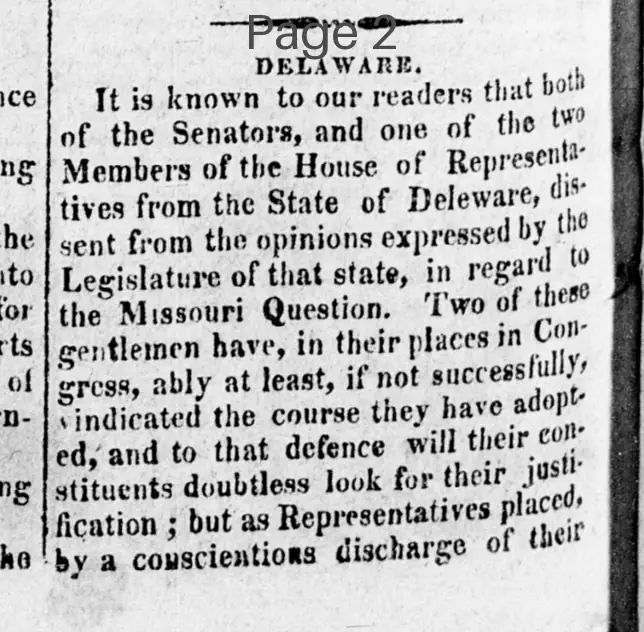
Delaware's U.S. Senators and one Representative explain in a February 12, 1820, letter their dissent from the state legislature's resolution supporting restrictions on slavery in Missouri's admission to the Union, arguing Congress lacks such power.
Merged-components note: Continuation of an article discussing the Delaware representatives' dissenting views on the Missouri question; the text flows directly from one component to the next, and the label is adjusted from 'story' to 'domestic_news' to better reflect the political news content.
Clippings
1 of 2
OCR Quality
Full Text
duty, in the responsible and unpleasant attitude of disobeying the expressed will of their constituents, on a question of great moment, we deem it but just to their motives known. It is with pleasure we afford them every facility in making their motives known. It is with pleasure, therefore, that we insert the following letter, a copy of which has been put into our hands:
Nat. Intel.
Washington, February 12, 1820.
House of Representatives of the state of Delaware.
Sir: We have received a copy of the resolution passed by the Senate and House of Representatives of the state of Delaware, on 15th Jan. last, declaring. "That it is in the opinion of the General Assembly, the constitutional right of the United States, in Congress assembled, to enact and establish as one of the conditions for the admission of a new state into the Union a provision which shall effectually prevent the further introduction of slavery into such state: and that a due regard to the true interests of such state as well as of the other states, requires that the same should be done."
That expression of the opinion of the legislature, upon the important question now under discussion in Congress, connected with the proposed admission of Missouri, as a new state, into the Union, has been considered, with all that deference and respectful attention to which it is justly entitled. The most deliberate examination of the subject, connected with the constitution of the United States and the treaty of cession by which that territory was acquired, has resulted in a sincere and firm conviction in our minds, that Congress does not possess the power to impose such a restriction upon the people of Missouri, in the formation of their state constitution. It would certainly be more gratifying to us to vote on this or any other question conformably to the opinion of the legislature, if we could do so consistently with a conscientious discharge of duty; but under our present convictions that it is not in our power in this instance, we trust that the legislature, in their candour, will duly appreciate our motives in the discharge of a painful duty, and that we shall stand excused for expressing an opinion upon the subject different from that stated in the resolution.
We have the honor to be, very respectfully, sir, your most obedient servants,
N. VANDYKE,
O. HORSEY.
L. McLANE.
Caleb Rodney, Esq. Speaker of the Senate of the state of Delaware.
What sub-type of article is it?
What keywords are associated?
What entities or persons were involved?
Where did it happen?
Domestic News Details
Primary Location
Washington
Event Date
February 12, 1820
Key Persons
Outcome
dissenting opinion expressed, seeking understanding from legislature for differing view on congressional power over slavery in missouri.
Event Details
Delaware's federal representatives respond to state legislature's January 15, 1820, resolution supporting slavery restrictions for Missouri's statehood, asserting Congress lacks authority to impose such conditions based on U.S. Constitution and cession treaty.