Thank you for visiting SNEWPapers!
Sign up free
Midland Cooperator
Minneapolis, Hennepin County, Minnesota
What is this article about?
The Committee of Review submits revised by-laws for Midland Cooperative Wholesale, clarifying rules on director qualifications, vacancies, powers, nepotism, and committee duties. Includes proposals for redistricting into 11 districts and a map of territories in Minnesota and Wisconsin. Annual meeting on June 10 for approval.
Merged-components note: Merged image (likely the map referenced in text) with the story due to spatial overlap in bounding boxes.
Clipping
OCR Quality
Full Text
Submits Revised
Midland By-Laws
A completely revised set of Midland by-laws will be submitted by the Committee of Review for approval of the delegates at the Midland Cooperative Wholesale annual meeting June 10.
The revision was carried out by the Committee in accordance with instructions given at the 1940 Midland annual meeting.
For the most part the changes consist in clarifying parts of the existing by-laws and in arranging a better grouping of the subjects dealt with.
Main Changes Explained
Principal changes or additions in the proposed by-laws are:
Qualifying for Director. ARTICLE III. Section 1. provides that "persons elected to the Board of Directors shall be notified of their election within two days following the annual meeting at which they were elected and shall file with the secretary a written statement of acceptance within ten days following election, and upon failure to file such a written statement the remaining members of the board may declare the office vacant and fill such vacancy in the manner hereinafter provided."
The reason for this, the Committee of Review explains, is that if a person should be elected and then never attend board meetings the only way that director's office could be declared vacant under the old by-laws is by holding a special election to remove such director and elect a successor.
Filling Vacancies on the Board. ARTICLE III, Section 2, provides that vacancies on the board of directors shall be filled by the board but says, in addition:
The district in which such a vacancy occurs may nominate a person to fill the vacancy and submit such nomination to the board.
The Committee points out that under the law under which Midland is organized there is no provision by which a district can actually elect a director of the wholesale. That must be done by all of the stockholders (local cooperatives). It follows, therefore, that a district could not be given that authority in the case of a vacancy. It can be generally accepted, however, that the board will follow out the wishes of the districts in such a matter.
Powers and Duties of Directors. ARTICLE IV, Section 1. provides that the board of directors shall manage the business and affairs of the wholesale and make all necessary rules and regulations, and shall establish and interpret policies. It gives them the same right as before to employ and dismiss a general manager and in addition the right to employ a direct representative to be known as "Comptroller."
The General Manager. Section 2 of Article IV deals with the powers of the general manager, who shall have such power and authority as the board may delegate to him, including the authority to employ and dismiss all employees except the comptroller and to name an assistant manager and department heads with the advice and approval of the board.
Nepotism. Section 3 of ARTICLE IV defines more clearly than at present which relatives of directors shall be barred from employment by the wholesale and provides that if a person should be employed by Midland BEFORE one of his or her relatives is elected to the board, that person need not resign his position.
Committee of Review. This committee is dealt with in ARTICLE VIII of the revised by-laws. This article provides for the election of the Committee of Review (one from each district) at the district meetings held just before the Midland annual meeting, the committeemen to take office on July 1 each year for one year. (The present Committee, elected last December, would hold office until June 30, 1942.)
Who Is Eligible?
Eligible for election to the Committee are members of local Midland-affiliated cooperatives who are not employees or directors of either the wholesale or the local co-op.
Duties of the Committee of Review:
1. To examine the records of Midland membership and board meetings and report to the membership whether duties and responsibilities of the various bodies and their officers have been properly carried out.
2. To receive and initiate resolutions or amendments to the articles and by-laws for consideration by the membership in district and annual meetings.
3. To recommend to the stockholders when they deem necessary and expedient a redistricting of Midland's trade territory.
Setting up of Districts. The present articles and by-laws, although referring to districts, do not provide any specific method for setting up districts, and in absence of such a provision there may be a lack of authority. The proposed revised by-laws, therefore, provide this authority in ARTICLE IX.
The Committee of Review was asked to prepare a uniform set of by-laws for the districts but it was decided that because of different conditions in different districts, this would be quite difficult. The Committee recommended, therefore, that each district draw up its own by-laws, taking care to prevent any conflict with the by-laws of the wholesale.
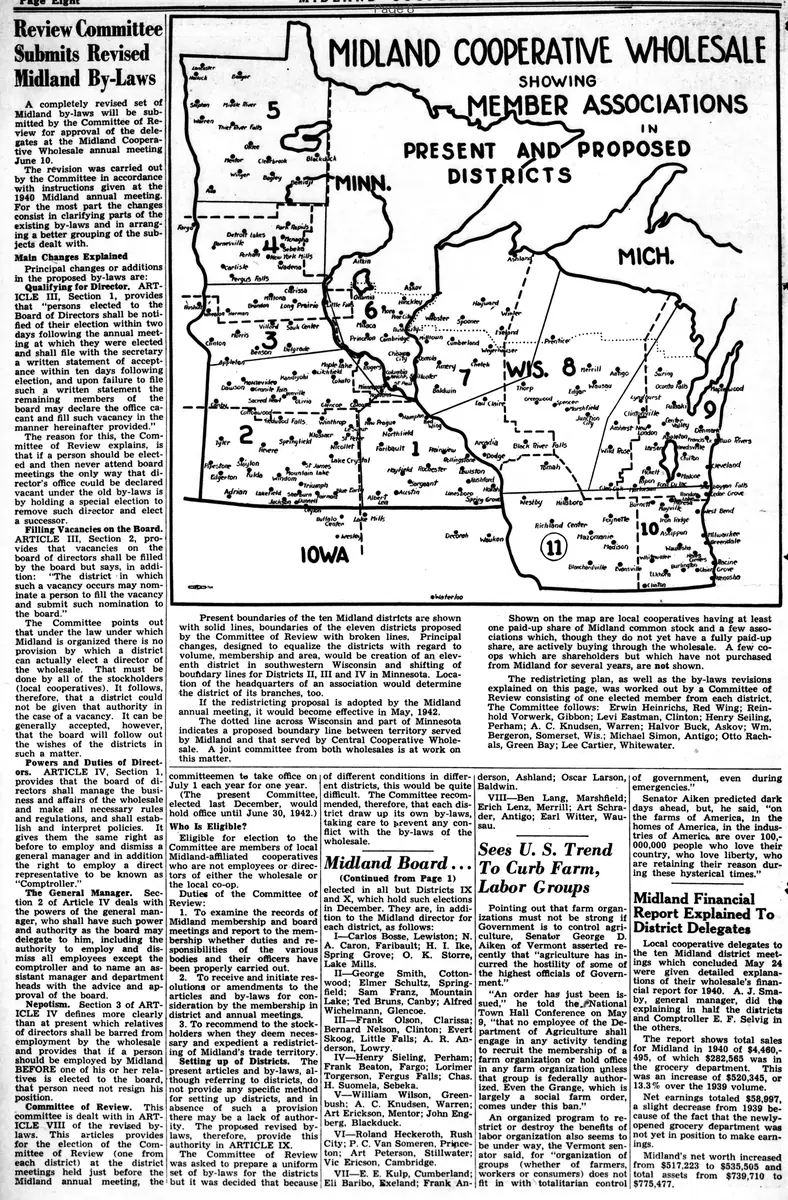
Present boundaries of the ten Midland districts are shown with solid lines, boundaries of the eleven districts proposed by the Committee of Review with broken lines. Principal changes, designed to equalize the districts with regard to volume, membership and area, would be creation of an eleventh district in southwestern Wisconsin and shifting of boundary lines for Districts II, III and IV in Minnesota. Location of the headquarters of an association would determine the district of its branches, too.
If the redistricting proposal is adopted by the Midland annual meeting, it would become effective in May, 1942.
The dotted line across Wisconsin and part of Minnesota indicates a proposed boundary line between territory served by Midland and that served by Central Cooperative Wholesale. A joint committee from both wholesales is at work on this matter.
Shown on the map are local cooperatives having at least one paid-up share of Midland common stock and a few associations which, though they do not yet have a fully paid-up share, are actively buying through the wholesale. A few co-ops which are shareholders but which have not purchased from Midland for several years, are not shown.
The redistricting plan, as well as the by-laws revisions explained on this page, was worked out by a Committee of Review consisting of one elected member from each district.
The Committee follows: Erwin Heinrichs, Red Wing; Reinhold Vorwerk, Gibbon; Levi Eastman, Clinton; Henry Seiling, Perham; A. C. Knudsen, Warren; Halvor Buck, Askov; Wm. Bergeron, Somerset, Wis.; Michael Simon, Antigo; Otto Rachals, Green Bay; Lee Cartier, Whitewater.
What sub-type of article is it?
What themes does it cover?
What keywords are associated?
What entities or persons were involved?
Where did it happen?
Story Details
Key Persons
Location
Midland Districts In Minnesota And Wisconsin
Event Date
June 10
Story Details
The Committee of Review submits revised by-laws clarifying director qualifications, vacancy filling, board powers, general manager duties, nepotism rules, and committee elections and duties. Proposes redistricting to 11 districts for equalization, effective May 1942 if approved at annual meeting.