Thank you for visiting SNEWPapers!
Sign up free
Editorial
January 24, 1843
The Madisonian
Washington, District Of Columbia
What is this article about?
Editorial defends the proposed Exchequer plan against Mr. Marshall's criticisms, arguing it is not a Government Bank, aligns with Mr. Webster's views on constitutional federal powers, and does not require state assent for essential functions.
Clipping
OCR Quality
98%
Excellent
Full Text
MR. MARSHALL:
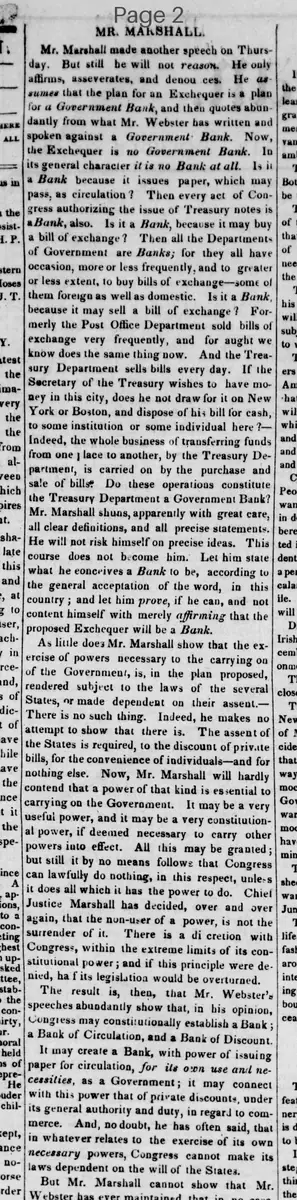
Mr. Marshall made another speech on Thursday. But still he will not reason. He only affirms, asseverates, and denounces. He assumes that the plan for an Exchequer is a plan for a Government Bank, and then quotes abundantly from what Mr. Webster has written and spoken against a Government Bank. Now the Exchequer is no Government Bank. In its general character it is no Bank at all. Is it a Bank because it issues paper, which may pass as circulation? Then every act of Congress authorizing the issue of Treasury notes is a Bank, also. Is it a Bank, because it may buy a bill of exchange? Then all the Departments of Government are Banks; for they all have occasion, more or less frequently, and to greater or less extent, to buy bills of exchange—some of them foreign as well as domestic. Is it a Bank because it may sell a bill of exchange? Formerly the Post Office Department sold bills of exchange very frequently, and for aught we know does the same thing now. And the Treasury Department sells bills every day. If the Secretary of the Treasury wishes to have money in this city, does he not draw for it on New York or Boston, and dispose of his bill for cash, to some institution or some individual here?
Indeed, the whole business of transferring funds from one place to another, by the Treasury Department, is carried on by the purchase and sale of bills. Do these operations constitute the Treasury Department a Government Bank?
Mr. Marshall shuns, apparently with great care, all clear definitions, and all precise statements. He will not risk himself on precise ideas. This course does not become him. Let him state what he conceives a Bank to be, according to the general acceptation of the word, in this country; and let him prove, if he can, and not content himself with merely affirming that the proposed Exchequer will be a Bank.
As little does Mr. Marshall show that the exercise of powers necessary to the carrying on of the Government, is, in the plan proposed, rendered subject to the laws of the several States, or made dependent on their assent. There is no such thing. Indeed, he makes no attempt to show that there is. The assent of the States is required, to the discount of private bills, for the convenience of individuals—and for nothing else. Now, Mr. Marshall will hardly contend that a power of that kind is essential to carrying on the Government. It may be a very useful power, and it may be a very constitutional power, if deemed necessary to carry other powers into effect. All this may be granted; but still it by no means follows that Congress can lawfully do nothing, in this respect, unless it does all which it has the power to do. Chief Justice Marshall has decided, over and over again, that the non-user of a power, is not the surrender of it. There is a discretion with Congress, within the extreme limits of its constitutional power; and if this principle were denied, half its legislation would be overturned.
The result is, then, that Mr. Webster's speeches abundantly show that, in his opinion, Congress may constitutionally establish a Bank; a Bank of Circulation, and a Bank of Discount. It may create a Bank, with power of issuing paper for circulation, for its own use and necessities, as a Government; it may connect with this power that of private discounts, under its general authority and duty, in regard to commerce. And, no doubt, he has often said, that in whatever relates to the exercise of its own necessary powers, Congress cannot make its laws dependent on the will of the States.
But Mr. Marshall cannot show that Mr. Webster has ever maintained, that in no case, and in regard to no subject, can a law of Congress require the assent of the States. Mr. Marshall himself could not have been of that opinion, when he voted for the Distribution bill. Nor can he show that Mr. Webster ever maintained, that forbearing to exercise a known power, on a given occasion, amounted to a relinquishment of that power.
Questions of this nature are somewhat complicated. They are not to be settled by declamation, personal commendation, or personal reproach. If Mr. Marshall would do honor to the great name he bears, let him not content himself with raising a storm, an agitation of the elements, which, when it subsides, leaves everything as it found it, except that the high roads are broken up, the banks of the rivers washed away, and the landmarks obliterated or confounded. Let him not be afraid to bring his opinions to the test of logic, of learning, of law, of precise ideas, and of a thorough understanding of the Constitution. These are the qualities which distinguished his immortal relative; and let not the world say,
"Stat nominis umbra."
Mr. Marshall made another speech on Thursday. But still he will not reason. He only affirms, asseverates, and denounces. He assumes that the plan for an Exchequer is a plan for a Government Bank, and then quotes abundantly from what Mr. Webster has written and spoken against a Government Bank. Now the Exchequer is no Government Bank. In its general character it is no Bank at all. Is it a Bank because it issues paper, which may pass as circulation? Then every act of Congress authorizing the issue of Treasury notes is a Bank, also. Is it a Bank, because it may buy a bill of exchange? Then all the Departments of Government are Banks; for they all have occasion, more or less frequently, and to greater or less extent, to buy bills of exchange—some of them foreign as well as domestic. Is it a Bank because it may sell a bill of exchange? Formerly the Post Office Department sold bills of exchange very frequently, and for aught we know does the same thing now. And the Treasury Department sells bills every day. If the Secretary of the Treasury wishes to have money in this city, does he not draw for it on New York or Boston, and dispose of his bill for cash, to some institution or some individual here?
Indeed, the whole business of transferring funds from one place to another, by the Treasury Department, is carried on by the purchase and sale of bills. Do these operations constitute the Treasury Department a Government Bank?
Mr. Marshall shuns, apparently with great care, all clear definitions, and all precise statements. He will not risk himself on precise ideas. This course does not become him. Let him state what he conceives a Bank to be, according to the general acceptation of the word, in this country; and let him prove, if he can, and not content himself with merely affirming that the proposed Exchequer will be a Bank.
As little does Mr. Marshall show that the exercise of powers necessary to the carrying on of the Government, is, in the plan proposed, rendered subject to the laws of the several States, or made dependent on their assent. There is no such thing. Indeed, he makes no attempt to show that there is. The assent of the States is required, to the discount of private bills, for the convenience of individuals—and for nothing else. Now, Mr. Marshall will hardly contend that a power of that kind is essential to carrying on the Government. It may be a very useful power, and it may be a very constitutional power, if deemed necessary to carry other powers into effect. All this may be granted; but still it by no means follows that Congress can lawfully do nothing, in this respect, unless it does all which it has the power to do. Chief Justice Marshall has decided, over and over again, that the non-user of a power, is not the surrender of it. There is a discretion with Congress, within the extreme limits of its constitutional power; and if this principle were denied, half its legislation would be overturned.
The result is, then, that Mr. Webster's speeches abundantly show that, in his opinion, Congress may constitutionally establish a Bank; a Bank of Circulation, and a Bank of Discount. It may create a Bank, with power of issuing paper for circulation, for its own use and necessities, as a Government; it may connect with this power that of private discounts, under its general authority and duty, in regard to commerce. And, no doubt, he has often said, that in whatever relates to the exercise of its own necessary powers, Congress cannot make its laws dependent on the will of the States.
But Mr. Marshall cannot show that Mr. Webster has ever maintained, that in no case, and in regard to no subject, can a law of Congress require the assent of the States. Mr. Marshall himself could not have been of that opinion, when he voted for the Distribution bill. Nor can he show that Mr. Webster ever maintained, that forbearing to exercise a known power, on a given occasion, amounted to a relinquishment of that power.
Questions of this nature are somewhat complicated. They are not to be settled by declamation, personal commendation, or personal reproach. If Mr. Marshall would do honor to the great name he bears, let him not content himself with raising a storm, an agitation of the elements, which, when it subsides, leaves everything as it found it, except that the high roads are broken up, the banks of the rivers washed away, and the landmarks obliterated or confounded. Let him not be afraid to bring his opinions to the test of logic, of learning, of law, of precise ideas, and of a thorough understanding of the Constitution. These are the qualities which distinguished his immortal relative; and let not the world say,
"Stat nominis umbra."
What sub-type of article is it?
Economic Policy
Constitutional
Partisan Politics
What keywords are associated?
Exchequer Plan
Government Bank
Mr Webster
Constitutional Powers
State Assent
Federal Authority
Treasury Operations
What entities or persons were involved?
Mr. Marshall
Mr. Webster
Chief Justice Marshall
Congress
States
Editorial Details
Primary Topic
Defense Of Exchequer Plan Against Claims Of Being A Government Bank
Stance / Tone
Critical Of Mr. Marshall And Supportive Of Exchequer And Mr. Webster's Views
Key Figures
Mr. Marshall
Mr. Webster
Chief Justice Marshall
Congress
States
Key Arguments
Exchequer Is Not A Government Bank As It Does Not Fit Standard Definitions
Government Operations Like Issuing Notes Or Buying Bills Do Not Constitute Banking
State Assent Required Only For Private Discounts, Not Essential Government Powers
Congress Has Discretion In Exercising Constitutional Powers Without Full Use
Mr. Webster Supports Constitutional Federal Bank For Circulation And Discounts
Federal Laws On Necessary Powers Cannot Depend On State Will