Thank you for visiting SNEWPapers!
Sign up free
Story
November 30, 1830
Phenix Gazette
Alexandria, Virginia
What is this article about?
Account of a large procession in New York on Nov. 26 celebrating French revolutionary events, with participants from trades, military, and societies marching along Broadway to Washington Square, where ceremonies ended in platform collapse and mob disruption. (218 characters)
Clipping
OCR Quality
95%
Excellent
Full Text
THE CELEBRATION
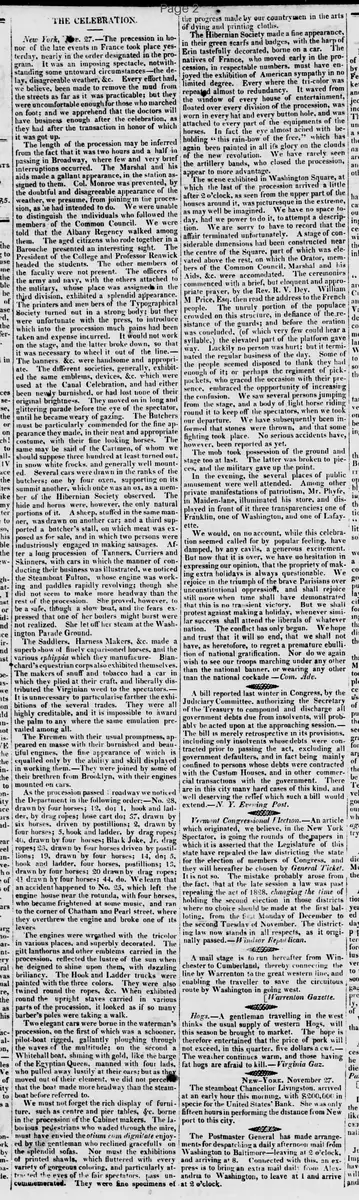
New York, Nov. 27.--The procession in honor of the late events in France took place yesterday, nearly in the order designated in the program. It was an imposing spectacle, notwithstanding some untoward circumstances--the delay, disagreeable weather, &c. Every effort had, we believe, been made to remove the mud from the streets as far as it was practicable; but they were uncomfortable enough for those who marched on foot; and we apprehend that the doctors will have business enough after the celebration, as they had after the transaction in honor of which it was got up.
The length of the procession may be inferred from the fact that it was two hours and a half in passing in Broadway, where few and very brief interruptions occurred. The Marshal and his aids made a gallant appearance, in the station assigned to them. Col. Monroe was prevented, by the doubtful and disagreeable appearance of the weather, we presume, from joining in the procession, as he had intended to do. We were unable to distinguish the individuals who followed the members of the Common Council. We were told that the Albany Regency walked among them. The aged citizens who rode together in a Barouche presented an interesting sight. The President of the College and Professor Renwick headed the students. The other members of the faculty were not present. The officers of the army and navy, with the others attached to the military, whose place was assigned in the third division, exhibited a splendid appearance.
The printers and members of the Typographical Society turned out in a strong body; but they were unfortunate with the press, to introduce which into the procession much pains had been taken and expense incurred. It would not work on the stage, and the latter broke down, so that it was necessary to wheel it out of the line.--The banners, &c. were handsome and appropriate. The different societies, generally, exhibited the same emblems, devices, &c. which were used at the Capitol Celebration, and had either been newly burnished, or had lost none of their original brightness. They moved on in long and glittering parade before the eye of the spectator, until he became weary of gazing. The Butchers must be particularly commended for the fine appearance they made, in their neat and appropriate costume, with their fine looking horses. The same may be said of the Cartmen, of whom we should suppose three hundred at least turned out, in snow white frocks, and generally well mounted. Several cars were drawn in the ranks of the butchers; one by four oxen, supporting on its summit another, which once was an ox, as a member of the Hibernian Society observed. The hide and horns were, however, the only natural portions of it. A sheep, stuffed in the same manner, was drawn on another car; and a third supported a butcher's stall, on which meat was exposed as for sale, and in which two persons were industriously engaged in making sausages.
After a long procession of Tanners, Curriers and Skinners, with cars in which the manner of conducting their business was illustrated, we noticed the Steamboat Fulton, whose engine was working and paddles rapidly revolving; though she did not seem to make more headway than the rest of the procession. She proved, however, to be a safe, though a slow boat, and the fears expressed that one of her boilers might burst were not realized. She let off her steam at the Washington Parade Ground.
The Saddlers, Harness Makers, &c. made a superb show of finely caparisoned horses, and the various ephippia which they manufacture--Blanchard's equestrian corps also exhibited themselves.
The makers of snuff and tobacco had a car in which they plied at their craft, and liberally distributed the Virginian weed to the spectators.--It is unnecessary to particularise farther the exhibitions of the several trades. They were all highly creditable, and it is impossible to award the palm to any where the same emulation prevailed among all.
The Firemen with their usual promptness, appeared en masse with their burnished and beautiful engines, the fine appearance of which is equalled only by the ability and skill displayed in working them.--They were joined by some of their brethren from Brooklyn, with their engines mounted on cars.
As the procession passed Broadway we noticed the Department in the following order:--No. 28, drawn by four horses; 12, do; 1, hook and ladder, by drag ropes; hose cart do; 37, drawn by six horses, driven by postillions; 2, drawn by four horses; 5, hook and ladder, by drag ropes; 40, drawn by four horses; Black Joke, Jr. drag ropes; 28, drawn by four horses driven by postillions; 19, drawn by four horses; 14, do; 5. hook and ladder, four horses, postillions; 18, drawn by four horses; 20 drawn by drag ropes; 41 drawn by four horses; 44, do. We learn that an accident happened to No. 25, which left the engine house near the rotunda, with four horses, who became frightened at some music, and ran to the corner of Chatham and Pearl street, where they overthrew the engine and broke one of its levers
The engines were wreathed with the tricolor in various places, and superbly decorated. The gilt lanthorns and other emblems carried in the procession, reflected the lustre of the sun when he deigned to shine upon them, with dazzling brilliancy. The Hook and Ladder trucks were painted with the three colors. They were also twined round the ropes, &c. When exhibited round the upright staves carried in various parts of the procession, it looked as if so many barber's poles were taking a walk.
Two elegant cars were borne in the waterman's procession, on the first of which was a schooner, pilot-boat rigged, gallantly ploughing through the waves of the multitude; on the second a Whitehall boat, shining with gold, like the barge of the Egyptian Queen, manned with four lads, who pulled away lustily at their oars; but as they moved out of their element, we did not percei that the boat made more headway than the steamboat before referred to.
We must not forget the rich display of furniture, such as centre and pier tables, &c. borne in the procession of the Cabinet makers. The laborious pedestrians who waded through the mire, must have envied the otium cum dignitate enjoyed by the gentleman who reclined gracefully on the splendid sofas. Nor must the exhibitions of printed shawls, which fluttered with every variety of gorgeous coloring, and particularly attracted the eyes of the fair spectators, pass uncommemorated. They were fine specimens of the progress made by our countrymen in the arts of dying and printing cloths.
The Hibernian Society made a fine appearance, in their green scarfs and badges, with the harp of Erin tastefully decorated, borne on a car. The natives of France, who moved early in the procession, in respectable numbers, must have enjoyed the exhibition of American sympathy in no limited degree. Every where the tri-color was repeated almost to redundancy. It waved from the window of every house of entertainment, floated over every division of the procession, was worn in every hat and every button hole, and was attached to every part of the equipments of the horses. In fact the eye almost ached with beholding "this rain-bow of the free," which has again been painted in all its glory on the clouds of the new revolution. We have rarely seen the artillery bands, who closed the procession, appear to more advantage.
The scene exhibited in Washington Square, at which the last of the procession arrived a little after 2 o'clock, as seen from the upper part of the houses around it, was picturesque in the extreme, as may well be imagined. We have no space to-day, had we power to do it, to attempt a description. We are sorry to have to record that the affair terminated unfortunately. A stage of considerable dimensions had been constructed near the centre of the Square, part of which was elevated above the rest, on which the Orator, members of the Common Council, Marshal and his Aids, &c. were accommodated. The ceremonies commenced with a brief, but eloquent and appropriate prayer, by the Rev. R. V. Dey. William M Price, Esq. then read the address to the French people. The unruly portion of the populace crowded on this structure, in defiance of the resistance of the guards; and before the oration was concluded, (of which very few could hear a syllable,) the elevated part of the platform gave way.
Luckily no person was hurt; but it terminated the regular business of the day. Some of the people seemed disposed to think they had enough of it; or perhaps the regiment of pick-pockets, who graced the occasion with their presence, embraced the opportunity of increasing the confusion. We saw several persons jumping from the stage, and a body of light horse riding round it to keep off the spectators, when we took our departure. We have subsequently been informed that stones were thrown, and that some fighting took place. No serious accidents have, however, been reported as yet.
The mob took possession of the ground and stage too at last. The latter was broken to pieces, and the military gave up the point.
In the evening, the several places of public amusement were well attended. Among other private manifestations of patriotism, Mr. Phyfe, in Maiden-lane, illuminated his store, and displayed in front of it three transparencies; one of Franklin, one of Washington, and one of Lafayette.
We would, on no account, while this celebration seemed called for by popular feeling, have damped, by any cavils, a generous excitement. But now that it is over, we have no hesitation in expressing our opinion, that the propriety of making extra holidays is always questionable. We rejoice in the triumph of the brave Parisians over unconstitutional oppression, and shall rejoice still more when time shall have demonstrated that this is no transient victory. But we shall protest against making a holiday, whenever similar success shall attend the liberals of whatever nation. The conflict has only begun. We hope and trust that it will so end, that we shall not have, as heretofore, to regret a premature ebullition of national gratification. Nor do we again wish to see our troops marching under any other than the national banner, or wearing any other than the national cockade--Com. Adv.
New York, Nov. 27.--The procession in honor of the late events in France took place yesterday, nearly in the order designated in the program. It was an imposing spectacle, notwithstanding some untoward circumstances--the delay, disagreeable weather, &c. Every effort had, we believe, been made to remove the mud from the streets as far as it was practicable; but they were uncomfortable enough for those who marched on foot; and we apprehend that the doctors will have business enough after the celebration, as they had after the transaction in honor of which it was got up.
The length of the procession may be inferred from the fact that it was two hours and a half in passing in Broadway, where few and very brief interruptions occurred. The Marshal and his aids made a gallant appearance, in the station assigned to them. Col. Monroe was prevented, by the doubtful and disagreeable appearance of the weather, we presume, from joining in the procession, as he had intended to do. We were unable to distinguish the individuals who followed the members of the Common Council. We were told that the Albany Regency walked among them. The aged citizens who rode together in a Barouche presented an interesting sight. The President of the College and Professor Renwick headed the students. The other members of the faculty were not present. The officers of the army and navy, with the others attached to the military, whose place was assigned in the third division, exhibited a splendid appearance.
The printers and members of the Typographical Society turned out in a strong body; but they were unfortunate with the press, to introduce which into the procession much pains had been taken and expense incurred. It would not work on the stage, and the latter broke down, so that it was necessary to wheel it out of the line.--The banners, &c. were handsome and appropriate. The different societies, generally, exhibited the same emblems, devices, &c. which were used at the Capitol Celebration, and had either been newly burnished, or had lost none of their original brightness. They moved on in long and glittering parade before the eye of the spectator, until he became weary of gazing. The Butchers must be particularly commended for the fine appearance they made, in their neat and appropriate costume, with their fine looking horses. The same may be said of the Cartmen, of whom we should suppose three hundred at least turned out, in snow white frocks, and generally well mounted. Several cars were drawn in the ranks of the butchers; one by four oxen, supporting on its summit another, which once was an ox, as a member of the Hibernian Society observed. The hide and horns were, however, the only natural portions of it. A sheep, stuffed in the same manner, was drawn on another car; and a third supported a butcher's stall, on which meat was exposed as for sale, and in which two persons were industriously engaged in making sausages.
After a long procession of Tanners, Curriers and Skinners, with cars in which the manner of conducting their business was illustrated, we noticed the Steamboat Fulton, whose engine was working and paddles rapidly revolving; though she did not seem to make more headway than the rest of the procession. She proved, however, to be a safe, though a slow boat, and the fears expressed that one of her boilers might burst were not realized. She let off her steam at the Washington Parade Ground.
The Saddlers, Harness Makers, &c. made a superb show of finely caparisoned horses, and the various ephippia which they manufacture--Blanchard's equestrian corps also exhibited themselves.
The makers of snuff and tobacco had a car in which they plied at their craft, and liberally distributed the Virginian weed to the spectators.--It is unnecessary to particularise farther the exhibitions of the several trades. They were all highly creditable, and it is impossible to award the palm to any where the same emulation prevailed among all.
The Firemen with their usual promptness, appeared en masse with their burnished and beautiful engines, the fine appearance of which is equalled only by the ability and skill displayed in working them.--They were joined by some of their brethren from Brooklyn, with their engines mounted on cars.
As the procession passed Broadway we noticed the Department in the following order:--No. 28, drawn by four horses; 12, do; 1, hook and ladder, by drag ropes; hose cart do; 37, drawn by six horses, driven by postillions; 2, drawn by four horses; 5, hook and ladder, by drag ropes; 40, drawn by four horses; Black Joke, Jr. drag ropes; 28, drawn by four horses driven by postillions; 19, drawn by four horses; 14, do; 5. hook and ladder, four horses, postillions; 18, drawn by four horses; 20 drawn by drag ropes; 41 drawn by four horses; 44, do. We learn that an accident happened to No. 25, which left the engine house near the rotunda, with four horses, who became frightened at some music, and ran to the corner of Chatham and Pearl street, where they overthrew the engine and broke one of its levers
The engines were wreathed with the tricolor in various places, and superbly decorated. The gilt lanthorns and other emblems carried in the procession, reflected the lustre of the sun when he deigned to shine upon them, with dazzling brilliancy. The Hook and Ladder trucks were painted with the three colors. They were also twined round the ropes, &c. When exhibited round the upright staves carried in various parts of the procession, it looked as if so many barber's poles were taking a walk.
Two elegant cars were borne in the waterman's procession, on the first of which was a schooner, pilot-boat rigged, gallantly ploughing through the waves of the multitude; on the second a Whitehall boat, shining with gold, like the barge of the Egyptian Queen, manned with four lads, who pulled away lustily at their oars; but as they moved out of their element, we did not percei that the boat made more headway than the steamboat before referred to.
We must not forget the rich display of furniture, such as centre and pier tables, &c. borne in the procession of the Cabinet makers. The laborious pedestrians who waded through the mire, must have envied the otium cum dignitate enjoyed by the gentleman who reclined gracefully on the splendid sofas. Nor must the exhibitions of printed shawls, which fluttered with every variety of gorgeous coloring, and particularly attracted the eyes of the fair spectators, pass uncommemorated. They were fine specimens of the progress made by our countrymen in the arts of dying and printing cloths.
The Hibernian Society made a fine appearance, in their green scarfs and badges, with the harp of Erin tastefully decorated, borne on a car. The natives of France, who moved early in the procession, in respectable numbers, must have enjoyed the exhibition of American sympathy in no limited degree. Every where the tri-color was repeated almost to redundancy. It waved from the window of every house of entertainment, floated over every division of the procession, was worn in every hat and every button hole, and was attached to every part of the equipments of the horses. In fact the eye almost ached with beholding "this rain-bow of the free," which has again been painted in all its glory on the clouds of the new revolution. We have rarely seen the artillery bands, who closed the procession, appear to more advantage.
The scene exhibited in Washington Square, at which the last of the procession arrived a little after 2 o'clock, as seen from the upper part of the houses around it, was picturesque in the extreme, as may well be imagined. We have no space to-day, had we power to do it, to attempt a description. We are sorry to have to record that the affair terminated unfortunately. A stage of considerable dimensions had been constructed near the centre of the Square, part of which was elevated above the rest, on which the Orator, members of the Common Council, Marshal and his Aids, &c. were accommodated. The ceremonies commenced with a brief, but eloquent and appropriate prayer, by the Rev. R. V. Dey. William M Price, Esq. then read the address to the French people. The unruly portion of the populace crowded on this structure, in defiance of the resistance of the guards; and before the oration was concluded, (of which very few could hear a syllable,) the elevated part of the platform gave way.
Luckily no person was hurt; but it terminated the regular business of the day. Some of the people seemed disposed to think they had enough of it; or perhaps the regiment of pick-pockets, who graced the occasion with their presence, embraced the opportunity of increasing the confusion. We saw several persons jumping from the stage, and a body of light horse riding round it to keep off the spectators, when we took our departure. We have subsequently been informed that stones were thrown, and that some fighting took place. No serious accidents have, however, been reported as yet.
The mob took possession of the ground and stage too at last. The latter was broken to pieces, and the military gave up the point.
In the evening, the several places of public amusement were well attended. Among other private manifestations of patriotism, Mr. Phyfe, in Maiden-lane, illuminated his store, and displayed in front of it three transparencies; one of Franklin, one of Washington, and one of Lafayette.
We would, on no account, while this celebration seemed called for by popular feeling, have damped, by any cavils, a generous excitement. But now that it is over, we have no hesitation in expressing our opinion, that the propriety of making extra holidays is always questionable. We rejoice in the triumph of the brave Parisians over unconstitutional oppression, and shall rejoice still more when time shall have demonstrated that this is no transient victory. But we shall protest against making a holiday, whenever similar success shall attend the liberals of whatever nation. The conflict has only begun. We hope and trust that it will so end, that we shall not have, as heretofore, to regret a premature ebullition of national gratification. Nor do we again wish to see our troops marching under any other than the national banner, or wearing any other than the national cockade--Com. Adv.
What sub-type of article is it?
Historical Event
What themes does it cover?
Triumph
Justice
What keywords are associated?
New York Procession
French Revolution Celebration
Trades Parade
Firemen Engines
Platform Collapse
Washington Square
Tricolor Banners
What entities or persons were involved?
Col. Monroe
Professor Renwick
Rev. R. V. Dey
William M Price
Mr. Phyfe
Where did it happen?
New York, Broadway, Washington Square
Story Details
Key Persons
Col. Monroe
Professor Renwick
Rev. R. V. Dey
William M Price
Mr. Phyfe
Location
New York, Broadway, Washington Square
Event Date
November 26 (Procession, Article Dated November 27)
Story Details
Grand procession in New York honoring recent events in France, featuring various trades, military, societies, and firemen; ended in chaos when platform collapsed at Washington Square during oration.