Thank you for visiting SNEWPapers!
Sign up free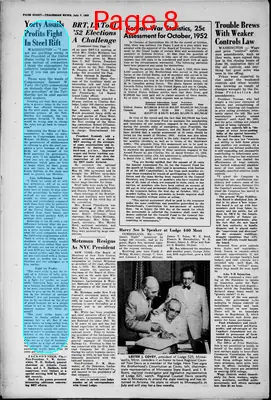
Story
July 7, 1952
Trainman News
Indianapolis, Marion County, Indiana
What is this article about?
Congressman Samuel W. Yorty defends President Truman's use of persuasion in the steel strike, criticizing steel companies' greed for an extra 50 cents per ton amid record profits and Korean War sacrifices, urging patriotism over selfishness.
Clipping

OCR Quality
98%
Excellent
Full Text
Yorty Assails Profits Fight In Steel Rift
WASHINGTON - "I cannot see anything wrong in the President of the United States trying to use persuasion instead of compulsion. I think the atmosphere for collective bargaining is better if you can use persuasion."
Those were the words of Congressman Samuel W. Yorty (D-Calif) commenting on demands that the "coercive procedure" of the Taft-Hartley Act be used against steel workers.
Pointing out that, thru persuasion, a greater delay in the steel strike was effected voluntarily by the steel union than the injunction process of the Taft-Hartley Act requires, the congressman declared, "I think it would be wrong now to change the rules and go back to compulsion."
Addressing the House of Representatives in reply to statements by Congressman Jesse P. Wolcott (R-Mich). who accused the government of stubbornness in refusing to give the steel companies a price increase of $5 or $5.50, per ton, instead of the $4.50 approved by government, Yorty said, "I am appalled, as I know you are, at some of the selfishness which goes on here at home while we have young men out there in the hills of Korea fighting in the slush and mud to protect our liberties."
Less Selfishness Needed
"I think we could all do with less selfishness. All of us need to search our consciences much more here at home; to stop some of the grumbling; to realize how well-off we are compared with people in other parts of the world, and particularly compared with those boys who by authority of acts. passed by the Congress of the United States have been ordered from their homes and into the armed services with or without their consent."
Referring to the 50 cents a ton difference between what the government was willing to approve as a price increase in steel and what the steel companies wanted, the California congressman asked, "Isn't it selfish to bring about a shutdown of desperately needed steel production rather than give up 50 cents per ton out of a price of over $100 per ton that is yielding record profits--and this while we are confronted with a menace not just to 'profits but to our liberties and our 'existence as a free nation."
Fight for Profits
"The steel' crisis is not the result of a defense of lofty principles by the steel companies. It is a fight for profits as usual while American boys are dying on a foreign battlefield. Wouldn't it be more consistent with patriotism to give up the 50 cents per ton in the interest of national defense? Are our precious liberties to be sacrificed on the altar of greed because we as a people refuse to act in the responsible, mature manner the times demand?
"The steel strike must, of course, be finally settled in a manner fair to all. But if one party insists on being unfair now, it may be that another will have to temporarily accept the unfairness in order to produce steel for defense of the free world. Such acceptance can be made honorably, not as a sign of weakness, but rather as a sign of strength, the strength that comes from patriotism worth more than 50 cents per ton."
WASHINGTON - "I cannot see anything wrong in the President of the United States trying to use persuasion instead of compulsion. I think the atmosphere for collective bargaining is better if you can use persuasion."
Those were the words of Congressman Samuel W. Yorty (D-Calif) commenting on demands that the "coercive procedure" of the Taft-Hartley Act be used against steel workers.
Pointing out that, thru persuasion, a greater delay in the steel strike was effected voluntarily by the steel union than the injunction process of the Taft-Hartley Act requires, the congressman declared, "I think it would be wrong now to change the rules and go back to compulsion."
Addressing the House of Representatives in reply to statements by Congressman Jesse P. Wolcott (R-Mich). who accused the government of stubbornness in refusing to give the steel companies a price increase of $5 or $5.50, per ton, instead of the $4.50 approved by government, Yorty said, "I am appalled, as I know you are, at some of the selfishness which goes on here at home while we have young men out there in the hills of Korea fighting in the slush and mud to protect our liberties."
Less Selfishness Needed
"I think we could all do with less selfishness. All of us need to search our consciences much more here at home; to stop some of the grumbling; to realize how well-off we are compared with people in other parts of the world, and particularly compared with those boys who by authority of acts. passed by the Congress of the United States have been ordered from their homes and into the armed services with or without their consent."
Referring to the 50 cents a ton difference between what the government was willing to approve as a price increase in steel and what the steel companies wanted, the California congressman asked, "Isn't it selfish to bring about a shutdown of desperately needed steel production rather than give up 50 cents per ton out of a price of over $100 per ton that is yielding record profits--and this while we are confronted with a menace not just to 'profits but to our liberties and our 'existence as a free nation."
Fight for Profits
"The steel' crisis is not the result of a defense of lofty principles by the steel companies. It is a fight for profits as usual while American boys are dying on a foreign battlefield. Wouldn't it be more consistent with patriotism to give up the 50 cents per ton in the interest of national defense? Are our precious liberties to be sacrificed on the altar of greed because we as a people refuse to act in the responsible, mature manner the times demand?
"The steel strike must, of course, be finally settled in a manner fair to all. But if one party insists on being unfair now, it may be that another will have to temporarily accept the unfairness in order to produce steel for defense of the free world. Such acceptance can be made honorably, not as a sign of weakness, but rather as a sign of strength, the strength that comes from patriotism worth more than 50 cents per ton."
What sub-type of article is it?
Historical Event
What themes does it cover?
Moral Virtue
Justice
Survival
What keywords are associated?
Steel Strike
Taft Hartley Act
Congressional Speech
Korean War
Profits Patriotism
Price Increase
What entities or persons were involved?
Samuel W. Yorty
Jesse P. Wolcott
Where did it happen?
Washington
Story Details
Key Persons
Samuel W. Yorty
Jesse P. Wolcott
Location
Washington
Story Details
Congressman Yorty argues against using Taft-Hartley Act compulsion on steel workers, praises persuasion for delaying strike, criticizes steel companies' profit demands over national defense needs during Korean War.