Thank you for visiting SNEWPapers!
Sign up free
Poem
December 18, 1788
The New York Journal, And Weekly Register
New York, New York County, New York
What is this article about?
A poem praising the virtue of friendship, invoking Homer and Virgil, envisioning a world ruled by peace and harmony without war or strife, signed G. E. from Gohen, Nov. 30, 1788.
Clipping
OCR Quality
95%
Excellent
Full Text
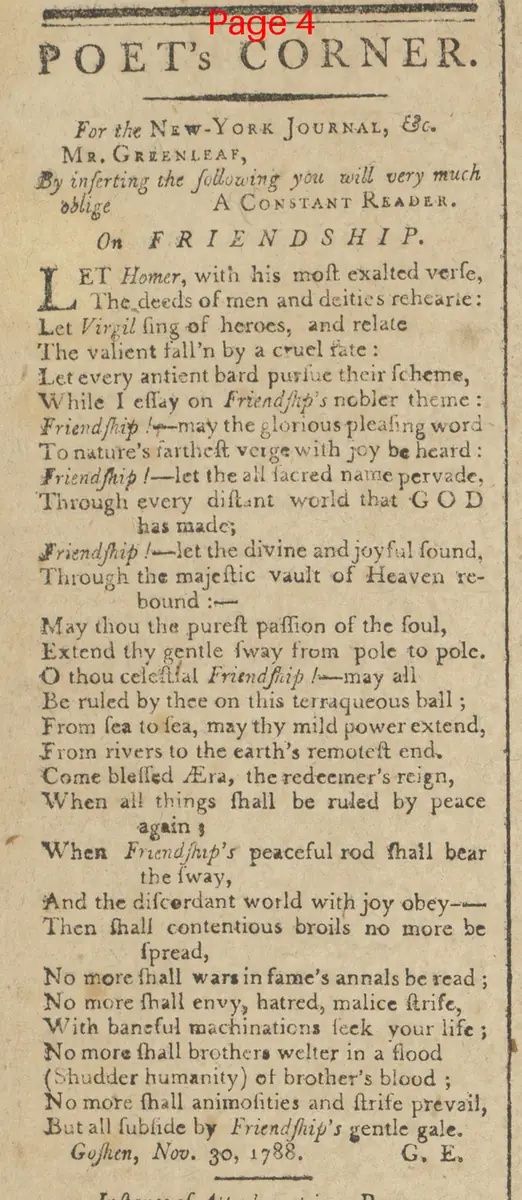
POET's CORNER.
For the New-York Journal, &c.
MR. GREENLEAF,
By inserting the following you will very much
oblige
A Constant Reader.
On FRIENDSHIP.
Let Homer, with his most exalted verse,
The deeds of men and deities rehearse:
Let Virgil sing of heroes, and relate
The valiant fall'n by a cruel fate:
Let every ancient bard pursue their scheme,
While I essay on Friendship's nobler theme:
Friendship!—may the glorious pleasing word
To nature's farthest verge with joy be heard:
Friendship!—let the all sacred name pervade
Through every distant world that GOD
has made:
Friendship!—let the divine and joyful sound
Through the majestic vault of Heaven rebound:
May thou the purest passion of the soul,
Extend thy gentle sway from pole to pole.
O thou celestial Friendship!—may all
Be ruled by thee on this terraqueous ball;
From sea to sea, may thy mild power extend,
From rivers to the earth's remotest end.
Come blessed ARA, the redeemer’s reign,
When all things shall be ruled by peace
again;
When Friendship's peaceful rod shall bear
the sway,
And the discordant world with joy obey—
Then shall contentious broils no more be
spread,
No more shall wars in fame's annals be read;
No more shall envy, hatred, malice strive
With baneful machinations seek your life;
No more shall brothers welter in a flood
(Shudder humanity) of brother's blood;
No more shall animosities and strife prevail,
But all subside by Friendship's gentle gale.
Gohen, Nov. 30, 1788.
G. E.
For the New-York Journal, &c.
MR. GREENLEAF,
By inserting the following you will very much
oblige
A Constant Reader.
On FRIENDSHIP.
Let Homer, with his most exalted verse,
The deeds of men and deities rehearse:
Let Virgil sing of heroes, and relate
The valiant fall'n by a cruel fate:
Let every ancient bard pursue their scheme,
While I essay on Friendship's nobler theme:
Friendship!—may the glorious pleasing word
To nature's farthest verge with joy be heard:
Friendship!—let the all sacred name pervade
Through every distant world that GOD
has made:
Friendship!—let the divine and joyful sound
Through the majestic vault of Heaven rebound:
May thou the purest passion of the soul,
Extend thy gentle sway from pole to pole.
O thou celestial Friendship!—may all
Be ruled by thee on this terraqueous ball;
From sea to sea, may thy mild power extend,
From rivers to the earth's remotest end.
Come blessed ARA, the redeemer’s reign,
When all things shall be ruled by peace
again;
When Friendship's peaceful rod shall bear
the sway,
And the discordant world with joy obey—
Then shall contentious broils no more be
spread,
No more shall wars in fame's annals be read;
No more shall envy, hatred, malice strive
With baneful machinations seek your life;
No more shall brothers welter in a flood
(Shudder humanity) of brother's blood;
No more shall animosities and strife prevail,
But all subside by Friendship's gentle gale.
Gohen, Nov. 30, 1788.
G. E.
What sub-type of article is it?
Ode
What themes does it cover?
Friendship
War Military
What keywords are associated?
Friendship
Peace
Homer
Virgil
War
Gohen
1788
What entities or persons were involved?
G. E.
Poem Details
Title
On Friendship.
Author
G. E.
Subject
Friendship
Form / Style
Rhymed Couplets
Key Lines
Let Homer, With His Most Exalted Verse,
The Deeds Of Men And Deities Rehearse:
Friendship!—May The Glorious Pleasing Word
To Nature's Farthest Verge With Joy Be Heard:
No More Shall Wars In Fame's Annals Be Read;
No More Shall Envy, Hatred, Malice Strive