Thank you for visiting SNEWPapers!
Sign up free
Literary
October 12, 1906
The Sisseton Weekly Standard
Sisseton, Roberts County, South Dakota
What is this article about?
In 'The Brangwyn Mystery,' Truscott manages his friend Billery's monthly drinking bouts discreetly. Billery improves and develops a romance with Belle Molloy in a rural parish. Truscott's editorial career thrives amid high society. He and his wife witness a fatal French quarrel and murder near their home, which remains unsolved despite searches.
Clipping
OCR Quality
95%
Excellent
Full Text
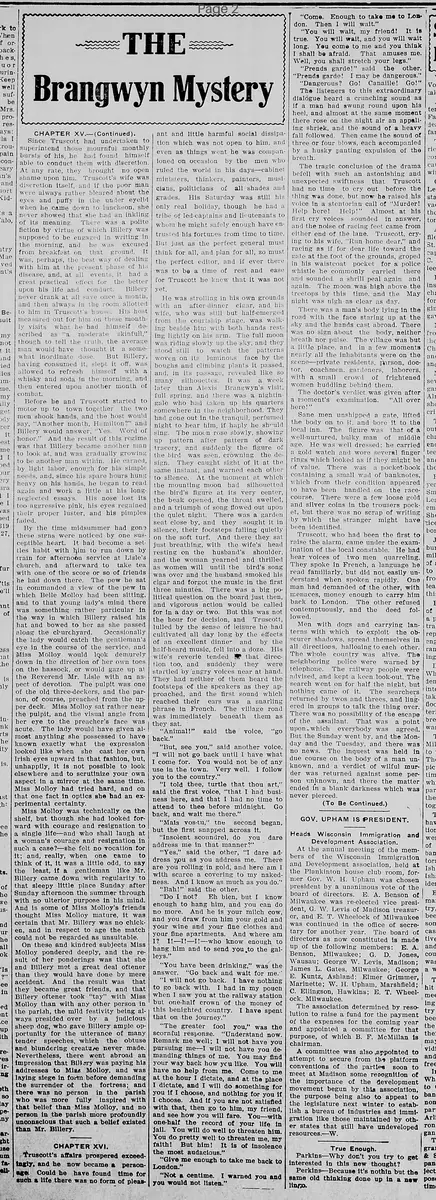
THE Brangwyn Mystery
Since Truscott had undertaken to superintend those mournful monthly bursts of his, he had found himself able to conduct them with discretion. At any rate, they brought no open shame upon him. Truscott's wife was discretion itself, and if the poor man were always rather bleared about the eyes and puffy in the under eyelid when he came down to luncheon, she never showed that she had an inkling of its meaning. There was a polite fiction by virtue of which Billery was supposed to be engaged in writing in the morning, and he was excused from breakfast on that ground. It was, perhaps, the best way of dealing with him at the present phase of his disease, and, at all events, it had a great practical effect for the better upon his life and conduct.
Billery never drank at all save once a month, and then always in the room allotted to him in Truscott's house. His host measured out for him on these monthly visits what he had himself described as "a moderate skinfull," though to tell the truth, the average man would have thought it a somewhat inordinate dose. But Billery, having consumed it, slept it off, was allowed to refresh himself with a whisky and soda in the morning, and then entered upon another month of combat.
Before he and Truscott started to motor up to town together the two men shook hands, and the host would say, "Another month, Hamilton?" and Billery would answer, "Yes. Word of honor." And the result of this regime was that Billery became another man to look at, and was gradually growing to be another man within. He earned, by light labor, enough for his simple needs, and, since his spare hours hung heavy on his hands, he began to read again and work a little at his long-neglected essays. His nose lost its too aggressive pink, his eyes regained their proper luster, and his pimples faded.
By the time midsummer had gone these signs were noticed by one susceptible heart. It had become a settled habit with him to run down by train for afternoon service at Lisle's church, and afterward to take tea with one of the score or so of friends he had down there. The pew he sat in commanded a view of the pew in which Belle Molloy had been sitting and to that young lady's mind there was something rather particular in the way in which Billery raised his hat and bowed to her as she passed along the churchyard. Occasionally the lady would catch the gentleman's eye in the course of the service, and Miss Molloy would look demurely down in the direction of her own toes on the hassock, or would gaze up at the Reverend Mr. Lisle with an aspect of devotion. The pulpit was one of the old three-deckers, and the parson, of course, preached from the upper deck. Miss Molloy sat rather near the pulpit, and the visual angle from her eye to the preacher's face was acute. The lady would have given almost anything she possessed to have known exactly what the expression looked like when she cast her own Irish eyes upward in that fashion, but, unhappily, it is not possible to look elsewhere and to scrutinize your own aspect in a mirror at the same time. Miss Molloy had tried hard, and on that one fact in optics she had an experimental certainty.
Miss Molloy was technically on the shelf, but though she had looked forward with courage and resignation to a single life--and who shall laugh at a woman's courage and resignation in such a case?--she felt no vocation for it; and, really, when one came to think of it, it was a little odd, to say the least, if a gentleman like Mr. Billery came down with regularity to that sleepy little place Sunday after Sunday afternoon the summer through with no ulterior purpose in his mind. And if some of Miss Molloy's friends thought Miss Molloy mature, it was certain that Mr. Billery was no chicken, and in respect to age the match could not be regarded as unsuitable.
On these and kindred subjects Miss Molloy pondered deeply, and the result of her ponderings was that she and Billery met a great deal oftener than they would have done by mere accident. And the result was that they became great friends, and that Billery oftener took "tay" with Miss Molloy than with any other person in the parish, the mild festivity being always presided over by a judicious sheep dog, who gave Billery ample opportunity for the utterance of many tender speeches, which the obtuse and blundering creature never made. Nevertheless, there went abroad an impression that Billery was paying his addresses to Miss Molloy, and was laying siege in form before demanding the surrender of the fortress; and there was no person in the parish who was more fully inspired with that belief than Miss Molloy, and no person in the parish more profoundly unconscious that such a belief existed than Mr. Billery.
CHAPTER XVI.
Truscott's affairs prospered exceedingly, and he now became a personage. Could he have found time for such a life there was no form of pleasure which was not open to him, and even as things went he was companioned on occasion by the men who ruled the world in his days--cabinet ministers, thinkers, painters, musicians, politicians of all shades and grades. His Saturday was still his only real holiday, though he had a tribe of led-captains and lieutenants to whom he might safely enough have entrusted his fortunes from time to time. But just as the perfect general must think for all, and plan for all, so must the perfect editor, and if ever there was to be a time of rest and ease for Truscott he knew that it was not yet.
He was strolling in his own grounds with an after-dinner cigar, and his wife, who was still but half-emerged from the courtship stage, was walking beside him with both hands resting lightly on his arm. The full moon was riding slowly up the sky, and they stood still to watch the patterns woven on its luminous face by the boughs and climbing plants it passed, and, in its passage, revealed like so many silhouettes. It was a week later than Alexis Brangwyn's visit, full spring, and there was a nightingale who had taken up his quarters somewhere in the neighborhood. They had gone out in the tranquil, perfumed night to hear him, if haply he should sing. The moon rose slowly, showing up pattern after pattern of dark tracery, and suddenly the figure of the bird was seen, crowning the design. They caught sight of it at the same instant, and warned each other to silence. At the moment at which the mounting moon had silhouetted the bird's figure at its very center, the beak opened, the throat swelled, and a triumph of song flowed out upon the quiet night. There was a garden seat close by, and they sought it in silence, their footsteps falling quietly on the soft turf. And there they sat just breathing, with the wife's head resting on the husband's shoulder, and the woman yearned and thrilled as women will until the bird's song was over and the husband smoked his cigar and forgot the music in the first three minutes. There was a big political question on the board just then, and vigorous action would be called for in a day or two. But this was not the hour for decision, and Truscott, lulled by the sense of leisure he had cultivated all day long by the effects of an excellent dinner and by the half-heard music, fell into a doze. His wife's reverie tended that direction too, and suddenly they were startled by angry voices near at hand. They had neither of them heard the footsteps of the speakers as they approached, and the first sound which reached their ears was a snarling phrase in French. The village road was immediately beneath them as they sat.
"Animal!" said the voice, "go back."
"But, see you," said another voice, "I will not go back until I have what I come for. You would not be of any use in the town. Very well. I follow you to the country."
"I told thee, turtle that thou art," said the first voice, "that I had business here, and that I had no time to attend to thee before midnight. Go back, and wait me there."
"Mais veux-tu," the second began but the first snapped across it.
"Insolent scoundrel, do you dare address me in that manner?"
"Yes," said the other, "I dare address you as you address me. There are you rolling in gold, and here am I with scarce a covering to my nakedness. And I know as much as you do."
"Bah!"
"Do I not? Eh bien, but I know enough to hang him, and you can do no more. And he is your milch cow, and you draw from him your gold and your wine and your fine clothes and your fine apartments. And where am I? I!--I!--I!--who know enough to hang him and to send you to the galleys."
"You have been drinking," was the answer. "Go back and wait for me."
"I will not go back. I have nothing to go back with. I had in my pouch when I saw you at the railway station but one-half crown of the money of this benighted country. I have spent that on the journey."
"The greater fool you," was the scornful response. "Understand now. Remark me well; I will not have you pursuing me. I will not have you demanding things of me. You may find your way back how you like. You will have no help from me. Come to me at the hour I dictate, and at the place I dictate, and I will do something for you if I choose, and nothing for you if I choose. And if you are not satisfied with that, then go to him, my friend, and see how you will fare. You--with one-half the record of your life in jail. You will do well to threaten him. You do pretty well to threaten me, my faith! But him! It is of insolence the most audacious."
"Give me enough to take me back to London."
"Not a centime. I warned you and you would not listen."
"Come. Enough to take me to London. Then I will wait."
"You will wait, my friend! It is true. You will wait, and you will wait long. You come to me and you think I shall be afraid. That amuses me. Well, you shall stretch your legs."
"Prends garde!" said the other. "Prends garde! I may be dangerous."
"Dangerous? Go! Canaille! Go!"
The listeners to this extraordinary dialogue heard a crunching sound as if a man had swung round upon his heel, and almost at the same moment there rose on the night air an appalling shriek, and the sound of a heavy fall followed. Then came the sound of three or four blows, each accompanied by a husky panting expulsion of the breath.
The tragic conclusion of the drama befell with such an astonishing and unexpected swiftness that Truscott had no time to cry out before the thing was done, but now he raised his voice in a stentorian call of "Murder! Help here! Help!" Almost at his first cry voices sounded in answer, and the noise of racing feet came from either end of the lane. Truscott, crying to his wife, "Run home dear," and racing as if for dear life toward the gate at the foot of the grounds, groped in his waistcoat pocket for a police whistle he commonly carried there and sounded a shrill peal again and again. The moon was high above the treetops by this time, and the May night was nigh as clear as day.
There was a man's body lying in the road with the face staring up at the sky and the hands cast abroad. There was no sign about the body, neither breath nor pulse. The village was but a little place, and in a few moments nearly all the inhabitants were on the scene--private residents, parson, doctor, coachmen, gardeners, laborers, with a small crowd of frightened women huddling behind them.
The doctor's verdict was given after a moment's examination.
"All over here!"
Some men unshipped a gate, lifted the body on to it, and bore it to the local inn. The figure was that of a well-nurtured, bulky man of middle age. He was well dressed: he carried a gold watch and wore several finger rings which looked as if they might be of value. There was a pocket-book containing a small wad of banknotes, which from their condition appeared to have been handled on the race-course. There were a few loose gold and silver coins in the trousers pocket, but there was no scrap of writing by which the stranger might have been identified.
Truscott, who had been the first to raise the alarm, came under the examination of the local constable. He had heard voices of two men quarreling. They spoke in French, a language he read familiarly, but did not easily understand when spoken rapidly. One man had demanded of the other, with menaces, money enough to carry him back to London. The other refused contemptuously, and the deed followed.
Men with dogs and carrying lanterns with which to exploit the obscurer shadows, spread themselves in all directions, halloaing to each other. The whole country was alive. The neighboring police were warned by telephone. The railway people were advised, and kept a keen look-out. The search went on for half the night, but nothing came of it. The searchers returned by twos and threes, and lingered in groups to talk the thing over. There was no possibility of the escape of the assailant. That was a point upon which everybody was agreed. But the Sunday went by, and the Monday and the Tuesday, and there was no news. The inquest was held in due course on the body of a man unknown, and a verdict of wilful murder was returned against some person unknown, and there the matter ended in a blank darkness which was never pierced.
(To Be Continued.)
Since Truscott had undertaken to superintend those mournful monthly bursts of his, he had found himself able to conduct them with discretion. At any rate, they brought no open shame upon him. Truscott's wife was discretion itself, and if the poor man were always rather bleared about the eyes and puffy in the under eyelid when he came down to luncheon, she never showed that she had an inkling of its meaning. There was a polite fiction by virtue of which Billery was supposed to be engaged in writing in the morning, and he was excused from breakfast on that ground. It was, perhaps, the best way of dealing with him at the present phase of his disease, and, at all events, it had a great practical effect for the better upon his life and conduct.
Billery never drank at all save once a month, and then always in the room allotted to him in Truscott's house. His host measured out for him on these monthly visits what he had himself described as "a moderate skinfull," though to tell the truth, the average man would have thought it a somewhat inordinate dose. But Billery, having consumed it, slept it off, was allowed to refresh himself with a whisky and soda in the morning, and then entered upon another month of combat.
Before he and Truscott started to motor up to town together the two men shook hands, and the host would say, "Another month, Hamilton?" and Billery would answer, "Yes. Word of honor." And the result of this regime was that Billery became another man to look at, and was gradually growing to be another man within. He earned, by light labor, enough for his simple needs, and, since his spare hours hung heavy on his hands, he began to read again and work a little at his long-neglected essays. His nose lost its too aggressive pink, his eyes regained their proper luster, and his pimples faded.
By the time midsummer had gone these signs were noticed by one susceptible heart. It had become a settled habit with him to run down by train for afternoon service at Lisle's church, and afterward to take tea with one of the score or so of friends he had down there. The pew he sat in commanded a view of the pew in which Belle Molloy had been sitting and to that young lady's mind there was something rather particular in the way in which Billery raised his hat and bowed to her as she passed along the churchyard. Occasionally the lady would catch the gentleman's eye in the course of the service, and Miss Molloy would look demurely down in the direction of her own toes on the hassock, or would gaze up at the Reverend Mr. Lisle with an aspect of devotion. The pulpit was one of the old three-deckers, and the parson, of course, preached from the upper deck. Miss Molloy sat rather near the pulpit, and the visual angle from her eye to the preacher's face was acute. The lady would have given almost anything she possessed to have known exactly what the expression looked like when she cast her own Irish eyes upward in that fashion, but, unhappily, it is not possible to look elsewhere and to scrutinize your own aspect in a mirror at the same time. Miss Molloy had tried hard, and on that one fact in optics she had an experimental certainty.
Miss Molloy was technically on the shelf, but though she had looked forward with courage and resignation to a single life--and who shall laugh at a woman's courage and resignation in such a case?--she felt no vocation for it; and, really, when one came to think of it, it was a little odd, to say the least, if a gentleman like Mr. Billery came down with regularity to that sleepy little place Sunday after Sunday afternoon the summer through with no ulterior purpose in his mind. And if some of Miss Molloy's friends thought Miss Molloy mature, it was certain that Mr. Billery was no chicken, and in respect to age the match could not be regarded as unsuitable.
On these and kindred subjects Miss Molloy pondered deeply, and the result of her ponderings was that she and Billery met a great deal oftener than they would have done by mere accident. And the result was that they became great friends, and that Billery oftener took "tay" with Miss Molloy than with any other person in the parish, the mild festivity being always presided over by a judicious sheep dog, who gave Billery ample opportunity for the utterance of many tender speeches, which the obtuse and blundering creature never made. Nevertheless, there went abroad an impression that Billery was paying his addresses to Miss Molloy, and was laying siege in form before demanding the surrender of the fortress; and there was no person in the parish who was more fully inspired with that belief than Miss Molloy, and no person in the parish more profoundly unconscious that such a belief existed than Mr. Billery.
CHAPTER XVI.
Truscott's affairs prospered exceedingly, and he now became a personage. Could he have found time for such a life there was no form of pleasure which was not open to him, and even as things went he was companioned on occasion by the men who ruled the world in his days--cabinet ministers, thinkers, painters, musicians, politicians of all shades and grades. His Saturday was still his only real holiday, though he had a tribe of led-captains and lieutenants to whom he might safely enough have entrusted his fortunes from time to time. But just as the perfect general must think for all, and plan for all, so must the perfect editor, and if ever there was to be a time of rest and ease for Truscott he knew that it was not yet.
He was strolling in his own grounds with an after-dinner cigar, and his wife, who was still but half-emerged from the courtship stage, was walking beside him with both hands resting lightly on his arm. The full moon was riding slowly up the sky, and they stood still to watch the patterns woven on its luminous face by the boughs and climbing plants it passed, and, in its passage, revealed like so many silhouettes. It was a week later than Alexis Brangwyn's visit, full spring, and there was a nightingale who had taken up his quarters somewhere in the neighborhood. They had gone out in the tranquil, perfumed night to hear him, if haply he should sing. The moon rose slowly, showing up pattern after pattern of dark tracery, and suddenly the figure of the bird was seen, crowning the design. They caught sight of it at the same instant, and warned each other to silence. At the moment at which the mounting moon had silhouetted the bird's figure at its very center, the beak opened, the throat swelled, and a triumph of song flowed out upon the quiet night. There was a garden seat close by, and they sought it in silence, their footsteps falling quietly on the soft turf. And there they sat just breathing, with the wife's head resting on the husband's shoulder, and the woman yearned and thrilled as women will until the bird's song was over and the husband smoked his cigar and forgot the music in the first three minutes. There was a big political question on the board just then, and vigorous action would be called for in a day or two. But this was not the hour for decision, and Truscott, lulled by the sense of leisure he had cultivated all day long by the effects of an excellent dinner and by the half-heard music, fell into a doze. His wife's reverie tended that direction too, and suddenly they were startled by angry voices near at hand. They had neither of them heard the footsteps of the speakers as they approached, and the first sound which reached their ears was a snarling phrase in French. The village road was immediately beneath them as they sat.
"Animal!" said the voice, "go back."
"But, see you," said another voice, "I will not go back until I have what I come for. You would not be of any use in the town. Very well. I follow you to the country."
"I told thee, turtle that thou art," said the first voice, "that I had business here, and that I had no time to attend to thee before midnight. Go back, and wait me there."
"Mais veux-tu," the second began but the first snapped across it.
"Insolent scoundrel, do you dare address me in that manner?"
"Yes," said the other, "I dare address you as you address me. There are you rolling in gold, and here am I with scarce a covering to my nakedness. And I know as much as you do."
"Bah!"
"Do I not? Eh bien, but I know enough to hang him, and you can do no more. And he is your milch cow, and you draw from him your gold and your wine and your fine clothes and your fine apartments. And where am I? I!--I!--I!--who know enough to hang him and to send you to the galleys."
"You have been drinking," was the answer. "Go back and wait for me."
"I will not go back. I have nothing to go back with. I had in my pouch when I saw you at the railway station but one-half crown of the money of this benighted country. I have spent that on the journey."
"The greater fool you," was the scornful response. "Understand now. Remark me well; I will not have you pursuing me. I will not have you demanding things of me. You may find your way back how you like. You will have no help from me. Come to me at the hour I dictate, and at the place I dictate, and I will do something for you if I choose, and nothing for you if I choose. And if you are not satisfied with that, then go to him, my friend, and see how you will fare. You--with one-half the record of your life in jail. You will do well to threaten him. You do pretty well to threaten me, my faith! But him! It is of insolence the most audacious."
"Give me enough to take me back to London."
"Not a centime. I warned you and you would not listen."
"Come. Enough to take me to London. Then I will wait."
"You will wait, my friend! It is true. You will wait, and you will wait long. You come to me and you think I shall be afraid. That amuses me. Well, you shall stretch your legs."
"Prends garde!" said the other. "Prends garde! I may be dangerous."
"Dangerous? Go! Canaille! Go!"
The listeners to this extraordinary dialogue heard a crunching sound as if a man had swung round upon his heel, and almost at the same moment there rose on the night air an appalling shriek, and the sound of a heavy fall followed. Then came the sound of three or four blows, each accompanied by a husky panting expulsion of the breath.
The tragic conclusion of the drama befell with such an astonishing and unexpected swiftness that Truscott had no time to cry out before the thing was done, but now he raised his voice in a stentorian call of "Murder! Help here! Help!" Almost at his first cry voices sounded in answer, and the noise of racing feet came from either end of the lane. Truscott, crying to his wife, "Run home dear," and racing as if for dear life toward the gate at the foot of the grounds, groped in his waistcoat pocket for a police whistle he commonly carried there and sounded a shrill peal again and again. The moon was high above the treetops by this time, and the May night was nigh as clear as day.
There was a man's body lying in the road with the face staring up at the sky and the hands cast abroad. There was no sign about the body, neither breath nor pulse. The village was but a little place, and in a few moments nearly all the inhabitants were on the scene--private residents, parson, doctor, coachmen, gardeners, laborers, with a small crowd of frightened women huddling behind them.
The doctor's verdict was given after a moment's examination.
"All over here!"
Some men unshipped a gate, lifted the body on to it, and bore it to the local inn. The figure was that of a well-nurtured, bulky man of middle age. He was well dressed: he carried a gold watch and wore several finger rings which looked as if they might be of value. There was a pocket-book containing a small wad of banknotes, which from their condition appeared to have been handled on the race-course. There were a few loose gold and silver coins in the trousers pocket, but there was no scrap of writing by which the stranger might have been identified.
Truscott, who had been the first to raise the alarm, came under the examination of the local constable. He had heard voices of two men quarreling. They spoke in French, a language he read familiarly, but did not easily understand when spoken rapidly. One man had demanded of the other, with menaces, money enough to carry him back to London. The other refused contemptuously, and the deed followed.
Men with dogs and carrying lanterns with which to exploit the obscurer shadows, spread themselves in all directions, halloaing to each other. The whole country was alive. The neighboring police were warned by telephone. The railway people were advised, and kept a keen look-out. The search went on for half the night, but nothing came of it. The searchers returned by twos and threes, and lingered in groups to talk the thing over. There was no possibility of the escape of the assailant. That was a point upon which everybody was agreed. But the Sunday went by, and the Monday and the Tuesday, and there was no news. The inquest was held in due course on the body of a man unknown, and a verdict of wilful murder was returned against some person unknown, and there the matter ended in a blank darkness which was never pierced.
(To Be Continued.)
What sub-type of article is it?
Prose Fiction
What themes does it cover?
Love Romance
Social Manners
Political
What keywords are associated?
Brangwyn Mystery
Truscott
Billery
Belle Molloy
Murder
French Quarrel
Unsolved Crime
Drinking Regime
Romance
Editor Life
Literary Details
Title
The Brangwyn Mystery Chapter Xvi.
Key Lines
"Animal!" Said The Voice, "Go Back."
"But, See You," Said Another Voice, "I Will Not Go Back Until I Have What I Come For. You Would Not Be Of Any Use In The Town. Very Well. I Follow You To The Country."
"Give Me Enough To Take Me Back To London."
"Not A Centime. I Warned You And You Would Not Listen."
The Listeners To This Extraordinary Dialogue Heard A Crunching Sound As If A Man Had Swung Round Upon His Heel, And Almost At The Same Moment There Rose On The Night Air An Appalling Shriek, And The Sound Of A Heavy Fall Followed.