Thank you for visiting SNEWPapers!
Sign up free
Story
September 25, 1828
The Litchfield County Post
Litchfield, Litchfield County, Connecticut
What is this article about?
Extract from an 1828 address by S. Bayard in Princeton church on benefits of Sabbath observance: promotes reflection on eternal matters, public morals, and domestic happiness; contrasts with idleness and intemperance in non-observing communities.
Clipping
OCR Quality
98%
Excellent
Full Text
From the New York Observer
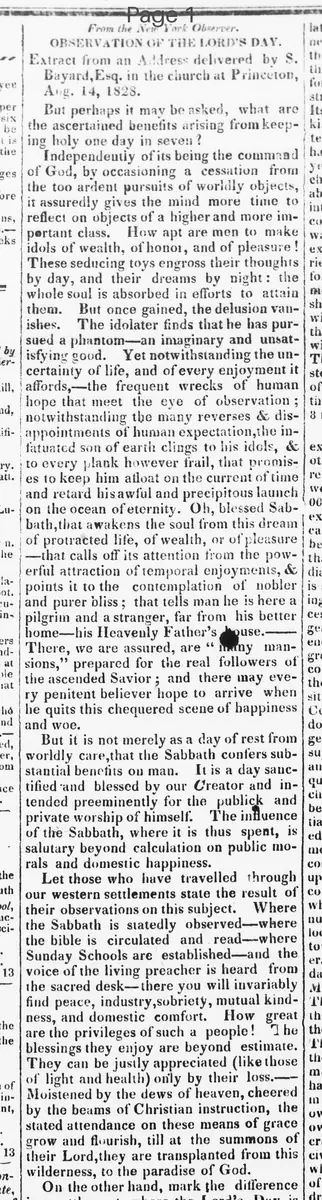
OBSERVATION OF THE LORDS DAY.
Extract from an Address delivered by S. Bayard, Esq. in the church at Princeton, Aug. 14, 1828.
But perhaps it may be asked, what are the ascertained benefits arising from keeping holy one day in seven?
Independently of its being the command of God, by occasioning a cessation from the too ardent pursuits of worldly objects, it assuredly gives the mind more time to reflect on objects of a higher and more important class. How apt are men to make idols of wealth, of honor, and of pleasure!
These seducing toys engross their thoughts by day, and their dreams by night: the whole soul is absorbed in efforts to attain them. But once gained, the delusion vanishes. The idolater finds that he has pursued a phantom—an imaginary and unsatisfying good. Yet notwithstanding the uncertainty of life, and of every enjoyment it affords,—the frequent wrecks of human hope that meet the eye of observation; notwithstanding the many reverses & disappointments of human expectation, the infatuated son of earth clings to his idols, & to every plank however frail, that promises to keep him afloat on the current of time and retard his awful and precipitous launch on the ocean of eternity. Oh, blessed Sabbath, that awakens the soul from this dream of protracted life, of wealth, or of pleasure—that calls off its attention from the powerful attraction of temporal enjoyments, & points it to the contemplation of nobler and purer bliss: that tells man he is here a pilgrim and a stranger, far from his better home—his Heavenly Father's house.
There, we are assured, are "many mansions," prepared for the real followers of the ascended Savior: and there may every penitent believer hope to arrive when he quits this chequered scene of happiness and woe.
But it is not merely as a day of rest from worldly care, that the Sabbath confers substantial benefits on man. It is a day sanctified—and blessed by our Creator and intended preeminently for the public and private worship of himself. The influence of the Sabbath, where it is thus spent, is salutary beyond calculation on public morals and domestic happiness.
Let those who have travelled through our western settlements state the result of their observations on this subject. Where the Sabbath is statedly observed—where the bible is circulated and read—where Sunday Schools are established—and the voice of the living preacher is heard from the sacred desk—there you will invariably find peace, industry, sobriety, mutual kindness, and domestic comfort. How great are the privileges of such a people! The blessings they enjoy are beyond estimate. They can be justly appreciated (like those of light and health) only by their loss.—
Moistened by the dews of heaven, cheered by the beams of Christian instruction, the stated attendance on these means of grace grow and flourish, till at the summons of their Lord, they are transplanted from this wilderness, to the paradise of God.
On the other hand, mark the difference in a settlement, where the Lord's Day is known only as a day of idleness and dissipation. Instead of assemblages for the worship of God, the tavern or the tippling house is the place of constant resort. Here the intoxicating cup is circulated—the profane oath—the coarse jest—the noisy mirth of fools, like the crackling of thorns under a pot—are heard, and all those revolting scenes that arise from the abuse of ardent spirits, are seen in all their shocking deformity. Hence the infatuated victims of intemperance return to their families ten-fold more the children of hell than when they quitted their peaceful homes. Alas, that such should be the occupation of creatures ordained to be immortal—that instead of rising in the scale of beings, they should sink below the very beasts that perish!
OBSERVATION OF THE LORDS DAY.
Extract from an Address delivered by S. Bayard, Esq. in the church at Princeton, Aug. 14, 1828.
But perhaps it may be asked, what are the ascertained benefits arising from keeping holy one day in seven?
Independently of its being the command of God, by occasioning a cessation from the too ardent pursuits of worldly objects, it assuredly gives the mind more time to reflect on objects of a higher and more important class. How apt are men to make idols of wealth, of honor, and of pleasure!
These seducing toys engross their thoughts by day, and their dreams by night: the whole soul is absorbed in efforts to attain them. But once gained, the delusion vanishes. The idolater finds that he has pursued a phantom—an imaginary and unsatisfying good. Yet notwithstanding the uncertainty of life, and of every enjoyment it affords,—the frequent wrecks of human hope that meet the eye of observation; notwithstanding the many reverses & disappointments of human expectation, the infatuated son of earth clings to his idols, & to every plank however frail, that promises to keep him afloat on the current of time and retard his awful and precipitous launch on the ocean of eternity. Oh, blessed Sabbath, that awakens the soul from this dream of protracted life, of wealth, or of pleasure—that calls off its attention from the powerful attraction of temporal enjoyments, & points it to the contemplation of nobler and purer bliss: that tells man he is here a pilgrim and a stranger, far from his better home—his Heavenly Father's house.
There, we are assured, are "many mansions," prepared for the real followers of the ascended Savior: and there may every penitent believer hope to arrive when he quits this chequered scene of happiness and woe.
But it is not merely as a day of rest from worldly care, that the Sabbath confers substantial benefits on man. It is a day sanctified—and blessed by our Creator and intended preeminently for the public and private worship of himself. The influence of the Sabbath, where it is thus spent, is salutary beyond calculation on public morals and domestic happiness.
Let those who have travelled through our western settlements state the result of their observations on this subject. Where the Sabbath is statedly observed—where the bible is circulated and read—where Sunday Schools are established—and the voice of the living preacher is heard from the sacred desk—there you will invariably find peace, industry, sobriety, mutual kindness, and domestic comfort. How great are the privileges of such a people! The blessings they enjoy are beyond estimate. They can be justly appreciated (like those of light and health) only by their loss.—
Moistened by the dews of heaven, cheered by the beams of Christian instruction, the stated attendance on these means of grace grow and flourish, till at the summons of their Lord, they are transplanted from this wilderness, to the paradise of God.
On the other hand, mark the difference in a settlement, where the Lord's Day is known only as a day of idleness and dissipation. Instead of assemblages for the worship of God, the tavern or the tippling house is the place of constant resort. Here the intoxicating cup is circulated—the profane oath—the coarse jest—the noisy mirth of fools, like the crackling of thorns under a pot—are heard, and all those revolting scenes that arise from the abuse of ardent spirits, are seen in all their shocking deformity. Hence the infatuated victims of intemperance return to their families ten-fold more the children of hell than when they quitted their peaceful homes. Alas, that such should be the occupation of creatures ordained to be immortal—that instead of rising in the scale of beings, they should sink below the very beasts that perish!
What sub-type of article is it?
Religious Sermon
Moral Exhortation
What themes does it cover?
Moral Virtue
Providence Divine
What keywords are associated?
Sabbath Observance
Moral Benefits
Religious Worship
Intemperance
Domestic Happiness
What entities or persons were involved?
S. Bayard, Esq.
Where did it happen?
Church At Princeton
Story Details
Key Persons
S. Bayard, Esq.
Location
Church At Princeton
Event Date
Aug. 14, 1828
Story Details
Address extols benefits of Sabbath observance for spiritual reflection, moral improvement, and domestic bliss in communities with worship, Bible reading, and schools; contrasts with vice, intemperance, and family ruin in places of idleness and dissipation.