Thank you for visiting SNEWPapers!
Sign up free
Story
April 12, 1954
Trainman News
Indianapolis, Marion County, Indiana
What is this article about?
In 1937, U.S. railroad workers' unions negotiated 20-cent hourly and 44-cent daily pay raises after years of stagnation, then defeated proposed 15% cuts during recession through National Mediation Board and Roosevelt's Emergency Board, highlighting over-capitalization.
Clipping
OCR Quality
98%
Excellent
Full Text
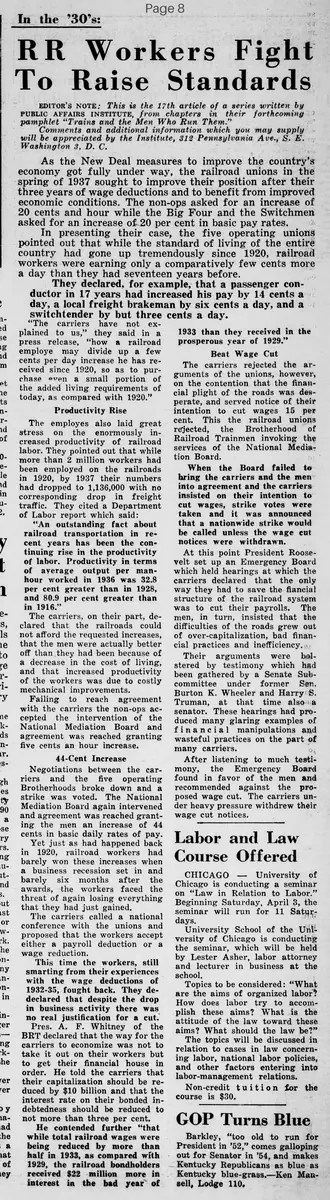
In the 30's: RR Workers Fight To Raise Standards
EDITOR's NOTE: This is the 17th article of a series written by PUBLIC AFFAIRS INSTITUTE from chapters in their forthcoming pamphlet "Trains and the Men Who Run Them."
Comments and additional information which you may supply will be appreciated by the Institute, 312 Pennsylvania Ave., S. E. Washington 3, D. C.
As the New Deal measures to improve the country's economy got fully under way, the railroad unions in the spring of 1937 sought to improve their position after their three years of wage deductions and to benefit from improved economic conditions. The non-ops asked for an increase of 20 cents an hour while the Big Four and the Switchmen asked for an increase of 20 per cent in basic pay rates.
In presenting their case, the five operating unions pointed out that while the standard of living of the entire country had gone up tremendously since 1920, railroad workers were earning only a comparatively few cents more a day than they had seventeen years before.
They declared, for example, that a passenger conductor in 17 years had increased his pay by 14 cents a day, a local freight brakeman by six cents a day, and a switchtender by but three cents a day.
"The carriers have not explained to us," they said in a press release, "how a railroad employe may divide up a few cents per day increase he has received since 1920, so as to purchase even a small portion of the added living requirements of today, as compared with 1920."
Productivity Rise
The employes also laid great stress on the enormously increased productivity of railroad labor. They pointed out that while more than 2 million workers had been employed on the railroads in 1920, by 1937 their numbers had dropped to 1,136,000 with no corresponding drop in freight traffic. They cited a Department of Labor report which said:
"An outstanding fact about railroad transportation in recent years has been the continuing rise in the productivity of labor. Productivity in terms of average output per man-hour worked in 1936 was 32.8 per cent greater than in 1928, and 80.9 per cent greater than in 1916."
The carriers, on their part, declared that the railroads could not afford the requested increases, that the men were actually better off than they had been because of a decrease in the cost of living, and that increased productivity of the workers was due to costly mechanical improvements.
Failing to reach agreement with the carriers the non-ops accepted the intervention of the National Mediation Board and agreement was reached granting five cents an hour increase.
44-Cent Increase
Negotiations between the carriers and the five operating Brotherhoods broke down and a strike was voted. The National Mediation Board again intervened and agreement was reached granting the men an increase of 44 cents in basic daily rates of pay.
Yet just as had happened back in 1920, railroad workers had barely won these increases when a business recession set in and barely six months after the awards, the workers faced the threat of again losing everything that they had just gained.
The carriers called a national conference with the unions and proposed that the workers accept either a payroll deduction or a wage reduction.
This time the workers, still smarting from their experiences with the wage deductions of 1932-35, fought back. They declared that despite the drop in business activity there was no real justification for a cut.
Pres. A. F. Whitney of the BRT declared that the way for the carriers to economize was not to take it out on their workers but to get their financial house in order. He told the carriers that their capitalization should be reduced by $10 billion and that the interest rate on their bonded indebtedness should be reduced to not more than three per cent.
He contended further "that while total railroad wages were being reduced by more than half in 1933, as compared with 1929, the railroad bondholders received $22 million more in interest in the bad year of 1933 than they received in the prosperous year of 1929."
Beat Wage Cut
The carriers rejected the arguments of the unions, however, on the contention that the financial plight of the roads was desperate, and served notice of their intention to cut wages 15 per cent. This the railroad unions rejected, the Brotherhood of Railroad Trainmen invoking the services of the National Mediation Board.
When the Board failed to bring the carriers and the men into agreement and the carriers insisted on their intention to cut wages, strike votes were taken and it was announced that a nationwide strike would be called unless the wage cut notices were withdrawn.
At this point President Roosevelt set up an Emergency Board which held hearings at which the carriers declared that the only way they had to save the financial structure of the railroad system was to cut their payrolls. The men, in turn, insisted that the difficulties of the roads grew out of over-capitalization, bad financial practices and inefficiency.
Their arguments were bolstered by testimony which had been gathered by a Senate Subcommittee under former Sen. Burton K. Wheeler and Harry S. Truman, at that time also a senator. These hearings had produced many glaring examples of financial manipulations and wasteful practices on the part of many carriers.
After listening to much testimony, the Emergency Board found in favor of the men and recommended against the proposed wage cut. The carriers under heavy pressure withdrew their wage cut notices.
EDITOR's NOTE: This is the 17th article of a series written by PUBLIC AFFAIRS INSTITUTE from chapters in their forthcoming pamphlet "Trains and the Men Who Run Them."
Comments and additional information which you may supply will be appreciated by the Institute, 312 Pennsylvania Ave., S. E. Washington 3, D. C.
As the New Deal measures to improve the country's economy got fully under way, the railroad unions in the spring of 1937 sought to improve their position after their three years of wage deductions and to benefit from improved economic conditions. The non-ops asked for an increase of 20 cents an hour while the Big Four and the Switchmen asked for an increase of 20 per cent in basic pay rates.
In presenting their case, the five operating unions pointed out that while the standard of living of the entire country had gone up tremendously since 1920, railroad workers were earning only a comparatively few cents more a day than they had seventeen years before.
They declared, for example, that a passenger conductor in 17 years had increased his pay by 14 cents a day, a local freight brakeman by six cents a day, and a switchtender by but three cents a day.
"The carriers have not explained to us," they said in a press release, "how a railroad employe may divide up a few cents per day increase he has received since 1920, so as to purchase even a small portion of the added living requirements of today, as compared with 1920."
Productivity Rise
The employes also laid great stress on the enormously increased productivity of railroad labor. They pointed out that while more than 2 million workers had been employed on the railroads in 1920, by 1937 their numbers had dropped to 1,136,000 with no corresponding drop in freight traffic. They cited a Department of Labor report which said:
"An outstanding fact about railroad transportation in recent years has been the continuing rise in the productivity of labor. Productivity in terms of average output per man-hour worked in 1936 was 32.8 per cent greater than in 1928, and 80.9 per cent greater than in 1916."
The carriers, on their part, declared that the railroads could not afford the requested increases, that the men were actually better off than they had been because of a decrease in the cost of living, and that increased productivity of the workers was due to costly mechanical improvements.
Failing to reach agreement with the carriers the non-ops accepted the intervention of the National Mediation Board and agreement was reached granting five cents an hour increase.
44-Cent Increase
Negotiations between the carriers and the five operating Brotherhoods broke down and a strike was voted. The National Mediation Board again intervened and agreement was reached granting the men an increase of 44 cents in basic daily rates of pay.
Yet just as had happened back in 1920, railroad workers had barely won these increases when a business recession set in and barely six months after the awards, the workers faced the threat of again losing everything that they had just gained.
The carriers called a national conference with the unions and proposed that the workers accept either a payroll deduction or a wage reduction.
This time the workers, still smarting from their experiences with the wage deductions of 1932-35, fought back. They declared that despite the drop in business activity there was no real justification for a cut.
Pres. A. F. Whitney of the BRT declared that the way for the carriers to economize was not to take it out on their workers but to get their financial house in order. He told the carriers that their capitalization should be reduced by $10 billion and that the interest rate on their bonded indebtedness should be reduced to not more than three per cent.
He contended further "that while total railroad wages were being reduced by more than half in 1933, as compared with 1929, the railroad bondholders received $22 million more in interest in the bad year of 1933 than they received in the prosperous year of 1929."
Beat Wage Cut
The carriers rejected the arguments of the unions, however, on the contention that the financial plight of the roads was desperate, and served notice of their intention to cut wages 15 per cent. This the railroad unions rejected, the Brotherhood of Railroad Trainmen invoking the services of the National Mediation Board.
When the Board failed to bring the carriers and the men into agreement and the carriers insisted on their intention to cut wages, strike votes were taken and it was announced that a nationwide strike would be called unless the wage cut notices were withdrawn.
At this point President Roosevelt set up an Emergency Board which held hearings at which the carriers declared that the only way they had to save the financial structure of the railroad system was to cut their payrolls. The men, in turn, insisted that the difficulties of the roads grew out of over-capitalization, bad financial practices and inefficiency.
Their arguments were bolstered by testimony which had been gathered by a Senate Subcommittee under former Sen. Burton K. Wheeler and Harry S. Truman, at that time also a senator. These hearings had produced many glaring examples of financial manipulations and wasteful practices on the part of many carriers.
After listening to much testimony, the Emergency Board found in favor of the men and recommended against the proposed wage cut. The carriers under heavy pressure withdrew their wage cut notices.
What sub-type of article is it?
Historical Event
What themes does it cover?
Triumph
Justice
Misfortune
What keywords are associated?
Railroad Unions
Wage Increases
1937 Negotiations
Recession Wage Cuts
Labor Mediation
What entities or persons were involved?
A. F. Whitney
Burton K. Wheeler
Harry S. Truman
Where did it happen?
United States Railroads
Story Details
Key Persons
A. F. Whitney
Burton K. Wheeler
Harry S. Truman
Location
United States Railroads
Event Date
1937
Story Details
Railroad unions sought and won wage increases in 1937 amid economic recovery, citing stagnant pay and rising productivity; faced proposed cuts during recession, rejected them, invoked mediation, and prevailed via Emergency Board against carriers' financial arguments.