Thank you for visiting SNEWPapers!
Sign up free
Edwardsville Spectator
Edwardsville, Madison County, Illinois
What is this article about?
An 1825 newspaper article explains the nature of comets, debunks superstitions linking them to calamities, and includes a letter from E. Long in Alton describing the current comet's visibility and path since September 10.
Merged-components note: The Spectator column features an explanatory article on comets including the current one, immediately followed by a related correspondent's letter observing the comet; merged into a single coherent informative unit on the topic.
Clipping
OCR Quality
Full Text
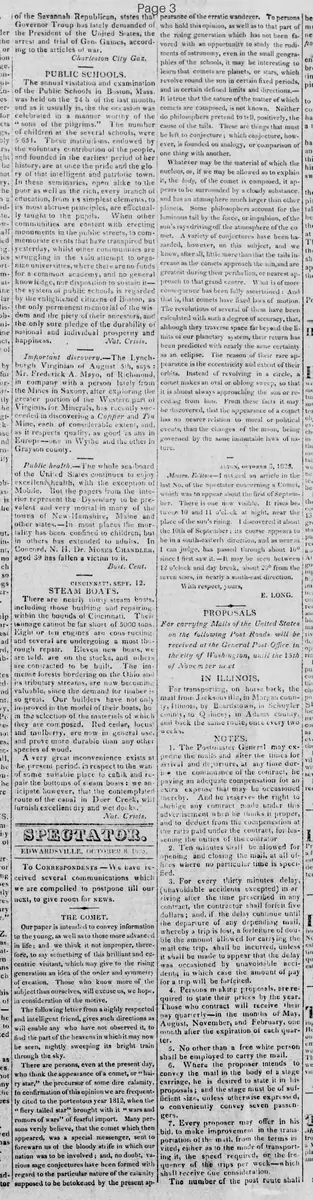
EDWARDSVILLE, OCTOBER 8, 1825.
To Correspondents--We have received several communications which we are compelled to postpone till our next, to give room for News.
THE COMET.
Our paper is intended to convey information to the young, as well as to those more advanced in life; and we think it not improper, therefore, to say something of this brilliant and eccentric visitant, which may give to the rising generation an idea of the order and symmetry of creation. Those who know more of the subject than ourselves, will excuse us, we hope, in consideration of the motive.
The following letter from a highly respected and intelligent friend, gives such directions as will enable any who have not observed it, to find the part of the heavens in which it may now be seen, nightly sweeping its bright train through the sky.
There are persons, even at the present day, who think the appearance of a comet, or "hairy star," the precursor of some dire calamity. In confirmation of this opinion we are frequently cited to the portentous year 1812, when the "fiery tailed star" brought with it "wars and rumors of wars" of fearful import. Many persons verily believe, that the comet which then appeared, was a special messenger, sent to forewarn us of the bloody strife in which our nation was to be involved; and, no doubt, various sage conjectures have been formed with regard to the particular nature of the calamity supposed to be betokened by the present appearance of the erratic wanderer. To persons who hold this opinion, as well as to that part of the rising generation which has not been favored with an opportunity to study the rudiments of astronomy, even in the small geographies of the schools, it may be interesting to learn that comets are planets, or stars, which revolve round the sun in certain fixed periods, and in certain defined limits and directions,--It is true that the nature of the matter of which comets are composed, is not known. Neither do philosophers pretend to tell, positively, the cause of the tails. These are things that must be left to conjecture; which conjecture, however, is founded on analogy, or comparison of one thing with another.
Whatever may be the material of which the nucleus, or, if we may be allowed so to explain it, the body, of the comet is composed, it appears to be surrounded by a cloudy substance, and has an atmosphere much larger than other planets. Some philosophers account for the luminous tail by the force, or impulsion, of the sun's rays driving off the atmosphere of the comet. A variety of conjectures have been hazarded, however, on this subject, and we know, after all, little more than that the tails increase as the comets approach the sun, and are greatest during their perihelion, or nearest approach to that grand centre. What is of more consequence has been fully ascertained: And that is, that comets have fixed laws of motion. The revolutions of several of them have been calculated with such a degree of accuracy, that, although they traverse space far beyond the limits of our planetary system, their return has been predicted with nearly the same certainty as an eclipse. The reason of their rare appearance is the eccentricity and extent of their orbits. Instead of revolving in a circle, a comet makes an oval or oblong sweep, so that it is almost always approaching the sun or receding from him. From these facts it may be discovered, that the appearance of a comet has no nearer relation to moral or political events, than the changes of the moon, being governed by the same immutable laws of nature.
ALTON, OCTOBER 3, 1825.
Messrs. Editors--I noticed an article in the last No. of the Spectator concerning a Comet, which was to appear about the first of September. There is one now visible. It rises between 10 and 11 o'clock at night, near the place of the sun's rising. I discovered it about the 10th of September; its course appears to be in a south-easterly direction, and as near as I can judge, has passed through about 10° since I first saw it.--It may be seen between 12 o'clock and day break, about 20° from the seven stars, in nearly a south-east direction.
With respect, yours,
E. LONG.
What sub-type of article is it?
What themes does it cover?
What keywords are associated?
What entities or persons were involved?
Where did it happen?
Story Details
Key Persons
Location
Alton, Edwardsville
Event Date
1825 10 08
Story Details
Newspaper editors explain comets as natural celestial bodies with fixed orbits, debunking superstitions of impending calamity, and publish E. Long's letter detailing the current comet's visibility rising between 10-11 PM near sunrise point, observed since September 10 in a south-easterly direction.