Thank you for visiting SNEWPapers!
Sign up free
Alexandria Gazette & Daily Advertiser
Alexandria, Virginia
What is this article about?
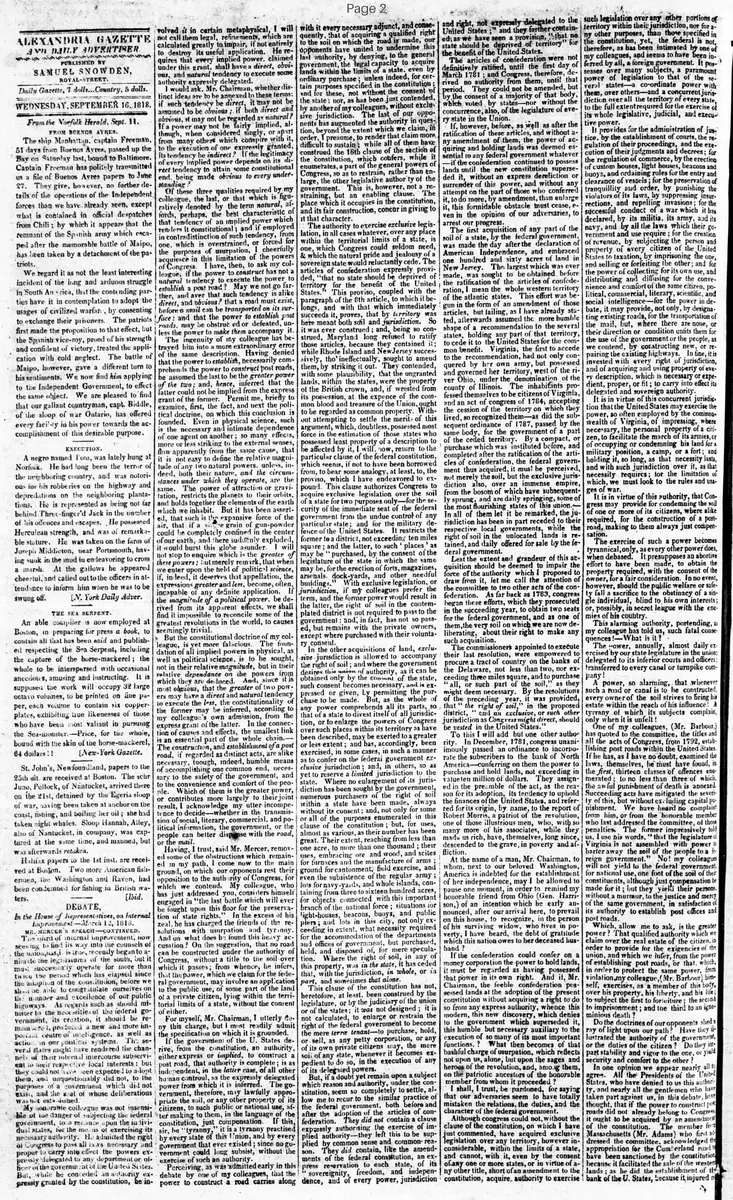
In the U.S. House of Representatives on March 12, 1818, Mr. Mercer continued his speech defending Congress's implied constitutional power to construct post roads for internal improvements, arguing against colleagues' restrictions on federal authority over state lands and jurisdiction.
Merged-components note: The component on page 3 is a direct textual continuation of Mr. Mercer's speech in the House of Representatives debate on internal improvements from page 2, forming a single coherent political news article; relabeled to 'domestic_news' as it fits local/national non-story news on government matters.
Clippings
1 of 2
OCR Quality
Full Text
In the House of Representatives, on Internal Improvement - March 12, 1818.
MR. MERCER'S SPEECH CONTINUED.
The spirit of internal improvement, now seeking to find its way into the counsels of the union, has, it is true, recently began to animate the legislatures of the south, but it must successfully operate for more than twice the period which has elapsed since the adoption of the constitution, before we shall be able to congratulate ourselves on the number and excellence of our public highways. As regards such as should minister to the necessities of the federal government, its creation, it should be remembered, produced a new and more important centre of intelligence, as well as action, in our political systems. The several states might have rendered the channels of their internal intercourse subservient to their respective local interests: but they could not have been expected to adopt them, and unquestionably did not, to the purposes of a government which did not exist, and the seat of whose deliberations was not established.
My honorable colleague was not insensible of the danger of subjecting the federal government, to a reliance upon the individual states, for the means of exercising its necessary authority. He admitted the right of Congress to pass all laws necessary and proper to carry into effect the powers expressly delegated to any department or officer of the government of the United States. But, while he conceded an authority expressly granted by the constitution, he involved it in certain metaphysical. I will not call them legal, refinements, which are calculated greatly to impair, if not entirely to destroy its useful application. He requires that every implied power claimed under this grant, shall have a direct, obvious, and natural tendency to execute some authority expressly delegated.
I would ask, Mr. Chairman, whether distinct ideas are to be annexed to these terms: if such tendency be direct, it may not be assumed to be obvious: if both direct and obvious, it may not be regarded as natural? though, when considered singly, or apart from many others which conspire with it, to the execution of one expressly granted, its tendency be indirect? If the legitimacy of every implied power depends on its direct tendency to attain some constitutional end, being made obvious to every understanding?
Of these three qualities required by my colleague, the last, or that which is figuratively denoted by the term natural, affords, perhaps, the best characteristic of one, which is overstrained, or forced: in contradistinction of such tendency, from that of Congress. I have, then, to ask my colleague, if he will acquiesce in this limitation of the powers of Congress. I cheerfully agree, if the power to construct has not a natural tendency to execute the power to establish a post road? May we not go farther, and aver that such tendency is alike direct, and obvious? that a road must exist, before a mail can be transported on its surface: and that the power to establish post roads, may be obstructed or defeated, unless the power to make them accompany it.
The ingenuity of my colleague has betrayed him into a more extraordinary error of the same description. Having denied that the power to establish, necessarily comprehends the power to construct post roads, he assumed the last to be the greater power of the two: and, hence, inferred that the latter could not be implied from the express grant of the former. Permit me, briefly to examine, first, the fact, and next the political doctrine, on which this conclusion is founded. Even in physical science, such is the necessary and intimate dependence of one agent on another; so many effects, more or less striking to the external senses, flow apparently from the same cause, that it is not easy to define the relative magnitude of any two natural powers, unless, indeed, both their nature, and the circumstances under which they operate, are the same. The power of attraction or gravitation, restricts the planets to their orbits, and holds together the elements of the earth which we inhabit. But it has been asserted, that such is the expansive force of the air, that if a single grain of gun-powder could be completely confined in the center of our earth, and there suddenly exploded, it would burst this globe asunder. I will not stop to enquire which is the greater of these powers; but merely remark, that when we enter upon the field of political science, if, indeed, it deserves that appellation, the expressions greater and less, become, often, incapable of any definite application. If the magnitude of a political power be derived from its apparent effects, we shall find it impossible to reconcile some of the greatest revolutions in the world, to causes seemingly trivial.
But the constitutional doctrine of my colleague, is yet more fallacious. The foundation of all implied powers in physical, as well as political science, is to be sought, not in their relative magnitude, but in their relative dependence on the powers from which they are deduced. And, since it is most obvious, that the greater of two powers may have a direct and natural tendency to execute the less, the constitutionality of the former may be inferred, according to my colleague's own admission, from the express grant of the latter. In the connection of causes and effects, the smallest link is an essential part of the whole chain. The construction, and establishment of a post road, if regarded as distinct acts, are alike necessary, though, indeed, humble means of accomplishing one common end, necessary to the safety of the government, and to the convenience and comfort of the people. Which of them is the greater power or contributes more largely to their joint result, I acknowledge my utter incompetence to decide - whether in the transmission of social, literary, commercial, and political information, the government, or the people can better dispense with the road, or the mail.
Having, I trust, said Mr. Mercer, removed some of the obstructions which remained in my path, I come now to the main ground, on which our opponents rest their opposition to the authority of Congress, for which we contend. My colleague, who has just addressed you, considers himself engaged in "the last battle which will ever be fought upon this floor for the preservation of state rights." In the excess of his zeal, he has charged the friends of the resolutions with usurpation and tyranny. And on what does he found this heavy accusation? On the suggestion, that no road can be constructed under the authority of Congress, without a title to the soil over which it passes; from whence, he infers, that the power, which we claim for the federal government, may involve an application to the public use, of some part of the land of a private citizen, lying within the territorial limits of a state, without the consent of either.
For myself, Mr. Chairman, I utterly deny this charge, but I most readily admit the specification on which it is grounded. If the government of the U. States derives from the constitution, an authority, either express or implied, to construct a post road, that authority is complete; is as independent, in the latter case, of all other human controul, as the expressly delegated power from which it is inferred. The government, therefore, may lawfully appropriate the soil, or any other property of its citizens, to such public or national use, after making to them, in the language of the constitution, just compensation. If this, sir, be "tyranny," it is a tyranny practised by every state of this Union, and by every government that ever existed; since no government could long subsist, without the exercise of such an authority.
Perceiving, as was admitted early in this debate by one of my colleagues, that the power to construct a road carries along with it every necessary adjunct, and consequently, that of acquiring a qualified right to the soil on which the road is made, our opponents have united to undermine this last authority, by denying, to the general government, the legal capacity to acquire lands within the limits of a state, even by ordinary purchase; unless indeed, for certain purposes specified in the constitution; and for these, not without the consent of the state: nor, as has been just contended, by another of my colleagues, without exclusive jurisdiction. The last of our opponents has augmented the authority in question, beyond the extent which we claim, in order, I presume, to render that claim more difficult to sustain; while all of them have construed the 16th clause of the section of the constitution, which confers, while it enumerates, a part of the general powers of Congress, so as to restrain, rather than enlarge, the other legislative authority of the government. This is, however, not a restraining, but an enabling clause. The place which it occupies in the constitution, and its fair construction, concur in giving to it that character.
The authority to exercise exclusive legislation, in all cases whatever, over any place within the territorial limits of a state, is one, which Congress could seldom need, & which the natural pride and jealousy of a sovereign state would reluctantly cede. The articles of confederation expressly provided, "that no state should be deprived of territory for the benefit of the United States." This proviso, coupled with the paragraph of the 8th article, to which it belongs, and with that which immediately succeeds it, proves, that by territory was here meant both soil and jurisdiction. So it was ever construed; and, being so construed, Maryland long refused to ratify those articles, because they contained it: while Rhode Island and New Jersey successively, tho' ineffectually, sought to amend them, by striking it out. They contended, with some plausibility, that the ungranted lands, within the states, were the property of the British crown, and, if wrested from its possession, at the expence of the common blood and treasure of the Union, ought to be regarded as common property. Without attempting to settle the merit, of this argument, which, doubtless, possessed no st force in the estimation of those states who possessed least property of a description to be affected by it, I will, now, return to the particular clause of the federal constitution, which seems, if not to have been borrowed from, to bear some analogy, at least, to, the proviso, which I have endeavored to expound. This clause authorizes Congress to acquire exclusive legislation over the soil of a state for two purposes only - for the security of the immediate seat of the federal government from the undue controul of any particular state: and for the military defence of the United States. It restricts the former to a district, not exceeding ten miles square; and the latter, to such 'places' as may be "purchased, by the consent of the legislature of the state in which the same may be, for the erection of forts, magazines, arsenals, dock-yards, and other needful buildings." With exclusive legislation, or jurisdiction, if my colleagues prefer the term, and the former power would result in the latter, the right of soil in the contemplated district is not required to pass to the government: and, in fact, has not so passed, but remains with the private owners, except where purchased with their voluntary consent.
In the other acquisitions of land, exclusive-jurisdiction is allowed to accompany the right of soil; and where the government desires this union of authority, as it can be obtained only by the consent of the state, such consent becomes necessary, and is expressed or given, by permitting the purchase to be made. But, as the whole of any power comprehends all its parts, so that of a state to divest itself of all jurisdiction, or to enlarge the powers of Congress over such places within its territory as have been described, may be exerted to a greater or less extent: and has, accordingly, been exercised, in some cases, in such a manner as to confer on the federal government exclusive jurisdiction; and, in others, so as yet to reserve a limited jurisdiction to the state. Where no enlargement of its jurisdiction has been sought by the government, numerous purchasers of the right of soil within a state have been made, always without its consent; and, not only for some or all of the purposes enumerated in this clause of the constitution; but, for uses, almost as various, as their number has been great. Their extent, reaching from less than one acre, to more than one thousand: their uses, embracing ore and wood, and sites for furnaces and the manufacture of arms: ground for cantonment; field exercise, and even the subsistence of the regular army; lots for navy-yards, and whole islands, containing from three to sixteen hundred acres, for objects connected with this important branch of the national force; situations for light-houses, beacons, buoys, and public piers; and lots in this city, not only exceeding in extent, what necessity required for the accommodation of the departments and offices of government, but purchased, held, and disposed of, for mere speculation. Where the right of soil, in any of this property, was in the state, it has ceded that, with the jurisdiction, in whole, or in part, and sometimes that alone.
This clause of the constitution has not, heretofore, at least, been construed by the legislature, or by the judiciary of the union or of the states; it was not designed; it is not calculated, to enlarge or restrain the right of the federal government to become the mere terra tenant - to purchase, hold, or sell, as any petty corporation, or any of its own private citizens may, the mere soil of any state, whenever it becomes expedient to do so, in the execution of any of its delegated powers.
But, if a doubt yet remain upon a subject which reason and authority, under the constitution, seem so completely to settle, allow me to recur to the similar practice of the federal government, both before and after the adoption of the articles of confederation. They did not contain a clause expressly authorising the exercise of implied authority - they left this to be supplied by common sense and common reason. They did contain, like the amendments of the federal constitution, an express reservation to each state, of its sovereignty, freedom, and independence, and of every power, jurisdiction and right, not expressly delegated to the United States;" and they further contained, as we have seen a provision, "that no state should be deprived of territory" for the benefit of the United States.
The articles of confederation were not definitively ratified, until the first day of March 1781; and Congress, therefore, derived no authority from them, until that period. They could not be amended, but by the consent of a majority of that body, which voted by states - nor without the concurrence, also, of the legislature of every state in the Union.
If, however, before, as well as after the ratification of these articles, and without any amendment of them; the power of acquiring and holding lands was deemed essential to any federal government whatever - if the confederation continued to possess lands until the new constitution superseded it, without an express dereliction or surrender of this power, and without any attempt on the part of those who conferred it, to do more, by amendment, than enlarge it, this formidable obstacle must cease, even in the opinion of our adversaries, to arrest our progress.
The first acquisition of any part of the soil of a state, by the federal government, was made the day after the declaration of American Independence, and embraced one hundred and sixty acres of land in New Jersey. The largest which was ever made, was sought to be obtained, before the ratification of the articles of confederation, I mean the whole western territory of the atlantic states. This effort was begun in the form of an amendment of those articles, but failing, as I have already stated, afterwards assumed the more humble shape of a recommendation to the several states, holding any part of that territory, to cede it to the United States for the common benefit. Virginia, the first to accede to the recommendation, had not only conquered by her own army, but possessed and governed her territory, west of the river Ohio, under the denomination of the county of Illinois. The inhabitants professed themselves to be citizens of Virginia, and an act of congress of 1784, accepting the cession of the territory on which they lived, so recognized them - as did the subsequent ordinance of 1787, passed by the same body, for the government of a part of the ceded territory. By a compact, or purchase which was instituted before, and completed after the ratification of the articles of confederation, the federal government thus acquired, it must be perceived, not merely the soil, but the exclusive jurisdiction also, over an immense empire, from the bosom of which have subsequently sprung, and are daily springing, some of the most flourishing states of this union. - In all of them let it be remarked, the jurisdiction has been in part receded to their respective local governments, while the right of soil in the unlocated lands is retained, and daily offered for sale by the federal government.
Lest the extent and grandeur of this acquisition should be deemed to impair the force of the authority which I proposed to draw from it, let me call the attention of the committee to two other acts of the confederation. As far back as 1783, congress began these efforts, which they prosecuted in the succeeding year, to obtain two seats for the federal government, and as one of them, the very soil on which we are now deliberating, about their right to make any such acquisition.
The commissioners appointed to execute their last resolution, were empowered to procure a tract of country on the banks of the Delaware, not less than two, nor exceeding three miles square, and to purchase "all, or such part of the soil," as they might deem necessary. By the resolutions of the preceding year, it was provided, that "the right of soil," in the proposed district, "and an exclusive, or such other jurisdiction as Congress might direct, should be vested in the United States."
To this I will add but one other authority. In December, 1781, congress unanimously passed an ordinance to incorporate the subscribers to the bank of North America - conferring on them the power to purchase and hold lands, not exceeding in value ten million of dollars. They assigned, in the preamble of the act, as the reason for its adoption, its tendency to uphold the finances of the United States, and referred for its origin, by name, to the report of Robert Morris, a patriot of the revolution, one of those illustrious men, who, with so many more of his associates, while they made us rich, have, themselves, long since, descended to the grave, in poverty and affliction.
At the name of a man, Mr. Chairman, to whom, next to our beloved Washington, America is indebted for the establishment of her independence, may I be allowed to pause one moment, in order to remind my honorable friend from Ohio (Gen. Harrison,) of an intention which he early announced, after our arrival here, to prevail on this house, to recognize, in the person of his surviving widow, who lives in poverty, I have heard, the debt of gratitude which this nation owes to her deceased husband?
If the confederation could confer on a money corporation the power to hold lands, it must be regarded as having possessed that power in its own right. And if, Mr. Chairman, the feeble confederation possessed lands at the adoption of the present constitution without acquiring a right to do so from any express authority, whence this modern, this new discovery, which denies to the government which superseded it, this humble but necessary auxiliary to the execution of so many of its most important functions.? What then becomes of that bashful charge of usurpation, which reflects not upon us, alone, but upon the sages and heroes of the revolution, and, among them, on the patriotic ancestors of the honorable member from whom it proceeded?
I shall, I trust, be pardoned, for saying that our adversaries seem to have totally mistaken the relations, the duties, and the character of the federal government. Although congress could not, without the clause of the constitution, on which I have just commented, have acquired exclusive legislation over any territory, however inconsiderable, within the limits of a state, and cannot, with it, even by the consent of any one or more states, or in virtue of any other title, short of an amendment to the constitution, acquire authority to exercise such legislation over any other portions of territory within their jurisdiction, nor for any other purposes, than those specified in the constitution, yet, the federal is not, therefore, as has been intimated by one of my colleagues, and seems to have been inferred by all, a foreign government. It possesses over many subjects, a paramount power of legislation to that of the several states - a co-ordinate power with them, over others - and a concurrent jurisdiction over all the territory of every state, to the full extent required for the exercise of its whole legislative, judicial, and executive power.
It provides for the administration of justice, by the establishment of courts, the regulation of their proceedings, and the execution of their judgments and decrees; for the regulation of commerce, by the erection of custom houses, light houses, beacons and buoys, and ordaining rules for the entry and clearance of vessels; for the preservation of tranquillity and order, by punishing the violators of its laws, by suppressing insurrections, and repelling invasions; for the successful conduct of a war which it has declared, by its militia, its army, and its navy, and by all the laws which their government and use require; for the creation of revenue, by subjecting the person and property of every citizen of the United States to taxation, by imprisoning the one, and selling or forfeiting the other; and for the power of collecting for its own use, and distributing and diffusing for the convenience and comfort of the same citizen, political, commercial, literary, scientific, and social intelligence - for the power in debate, it may provide, not only, by designating existing roads, for the transportation of the mail, but, where there are none, or their direction or condition unfits them for the use of the government or the people, as we contend, by constructing new, or repairing the existing highways. In fine, it is invested with every right of jurisdiction, and of acquiring and using property of every description, which is necessary or expedient, proper, or fit; to carry into effect its delegated and sovereign authority.
It is in virtue of this concurrent jurisdiction that the United States may exercise the power, so often employed by the commonwealth of Virginia, of impressing, where necessary, the personal property of a citizen, to facilitate the march of its armies, or of occupying or condemning his land for a military position, a camp, or a fort; and holding it, so long, as that necessity lasts and with such jurisdiction over it, as that necessity requires; for the limitation of which, we must look to the rules and usages of war.
It is in virtue of this authority, that Congress may provide for condemning the soil of one or more of its citizens, where alike required, for the construction of a post-road, making to them always just compensation.
The exercise of such a power becomes tyrannical, only, as every other power does, when debased. It presupposes an abortive effort to have been made, to obtain the property required, with the consent of the owner, for a fair consideration. In no event, however, should the public welfare or safety fall a sacrifice to the obstinacy of a single individual, blind to his own interests; or, possibly, in secret league with the enemies of his country.
This alarming authority, portending, as my colleague has told us, such fatal consequences! What is it? The power, annually, almost daily exercised by our state legislature in the union; delegated to its inferior courts and officers: transferred to every canal or turnpike company!
A power, so alarming, that whenever such a road or canal is to be constructed, every owner of the soil strives to bring his estate within the reach of its influence! A tyranny of which its subjects complain, only when it is unfelt!
One of my colleagues, (Mr. Barbour,) has quoted to the committee, the titles and all the acts of Congress, from 1792, establishing post roads within the United States. If he has, as I have no doubt, examined the laws themselves, he must have found, in the first, thirteen classes of offences enumerated; to no less than three of which, the awful punishment of death is annexed. Succeeding acts have mitigated the severity of this, but without excluding capital punishment. We have heard no complaint from him, or from the honorable member who last addressed the committee, of those penalties. The former impressively told us, I use his words, "that the legislature of Virginia is not assembled with power to barter away the soil of the people to a foreign government." No! my colleagues will not yield to the federal government for national use, one foot of the soil of their constituents, although just compensation be made for it; but they yield their persons, without a murmur, to the justice and mercy of the same government, in satisfaction of its authority to establish post offices and post roads.
Which, allow me to ask, is the greater power? That qualified authority which we claim over the real estate of the citizen, in order to provide for the exigencies of the union, and which we infer, from the power of establishing post roads, or that, which, in order to protect the same power, from violation, my colleague, (Mr. Barbour) himself, exercises, as a member of this body, over his property, his liberty, and his life; to subject the first to forfeiture; the second to imprisonment; and the third to an ignominious death?
Do the doctrines of our opponents shed a ray of light upon our path? Have they illustrated the authority of the government, or the duties of the citizen? Do they impart stability and vigor to the one, or yield security and comfort to the other?
In one opinion we appear nearly all to agree. All the Presidents of the United States, who have denied to us this authority, and nearly all the gentlemen who have taken part against us, in this debate, have thought, that if the power to construct post roads did not already belong to Congress it ought to be acquired by an amendment of the constitution. The member from Massachusetts (Mr. Adams) who first addressed the committee, acknowledged the appropriation of the Cumberland road to have been sanctioned by the constitution because it facilitated the sale of the western lands; as he did the establishment of the bank of the U. States, because it injured no one, some, and advanced the public welfare. He surely ought not to have questioned the legitimacy of the power which we now invite him to exercise.
The member from New-Hampshire (Mr. Claggett) who immediately succeeded him, distinctly admitted, in the first part of his argument, the expediency of obtaining this power; and before he sat down, expressed a doubt whether congress did not already possess it.
The member who closed the second day's debate, (Mr. Barbour) remarked, it is true, "that he was not clear that he would give the power contended for, were he in a convention authorised to confer it." But if the candor of my colleague conceded so much, amidst the ardor of a debate, in which he bore so distinguished a part, what might not be expected from his patriotism, were his constitutional objections removed, and his conscience no longer an impediment to the prosperity of his country?
My colleague, who preceded him, has, perhaps, stood alone, for accident deprived me, much to my regret, of a part, or the whole of the arguments of other honorable gentlemen, who have risen on the same side of this question; if I mistake not, he stands alone in maintaining the extraordinary position, that roads, and even canals, are of local concern. I regretted to hear him say that a good road, from Washington to Richmond, would not be one of general interest. But I do not understand that he questions the power of the federal government to acquire the mere soil of a state, by fair purchase; nor that of Congress, to exercise the power, which I shall presently examine, of appropriating part of the public revenue, to the purchase of the stock of a canal, or turnpike company. From him, therefore, we differ only as to the mode of attaining our end. But both the gentlemen, to whom I have last referred, have, by clear implication, furnished to the friends of the resolutions a doctrine, and a very sound one too, sufficiently broad to protect our whole ground.
The one advanced the position, in which I heartily concur with him, "that the several states ought to retain every power which they can exercise, as effectually, by themselves as by the federal government;" and the other furnished an equally just and clear limitation of the proper objects of federal authority, when he told us, "that in regard to all those things, which require the combined strength of the union, the framers of the constitution sought to provide by a federal government."
Taken either separately, or together, their doctrines amount to this, that all those powers which can be most efficaciously and beneficially exercised by the common authority pervading all the United States, do, or should, belong to the federal government.
And if this doctrine be applied to the character of the power in debate, can any mind, so intelligent as that of either of my colleagues, hesitate in determining to what government it should belong.
[To be continued.]
What sub-type of article is it?
What keywords are associated?
What entities or persons were involved?
Where did it happen?
Domestic News Details
Primary Location
Washington
Event Date
March 12, 1818
Key Persons
Outcome
debate ongoing; speech continued and to be continued.
Event Details
Mr. Mercer argues in favor of Congress's implied constitutional authority to construct post roads, refuting colleagues' arguments on federal powers, state rights, land acquisition, and jurisdiction, drawing on historical precedents from the Articles of Confederation and constitutional clauses.