Thank you for visiting SNEWPapers!
Sign up free
Editorial
August 11, 1878
The Morning Star And Catholic Messenger
New Orleans, Orleans County, Louisiana
What is this article about?
Editorial criticizes overzealous yellow fever quarantines in Mississippi towns like Vicksburg and Jackson, arguing they are unnecessary in low-risk areas, unlawfully extend to rural regions, harm commerce, and violate humanity by excluding healthy refugees.
Clipping
OCR Quality
95%
Excellent
Full Text
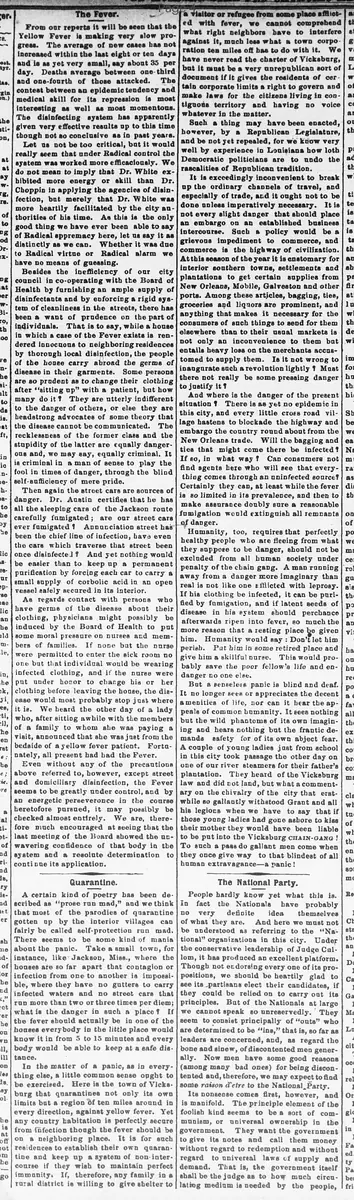
Quarantine.
A certain kind of poetry has been described as "prose run mad," and we think that most of the parodies of quarantine gotten up by the interior villages can fairly be called self-protection run mad. There seems to be some kind of mania about the panic. Take a small town, for instance, like Jackson, Miss., where the houses are so far apart that contagion or infection from one to another is impossible, where they have no gutters to carry infected waters and no street cars that run more than two or three times per diem; what is the danger in such a place? If the fever should actually be in one of the houses everybody in the little place would know it in from 5 to 15 minutes and everybody would be able to keep at a safe distance.
In the matter of a panic, as in everything else, a little common sense ought to be exercised. Here is the town of Vicksburg that quarantines not only its own limits but a region of ten miles around in every direction, against yellow fever. Yet any country habitation is perfectly secure from infection though the fever should be on a neighboring place. It is for such residences to establish their own quarantine and keep up a system of non-intercourse if they wish to maintain perfect immunity. If, therefore, any family in a rural district is willing to give shelter to a visitor or refugee from some place afflicted with fever, we cannot comprehend what right neighbors have to interfere against it, much less what a town corporation ten miles off has to do with it. We have never read the charter of Vicksburg, but it must be a very unrepublican sort of document if it gives the residents of certain corporate limits a right to govern and make laws for the citizens living in contiguous territory and having no voice whatever in the matter.
Such a thing may have been enacted, however, by a Republican Legislature, and be not yet repealed, for we know very well by experience in Louisiana how loth Democratic politicians are to undo the rascalities of Republican tradition.
It is exceedingly inconvenient to break up the ordinary channels of travel, and especially of trade, and it ought not to be done unless imperatively necessary. It is not every slight danger that should place an embargo on an established business intercourse. Such a policy would be a grievous impediment to commerce, and commerce is the highway of civilization.
At this season of the year it is customary for interior southern towns, settlements and plantations to get certain supplies from New Orleans, Mobile, Galveston and other ports. Among these articles, bagging, ties, groceries and liquors are prominent, and anything that makes it necessary for the consumers of such things to send for them elsewhere than to their usual markets is not only an inconvenience to them but entails heavy loss on the merchants accustomed to supply them. Is it not wrong to inaugurate such a revolution lightly? Must there not really be some pressing danger to justify it?
And where is the danger of the present situation? There is as yet no epidemic in this city, and every little cross road village hastens to blockade the highway and embargo the country round about from the New Orleans trade. Will the bagging and ties that might come there be infected? If so, in what way? Can consumers not find agents here who will see that everything comes through an uninfected source? Certainly they can, at least while the fever is so limited in its prevalence, and then to make assurance doubly sure a reasonable fumigation would extinguish all remnants of danger.
Humanity, too, requires that perfectly healthy people who are fleeing from what they suppose to be danger, should not be excluded from all human society under penalty of the chain gang. A man running away from a danger more imaginary than real is not like one afflicted with leprosy. If his clothing be infected, it can be purified by fumigation, and if latent seeds of disease in his system should perchance afterwards ripen into fever, so much the more reason that a resting place be given him. Humanity would say: Don’t let him perish. Put him in some retired place and give him a skillful nurse. This would probably save the poor fellow’s life and endanger no one else.
But a senseless panic is blind and deaf. It no longer sees or appreciates the decent amenities of life, nor can it bear the appeals of common humanity. It sees nothing but the wild phantoms of its own imagining and hears nothing but the frantic demands safety for of its own abject fear.
A couple of young ladies just from school in this city took passage the other day on one of our river steamers for their father’s plantation. They heard of the Vicksburg law and did not land, but what a commentary on the chivalry of the city that erstwhile so gallantly withstood Grant and all his legions when we have to say that if those young ladies had gone ashore to kiss their mother they would have been liable to be put into the Vicksburg chain-gang! To such a pass do gallant men come when they once give way to that blindest of all human extravagance—a panic!
A certain kind of poetry has been described as "prose run mad," and we think that most of the parodies of quarantine gotten up by the interior villages can fairly be called self-protection run mad. There seems to be some kind of mania about the panic. Take a small town, for instance, like Jackson, Miss., where the houses are so far apart that contagion or infection from one to another is impossible, where they have no gutters to carry infected waters and no street cars that run more than two or three times per diem; what is the danger in such a place? If the fever should actually be in one of the houses everybody in the little place would know it in from 5 to 15 minutes and everybody would be able to keep at a safe distance.
In the matter of a panic, as in everything else, a little common sense ought to be exercised. Here is the town of Vicksburg that quarantines not only its own limits but a region of ten miles around in every direction, against yellow fever. Yet any country habitation is perfectly secure from infection though the fever should be on a neighboring place. It is for such residences to establish their own quarantine and keep up a system of non-intercourse if they wish to maintain perfect immunity. If, therefore, any family in a rural district is willing to give shelter to a visitor or refugee from some place afflicted with fever, we cannot comprehend what right neighbors have to interfere against it, much less what a town corporation ten miles off has to do with it. We have never read the charter of Vicksburg, but it must be a very unrepublican sort of document if it gives the residents of certain corporate limits a right to govern and make laws for the citizens living in contiguous territory and having no voice whatever in the matter.
Such a thing may have been enacted, however, by a Republican Legislature, and be not yet repealed, for we know very well by experience in Louisiana how loth Democratic politicians are to undo the rascalities of Republican tradition.
It is exceedingly inconvenient to break up the ordinary channels of travel, and especially of trade, and it ought not to be done unless imperatively necessary. It is not every slight danger that should place an embargo on an established business intercourse. Such a policy would be a grievous impediment to commerce, and commerce is the highway of civilization.
At this season of the year it is customary for interior southern towns, settlements and plantations to get certain supplies from New Orleans, Mobile, Galveston and other ports. Among these articles, bagging, ties, groceries and liquors are prominent, and anything that makes it necessary for the consumers of such things to send for them elsewhere than to their usual markets is not only an inconvenience to them but entails heavy loss on the merchants accustomed to supply them. Is it not wrong to inaugurate such a revolution lightly? Must there not really be some pressing danger to justify it?
And where is the danger of the present situation? There is as yet no epidemic in this city, and every little cross road village hastens to blockade the highway and embargo the country round about from the New Orleans trade. Will the bagging and ties that might come there be infected? If so, in what way? Can consumers not find agents here who will see that everything comes through an uninfected source? Certainly they can, at least while the fever is so limited in its prevalence, and then to make assurance doubly sure a reasonable fumigation would extinguish all remnants of danger.
Humanity, too, requires that perfectly healthy people who are fleeing from what they suppose to be danger, should not be excluded from all human society under penalty of the chain gang. A man running away from a danger more imaginary than real is not like one afflicted with leprosy. If his clothing be infected, it can be purified by fumigation, and if latent seeds of disease in his system should perchance afterwards ripen into fever, so much the more reason that a resting place be given him. Humanity would say: Don’t let him perish. Put him in some retired place and give him a skillful nurse. This would probably save the poor fellow’s life and endanger no one else.
But a senseless panic is blind and deaf. It no longer sees or appreciates the decent amenities of life, nor can it bear the appeals of common humanity. It sees nothing but the wild phantoms of its own imagining and hears nothing but the frantic demands safety for of its own abject fear.
A couple of young ladies just from school in this city took passage the other day on one of our river steamers for their father’s plantation. They heard of the Vicksburg law and did not land, but what a commentary on the chivalry of the city that erstwhile so gallantly withstood Grant and all his legions when we have to say that if those young ladies had gone ashore to kiss their mother they would have been liable to be put into the Vicksburg chain-gang! To such a pass do gallant men come when they once give way to that blindest of all human extravagance—a panic!
What sub-type of article is it?
Science Or Medicine
Trade Or Commerce
Social Reform
What keywords are associated?
Yellow Fever
Quarantine
Panic
Vicksburg
Trade Disruption
Humanity
Common Sense
What entities or persons were involved?
Vicksburg
Jackson Miss.
New Orleans
Mobile
Galveston
Republican Legislature
Democratic Politicians
Editorial Details
Primary Topic
Criticism Of Excessive Yellow Fever Quarantine Measures
Stance / Tone
Critical Of Panic And Overreach, Advocating Common Sense, Humanity, And Minimal Trade Disruption
Key Figures
Vicksburg
Jackson Miss.
New Orleans
Mobile
Galveston
Republican Legislature
Democratic Politicians
Key Arguments
Quarantine In Sparse Towns Like Jackson Is Unnecessary Due To Low Risk Of Spread
Vicksburg's Quarantine Unlawfully Extends Ten Miles Beyond City Limits
Interrupting Travel And Trade Causes Economic Loss Without Pressing Danger
Rural Residents Should Handle Their Own Quarantines Without Town Interference
Healthy Refugees Should Not Be Excluded; Provide Shelter And Nursing If Needed
Panic Overrides Humanity And Civilized Commerce