Thank you for visiting SNEWPapers!
Sign up free
Story
November 15, 1922
The Laramie Republican
Laramie, Albany County, Wyoming
What is this article about?
Writer's personal recollections of Armistice Day 1918 in Liverpool suburb, marked by restrained joy amid war's toll, and Peace Day 1919 in France, with villagers' exuberant celebrations, highlighting contrast and enduring peace struggle. (214 characters)
Clipping
OCR Quality
98%
Excellent
Full Text
Two Pictures
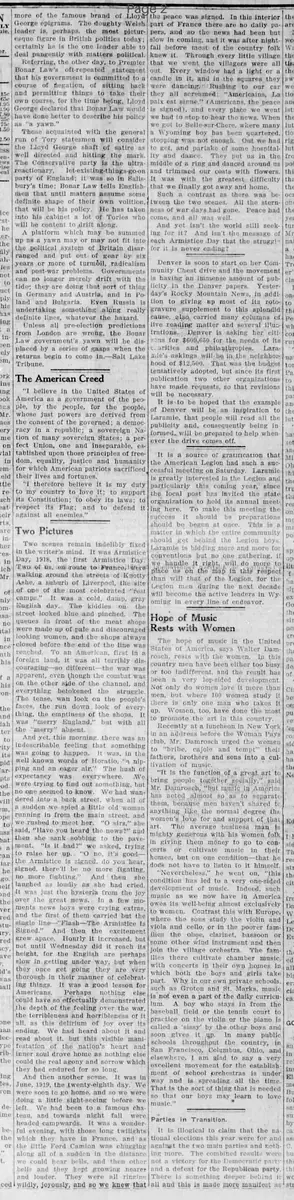
Two scenes remain indelibly fixed in the writer's mind. It was Armistice Day, 1918, the first Armistice Day. Two of us, en route to France, were walking around the streets of Knotty Ash, a suburb of Liverpool, the site of one of the most celebrated rest camps. It was a cold, damp, gray English day. The kiddies on the street looked blue and pinched. The queues in front of the meat shops were made up of pale and discouraged looking women, and the shops always closed before the end of the line was reached. To an American, first in a foreign land, it was all terribly discouraging—so different—the war was apparent, even though the combat was on the other side of the channel, and everything betokened the struggle. The tense, wan look on the people's faces, the run down look of everything, the emptiness of the shops. It was "merry England," but with all the "merry" absent.
And yet, this morning, there was an indescribable feeling that something was going to happen. It was, in the well known words of Horatio, "a nipping and an eager air." The hush of expectancy was everywhere. We were trying to find out something, but no one seemed to know. We had wandered into a back street, when all of a sudden we spied a little old woman running in from the main street, and we rushed to meet her. "O sirs," she said, "Have you heard the news?" and then she sank sobbing to the pavement. "Is it bad?" we asked, trying to raise her up. "O no, it's good—the Armistice is signed, do you hear, signed, there'll be no more fighting, no more fighting." And then she laughed as loudly as she had cried. It was just the hysteria from the joy over the great news. In a few moments news boys were crying extras, and the first of them carried but the single line "Flash—The Armistice Is Signed." And then the excitement grew apace. Hourly it increased, but not until Wednesday did it reach its height, for the English are perhaps slow in getting under way, but when they once get going they are very thorough in their manner of celebrating things. It was a good lesson for Americans.
Perhaps nothing else could have so effectually demonstrated the depth of the feeling over the war, the terribleness and horribleness of it all, as this delirium of joy over its ending. We had heard about it and read about it, but this visible manifestation of the nation's heart and inner soul drove home as nothing else could the real agony and sorrow which they had endured for so long.
And then another scene. It was in June, 1919, the twenty-eighth day. We were soon to go home, and so we were doing a little sight-seeing before we left. We had been to a famous chateau, and towards night fall were headed campwards. It was a wonderful evening, with those long twilights which they have in France, and as the little Ford camion was chugging along all of a sudden in the distance we could hear bells, and then other bells and they kept growing nearer and louder. They were all ringing wildly, joyously, and so we knew that the peace was signed. In this interior part of France there are no daily papers, and so the news had been but slow in coming, and it was after nightfall before most of the country folk knew it. Through every little village that we went the villagers were all out. Every window had a light or a candle in it, and in the squares they were dancing. Rushing to our car they all screamed: "Americains, La paix est signée." (Americans, the peace is signed), and every place we went we had to stop to hear the news. When we got to Selle-sur-Chere, where many a Wyoming boy has been quartered, stopping was not enough. Out we had to get, and partake of some hospitality and dance. They put us in the middle of a ring and danced around us and trimmed our coats with flowers. It was with the greatest difficulty that we finally got away and home.
Such a contrast as there was between the two scenes. All the sternness of war days had gone. Peace had come, and all was well.
And yet isn't the world still seeking for it? And isn't the message of each Armistice Day that the struggle for it is never ending?
Two scenes remain indelibly fixed in the writer's mind. It was Armistice Day, 1918, the first Armistice Day. Two of us, en route to France, were walking around the streets of Knotty Ash, a suburb of Liverpool, the site of one of the most celebrated rest camps. It was a cold, damp, gray English day. The kiddies on the street looked blue and pinched. The queues in front of the meat shops were made up of pale and discouraged looking women, and the shops always closed before the end of the line was reached. To an American, first in a foreign land, it was all terribly discouraging—so different—the war was apparent, even though the combat was on the other side of the channel, and everything betokened the struggle. The tense, wan look on the people's faces, the run down look of everything, the emptiness of the shops. It was "merry England," but with all the "merry" absent.
And yet, this morning, there was an indescribable feeling that something was going to happen. It was, in the well known words of Horatio, "a nipping and an eager air." The hush of expectancy was everywhere. We were trying to find out something, but no one seemed to know. We had wandered into a back street, when all of a sudden we spied a little old woman running in from the main street, and we rushed to meet her. "O sirs," she said, "Have you heard the news?" and then she sank sobbing to the pavement. "Is it bad?" we asked, trying to raise her up. "O no, it's good—the Armistice is signed, do you hear, signed, there'll be no more fighting, no more fighting." And then she laughed as loudly as she had cried. It was just the hysteria from the joy over the great news. In a few moments news boys were crying extras, and the first of them carried but the single line "Flash—The Armistice Is Signed." And then the excitement grew apace. Hourly it increased, but not until Wednesday did it reach its height, for the English are perhaps slow in getting under way, but when they once get going they are very thorough in their manner of celebrating things. It was a good lesson for Americans.
Perhaps nothing else could have so effectually demonstrated the depth of the feeling over the war, the terribleness and horribleness of it all, as this delirium of joy over its ending. We had heard about it and read about it, but this visible manifestation of the nation's heart and inner soul drove home as nothing else could the real agony and sorrow which they had endured for so long.
And then another scene. It was in June, 1919, the twenty-eighth day. We were soon to go home, and so we were doing a little sight-seeing before we left. We had been to a famous chateau, and towards night fall were headed campwards. It was a wonderful evening, with those long twilights which they have in France, and as the little Ford camion was chugging along all of a sudden in the distance we could hear bells, and then other bells and they kept growing nearer and louder. They were all ringing wildly, joyously, and so we knew that the peace was signed. In this interior part of France there are no daily papers, and so the news had been but slow in coming, and it was after nightfall before most of the country folk knew it. Through every little village that we went the villagers were all out. Every window had a light or a candle in it, and in the squares they were dancing. Rushing to our car they all screamed: "Americains, La paix est signée." (Americans, the peace is signed), and every place we went we had to stop to hear the news. When we got to Selle-sur-Chere, where many a Wyoming boy has been quartered, stopping was not enough. Out we had to get, and partake of some hospitality and dance. They put us in the middle of a ring and danced around us and trimmed our coats with flowers. It was with the greatest difficulty that we finally got away and home.
Such a contrast as there was between the two scenes. All the sternness of war days had gone. Peace had come, and all was well.
And yet isn't the world still seeking for it? And isn't the message of each Armistice Day that the struggle for it is never ending?
What sub-type of article is it?
Historical Event
Biography
What themes does it cover?
Triumph
Recovery
What keywords are associated?
Armistice Day
World War I
Peace Signing
Wartime Hardship
Celebrations
English Restraint
French Joy
What entities or persons were involved?
The Writer
Old Woman
Villagers
Where did it happen?
Knotty Ash, Liverpool; France, Selle Sur Chere
Story Details
Key Persons
The Writer
Old Woman
Villagers
Location
Knotty Ash, Liverpool; France, Selle Sur Chere
Event Date
Armistice Day, 1918; June 28, 1919
Story Details
The writer recalls two scenes: the subdued joy in England on Armistice Day 1918 amid wartime hardship, and exuberant celebrations in France on the day peace was signed in 1919, contrasting war's end with ongoing quest for peace.