Thank you for visiting SNEWPapers!
Sign up free
Boon's Lick Times
Fayette, Howard County, Missouri
What is this article about?
Committee report from the Missouri Constitutional Convention on reforming the eighth article, proposing bans on new banks, restrictions on corporations including stockholder liability, prohibition of paper money issuance, and winding up the Bank of the State of Missouri by 1847.
Merged-components note: Continuation of the Missouri Constitutional Convention report on banks and corporations.
Clipping
OCR Quality
Full Text
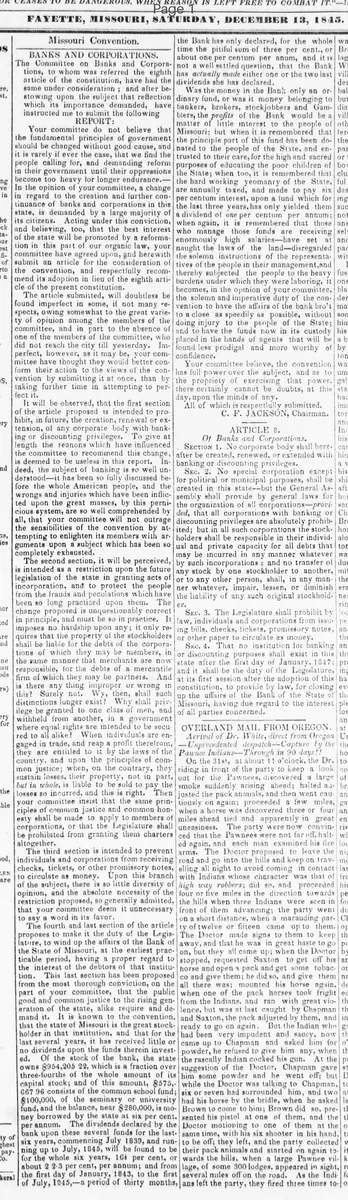
Missouri Convention.
BANKS AND CORPORATIONS.
The Committee on Banks and Corporations, to whom was referred the eighth article of the constitution, have had the same under consideration; and after bestowing upon the subject that reflection which its importance demanded, have instructed me to submit the following REPORT:
Your committee do not believe that the fundamental principles of government should be changed without good cause, and it is rarely if ever the case, that we find the people calling for, and demanding reform in their government until their oppressions become too heavy for longer endurance.
In the opinion of your committee, a change in regard to the creation and further continuance of banks and corporations in this state, is demanded by a large majority of its citizens. Acting under this conviction, and believing, too, that the best interest of the state will be promoted by a reformation in this part of our organic law, your committee have agreed upon, and herewith submit an article for the consideration of the convention, and respectfully recommend its adoption in lieu of the eighth article of the present constitution.
The article submitted, will doubtless be found imperfect in some, if not many respects, owing somewhat to the great variety of opinion among the members of the committee, and in part to the absence of one of the members of the committee, who did not reach the city till yesterday. Imperfect, however, as it may be, your committee have thought they would better conform their action to the views of the convention by submitting it at once, than by taking further time in attempting to perfect it.
It will be observed, that the first section of the article proposed is intended to prohibit, in future, the creation, renewal or extension, of any corporate body with banking or discounting privileges. To give at length the reasons which have influenced the committee to recommend this change, is deemed to be useless in this report. Indeed, the subject of banking is so well understood—it has been so fully discussed before the whole American people, and the wrongs and injuries which have been inflicted upon the great masses, by this pernicious system, are so well comprehended by all, that your committee will not outrage the sensibilities of the convention by attempting to enlighten its members with arguments upon a subject which has been so completely exhausted.
The second section, it will be perceived, is intended as a restriction upon the future legislation of the state in granting acts of incorporation, and to protect the people from the frauds and peculations which have been so long practiced upon them. The change proposed is unquestionably correct in principle, and must be so in practice. It imposes no hardship upon any; it only requires that the property of the stockholders shall be liable for the debts of the corporations of which they may be members, in the same manner that merchants are now responsible, for the debts of a mercantile firm of which they may be partners. And is there any thing improper or wrong in this? Surely not. Why, then, shall such distinctions longer exist? Why shall privilege be granted to one class of men, and withheld from another, in a government where equal rights are intended to be secured to all alike? When individuals are engaged in trade, and reap a profit therefrom, they are entitled to it by the laws of the country, and upon the principles of common justice; when, on the contrary, they sustain losses, their property, not in part, but in whole, is liable to be sold to pay the losses so incurred, and this is right. Then your committee insist that the same principles of common justice and common honesty shall be made to apply to members of corporations, or that the Legislature shall be prohibited from granting them charters altogether.
The third section is intended to prevent individuals and corporations from receiving checks, tickets, or other promissory notes, to circulate as money. Upon this branch of the subject, there is so little diversity of opinion, and the absolute necessity of the restriction proposed, so generally admitted, that your committee deem it unnecessary to say a word in its favor.
The fourth and last section of the article proposes to make it the duty of the Legislature, to wind up the affairs of the Bank of the State of Missouri, at the earliest practicable period, having a proper regard to the interest of the debtors of that institution. This last section has been proposed from the most thorough conviction, on the part of your committee, that the public good and common justice to the rising generation of the state, alike require and demand it. It is known to the convention, that the state of Missouri is the great stockholder in that institution, and that for the last several years, it has received little or no dividends upon the funds therein invested. Of the stock of the bank, the state owns $954,205 22, which is a fraction over three-fourths of the whole amount of its capital stock; and of this amount, $575,667 96 consists of the common school fund; $100,000, of the seminary or university fund, and the balance, near $280,000, is money borrowed by the state at six per cent. per annum. The dividends declared by the bank upon these several funds for the last six years, commencing July 1839, and running up to July, 1845, will be found to be for the whole six years, 16 2/3 per cent, or about 2 2-3 per cent, per annum; and from the first day of January, 1843, to the first of July, 1845,—a period of thirty months.
the Bank has only declared, for the whole time the pitiful sum of three per cent., or about one per centum per annum, and it is not a well settled question, that the Bank has actually made either one or the two last dividends she has declared.
Was the money in the Bank only an ordinary fund, or was it money belonging to bankers, brokers, stockjobbers and Gamblers, the profits of the Bank would be a matter of little interest to the people of Missouri; but when it is remembered that the principle part of this fund has been donated to the people of the State, and entrusted to their care, for the high and sacred purposes of educating the poor children of the State; when too, it is remembered that the hard working yeomanry of the State, are annually taxed, and made to pay six per centum interest, upon a fund which for the last three years, has only yielded them a dividend of one per centum per annum; when again, it is remembered that those who manage those funds are receiving enormously high salaries—have set at naught the laws of the land—disregarded the solemn instructions of the representatives of the people in their management, and thereby subjected the people to the heavy burdens under which they were laboring, it becomes, in the opinion of your committee, the solemn and imperative duty of the convention to have the affairs of the bank bro't to a close as speedily as possible, without doing injury to the people of the State; and to have the funds now in its custody placed in the hands of agents that will be found less prodigal and more worthy of confidence.
Your committee believe, the convention has full power over the subject, and as to the propriety of exercising that power, there certainly cannot be doubts, at this day, upon the minds of any.
All of which is respectfully submitted.
C. F. JACKSON, Chairman.
ARTICLE 8.
Of Banks and Corporations.
Section 1. No corporate body shall hereafter be created, renewed, or extended with banking or discounting privileges.
Sec. 2. No special corporation except for political or municipal purposes, shall be created in this state—but the General Assembly shall provide by general laws for the organization of all corporations—provided, that all corporations with banking or discounting privileges are absolutely prohibited; but in all such corporations the stockholders shall be responsible in their individual and private capacity for all debts that may be incurred in any manner whatever by such incorporations; and no transfer of any stock by one stockholder to another, or to any other person, shall, in any manner whatever, impair, lessen, or diminish the liability of any such original stockholder.
Sec. 3. The Legislature shall prohibit by law, individuals and corporations from issuing bills, checks, tickets, promissory notes, or other paper to circulate as money.
Sec. 4. That no institution for banking or discounting purposes shall exist in this state after the first day of January, 1847; and it shall be the duty of the Legislature, at its first session after the adoption of this constitution, to provide by law, for closing up the affairs of the Bank of the State of Missouri, having due regard to the interest of all parties concerned.
What sub-type of article is it?
What keywords are associated?
What entities or persons were involved?
Where did it happen?
Domestic News Details
Primary Location
Missouri
Event Date
December 13, 1845
Key Persons
Event Details
The Committee on Banks and Corporations submits a report recommending replacement of the eighth article of the Missouri constitution to prohibit future banks with discounting privileges, restrict incorporations to general laws with full stockholder liability, ban issuance of paper to circulate as money, and require the legislature to wind up the Bank of the State of Missouri by January 1, 1847, citing poor performance and misuse of public funds.