Thank you for visiting SNEWPapers!
Sign up free
Virginia Argus
Richmond, Virginia
What is this article about?
On January 3, 1810, the U.S. House of Representatives received President Madison's message recommending renewal of militia detachment act, provisions for volunteers and navy, and militia organization. Various petitions and bills were referred to committees. A resolution approving the executive's refusal to receive communications from British minister Francis James Jackson passed after a 19-hour debate, 72-41.
Merged-components note: Continuation of congressional proceedings report, including resolutions and debates.
Clipping
OCR Quality
Full Text
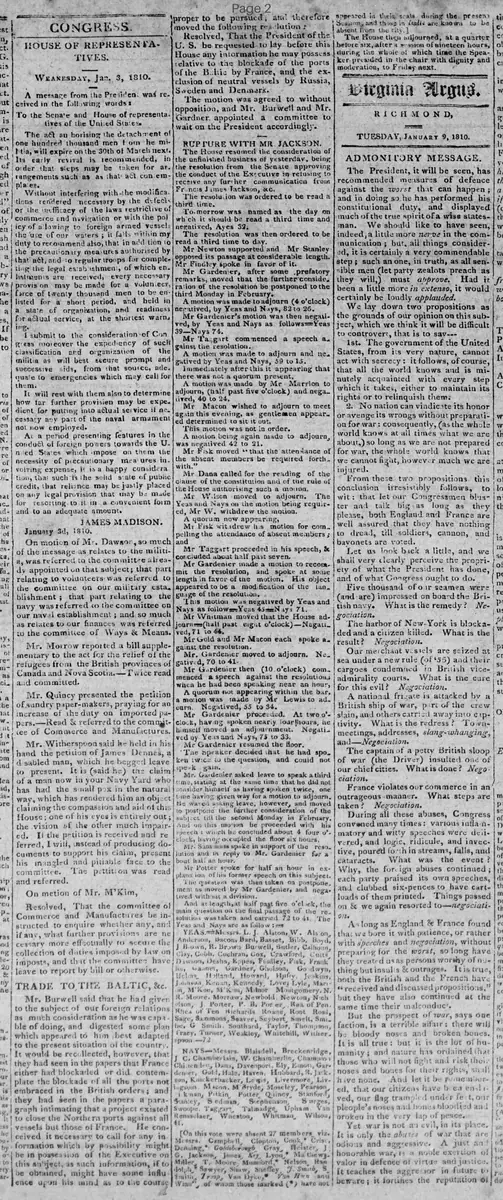
HOUSE OF REPRESENTATIVES.
Wednesday, Jan. 3, 1810.
A message from the President was received in the following words:
To the Senate and House of Representatives of the United States:
The act authorising the detachment of one hundred thousand men from the militia, will expire on the 30th of March next. Its early revival is recommended, in order that steps may be taken for arrangements such as that act contemplates.
Without interfering with the modifications rendered necessary by the defects of the efficacy of the laws restrictive of commerce and navigation or with the policy of allowing to foreign armed vessels the use of our waters; it falls within my duty to recommend also, that in addition to the precautionary measures authorised by that act, and to regular troops for completing the legal establishment, of which enlistments are received, every necessary provision may be made for a volunteer force of twenty thousand men to be enlisted for a short period, and held in a state of organization, and readiness for actual service, at the shortest warning.
I submit to the consideration of Congress moreover the expediency of such classification and organization of the militia as will best secure prompt and successive aids from that source, adequate to emergencies which may call for them.
It will rest with them also to determine how far further provision may be expedient for putting into actual service if necessary any part of the naval armament not now employed.
At a period presenting features in the conduct of foreign powers towards the United States which impose on them the necessity of precautionary measures involving expense, it is a happy consideration, that such is the solid state of public credit, that reliance may be justly placed on any legal provision that may be made for resorting to it in a convenient form and to an adequate amount.
JAMES MADISON.
January 3d, 1810.
On motion of Mr. Dawson, so much of the message as relates to the militia, was referred to the committee already appointed on that subject; that part relating to volunteers was referred to the committee on our military establishment; that part relating to the navy was referred to the committee on our naval establishment; and so much as relates to our finances was referred to the committee of Ways & Means.
Mr. Morrow reported a bill supplementary to the act for the relief of the refugees from the British provinces of Canada and Nova Scotia.-- Twice read and committed.
Mr. Quincy presented the petition of sundry paper-makers, praying for an increase of the duty on imported papers.--Read & referred to the committee of Commerce and Manufactures.
Mr. Witherspoon said he held in his hand the petition of James Dennes, a disabled man, which he begged leave to present. It is (said he) the claim of a man now in your Navy Yard who has had the small pox in the natural way, which has rendered him an object claiming the compassion and aid of this House; one of his eyes is entirely out; the vision of the other much impaired. If the petition is received and referred, I will, instead of producing documents to support his claim, present his mangled and pitiable face to the committee. The petition was read and referred.
On motion of Mr. M'Kim,
Resolved, That the committee of Commerce and Manufactures be instructed to enquire whether any, and if any, what further provisions are necessary more effectually to secure the collection of duties imposed by law on imposts, and that the committee have leave to report by bill or otherwise.
TRADE TO THE BALTIC, &c.
Mr. Burwell said that he had given to the subject of our foreign relations as much consideration as he was capable of doing, and digested some plan which appeared to him best adapted to the present situation of the country. It would be recollected, however, that they had seen in the papers that France either had blockaded or did contemplate the blockade of all the ports not embraced in the British orders; and they had seen in the papers a paragraph intimating that a project existed to close the Northern ports against all vessels but those of France. He conceived it necessary to call for any information which by possibility might be in possession of the Executive on this subject, as such information, if to be obtained, might have some influence upon his mind as to the course proper to be pursued; and therefore moved the following resolution:
Resolved. That the President of the U. S. be requested to lay before this House any information he may possess relative to the blockade of the ports of the Baltic by France, and the exclusion of neutral vessels by Russia, Sweden and Denmark.
The motion was agreed to without opposition, and Mr. Burwell and Mr. Gardner, appointed a committee to wait on the President accordingly.
RUPTURE WITH MR. JACKSON.
The House resumed the consideration of the unfinished business of yesterday, being the resolution from the Senate approving the conduct of the Executive in refusing to receive any further communication from Francis James Jackson, &c.
The resolution was ordered to be read a third time.
Tomorrow was named as the day on which it should be read a third time and negatived, Aves 32:
The resolution was then ordered to be read a third time to day.
Mr Newton supported and Mr Stanley opposed its passage at considerable length.
Mr Findley spoke in favor of it.
Mr Gardenier, after some prefatory remarks, moved that the further consideration of the resolution be postponed to the third Monday in February.
A motion was made to adjourn (4 o'clock) negatived, by Yeas and Nays, 82 to 26.
Mr Gardenier's motion was then negatived, by Yeas and Nays as follows--Yeas 39 Nays 74.
Mr Taggart commenced a speech against the resolution.
A motion was made to adjourn and negatived by Yeas and Nays, 59 to 15.
Immediately after this it appearing that there was not a quorum present,
A motion was made by Mr Marion to adjourn, (half past five o'clock) and negatived, 40 to 24,
Mr Macon wished to adjourn to meet again this evening, as gentlemen appeared determined to sit it out.
'This motion was not in order.
A motion being again made to adjourn, was negatived 42 to 21.
Mr Fisk moved "that the attendance of the absent members be required forthwith."
Mr Dana called for the reading of the clause of the constitution and of the rule of the House authorising such a motion.
Mr Wilson moved to adjourn. The Yeas and Nays on the motion being required, Mr W. withdrew the motion.
A quorum now appearing,
Mr Fisk withdrew his motion for compelling the attendance of absent members;
and
Mr Taggart proceeded in his speech, & concluded about half past seven.
Mr Gardenier made a motion to recommit the resolution, and spoke at some length in favor of the motion. His object appeared to be a modification of the language of the resolution..
This motion was negatived by Yeas and Nays as follow--Yeas 45 -Nays 71.
Mr Whitman moved that the House adjourn-(half past eight o'clock)-Negatived,71 to 44.
Mr Gold and Mr Macon each spoke against the resolution.
Mr. Gardenier moved to adjourn. Negatived, 70 to 41.
Mr Gardenier then (10 o'clock) commenced a speech against the resolution: when he had been speaking near an hour,
A quorum not appearing within the bar,
a motion was made by Mr Lewis to adjourn. Negatived, 55 to 34.
Mr Gardenier proceeded. At two o'clock, having spoken nearly four hours, he himself moved an adjournment. Negatived by Yeas and Nays, 75 to 33.
Mr Gardenier resumed the floor.
The Speaker decided that he had spoken twice to the question, and could not speak again.
Mr. Gardenier asked leave to speak a third time, stating at the same time that he did not consider himself as having spoken twice, one time having given way for a motion to adjourn.
He waved asking leave, however, and moved to postpone the further consideration of the subject till the second Monday in February.
And on this motion he proceeded with his speech : which he concluded about four o'clock, having occupied the floor six hours,
Mr. Sammons spoke in support of the resolution and in reply to Mr. Gardenier for about half an hour.
Mr Potter spoke for half an hour in explanation of his former speech on this subject.
The question was then taken on postponement as moved by Mr Gardenier, and negatived without a division.
And at length, at half past five o'clock, the main question on the final passage of the resolution was taken and carried 72 to 41. The Yeas and Nays are as follow :-
YEAS--Messrs. L. J. Alston, W. Alston. Anderson, Bacon, Bard, Bassett, Bibb, Boyd, J Brown, R. Brown Burwell, Butler, Calhoun Clay, Cobb, Cochran, Cox, Crawford, Creets Dawson, Desha, Eppes, Findley, Fisk, Franklin, Cane, Gardner, Gholson, Godwin, Helms, Holland, Howard, Huger, Jenkins, Johnson, Kenan, Kennedy, Lowry Lyle, Marion, M'Kee, M'Kim, Minor Montgomery. N. R. Moore. Morrow. Newbold. Newton, Nicholson, J. Porter, P. B. Porter, Reed of Pennsylvania, Rhett or Ten Ketch Richards Roane, Root Ross, Sage, Sammons, Seaver, Seybert, Smilie, & Smith. Southard, Taylor, Thompson, Troup, Turner, Weakley, Whitehill, Witherspoon -72
NAYS--Messrs. Blaisdell, Breckenridge, J C, Chamberlain, W. Chamberlin, Champion Chittenden, Dana, Davenport, Ely, Emotti, Gardenier, Gold, Hale, Haven, Hubbard, R. Jackson, Knickerbocker, Lewis, Livermore, Livingston. Macon, M'Arthur, Moseley, Pearson Pitkin, Potter Quincy Stanford Stanley, Reedman, Stephenson. Sturges, Swoope. Taggart. Talmadge Upham Van Rensselaer Wheaton, Whitman Wilson 41,
[On this vote were absent 27 members viz. Messrs. Campbell Clopton, Cook Crist, Denning, Goldsborough Gray, Westcott, J. G. Jackson, Jones. Key. Lyon Matthews. Miller, T. Moore Mumford Nelson Randolph, Sawyer, Shaw, Sheey, J. Smith, S imith, Troup, Van Dyke, Van Horn and Winn of whom those marked () have not appeared in their seats during the present Session, and those in italics are known to be absent from the city.]
The House then adjourned, at a quarter before six, after a session of nineteen hours, during the whole of which time the Speaker presided in the chair with dignity and moderation, to Friday next.
What sub-type of article is it?
What keywords are associated?
What entities or persons were involved?
Where did it happen?
Domestic News Details
Primary Location
United States
Event Date
January 3, 1810
Key Persons
Outcome
resolution approving executive's refusal of communications from francis james jackson passed 72-41 after 19-hour debate; various parts of president's message referred to committees; petitions read and referred; resolution on baltic trade information agreed to.
Event Details
The House received and referred President Madison's message on renewing militia act, volunteer force, navy provisions, and militia organization. Reported and committed bill for refugees; presented petitions from paper-makers and disabled sailor James Dennes, both referred. Instructed committee on impost duties. Passed resolution requesting information on Baltic blockades. Debated and passed Senate resolution on rupture with Jackson after extended speeches, motions to adjourn, and quorum issues.