Thank you for visiting SNEWPapers!
Sign up free
Potosi Journal
Potosi, Washington County, Missouri
What is this article about?
In London, British and French governments agree on an ultimatum to Germany, giving 10 days to accept reparations payments and financial controls, or face penalties including Ruhr occupation. Belgian intervention aids agreement; French prepare militarily amid concerns over US mediation.
Clipping
OCR Quality
Full Text
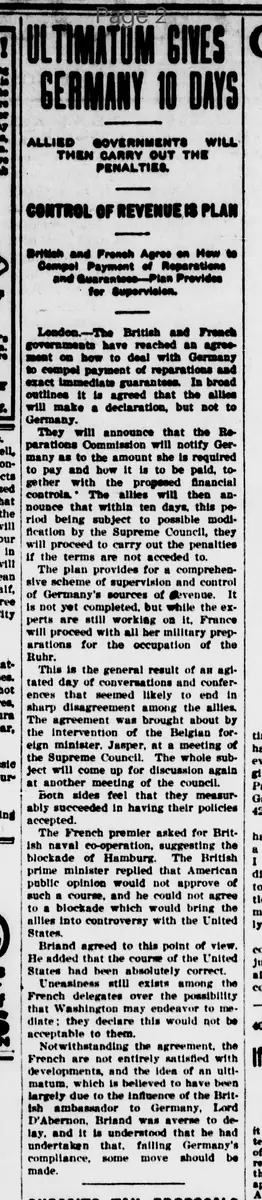
Allied governments will then carry out the penalties. Control of revenue is planned and French agree on new compel payment of reparations and guarantees-plan provides for supervision.
London.--The British and French governments have reached an agreement on how to deal with Germany to compel payment of reparations and exact immediate guarantees. In broad outlines it is agreed that the allies will make a declaration, but not to Germany. They will announce that the Reparations Commission will notify Germany as to the amount she is required to pay and how it is to be paid, together with the proposed financial control. The allies will then announce that within ten days, this period being subject to possible modification by the Supreme Council, they will proceed to carry out the penalties if the terms are not acceded to. The plan provides for a comprehensive scheme of supervision and control of Germany's sources of revenue. It is not yet completed, but while the experts are still working on it, France will proceed with all her military preparations for the occupation of the Ruhr. This is the general result of an agitated day of conversations and conferences that seemed likely to end in sharp disagreement among the allies. The agreement was brought about by the intervention of the Belgian foreign minister, Jaspar, at a meeting of the Supreme Council. The whole subject will come up for discussion again at another meeting of the council. Both sides feel that they measurably succeeded in having their policies accepted. The French premier asked for British naval co-operation, suggesting the blockade of Hamburg. The British prime minister replied that American public opinion would not approve of such a course, and he could not agree to a blockade which would bring the allies into controversy with the United States. Briand agreed to this point of view. He added that the course of the United States had been absolutely correct. Uneasiness still exists among the French delegates over the possibility that Washington may endeavor to mediate; they declare this would not be acceptable to them. Notwithstanding the agreement, the French are not entirely satisfied with developments, and the idea of an ultimatum, which is believed to have been largely due to the influence of the British ambassador to Germany, Lord D'Abernon, Briand was averse to delay, and it is understood that he had undertaken that, failing Germany's compliance, some move should be made.
What sub-type of article is it?
What keywords are associated?
What entities or persons were involved?
Where did it happen?
Foreign News Details
Primary Location
Germany
Key Persons
Outcome
ultimatum gives germany 10 days to comply with reparations demands or face penalties including occupation of the ruhr and financial controls.
Event Details
British and French governments reach agreement in London on ultimatum to Germany via Reparations Commission notification of payment amounts and financial controls. Within 10 days, allies will enforce penalties if not acceded to. Plan includes supervision of German revenue sources. France prepares military for Ruhr occupation. Agreement facilitated by Belgian foreign minister Jaspar at Supreme Council. French premier Briand seeks but drops naval blockade idea due to US concerns. French uneasy about potential US mediation.