Thank you for visiting SNEWPapers!
Sign up free
The Liberator
Boston, Suffolk County, Massachusetts
What is this article about?
George W. McRee, from Nottingham, England, writes to W.L. Garrison expressing profound shock and sorrow over American slavery's contradiction to national ideals and Christianity, quoting Cowper on human equality to advocate emancipation. He praises George Thompson's parliamentary role against war and slavery, lauds Henry C. Wright's truthful writings, deplores the Mexican War's harms, and offers to correspond on British affairs for The Liberator.
Clipping
OCR Quality
Full Text
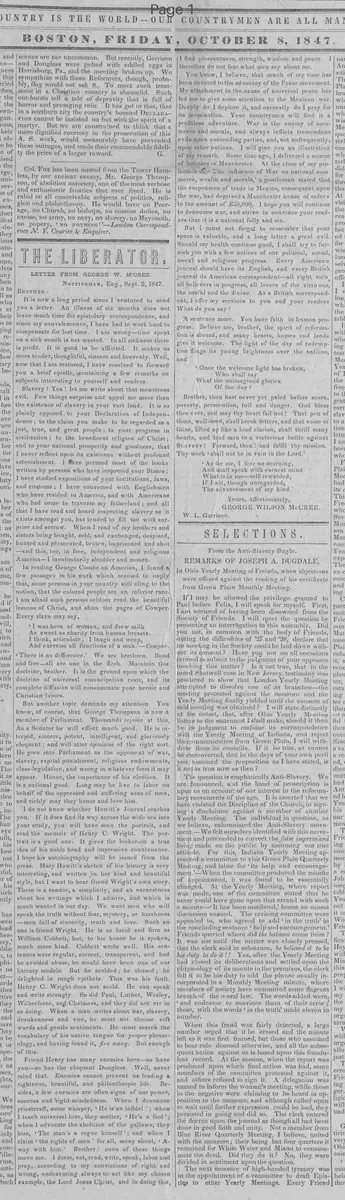
LETTER FROM GEORGE W. MCREE.
NOTTINGHAM, Eng., Sept. 2, 1847.
BROTHER:
It is now a long period since I ventured to send you a letter. An illness of six months does not leave much time for epistolary correspondence, and since my convalescence, I have had to work hard to compensate for lost time. I am wrong—time spent on a sick couch is not wasted. In all sickness there is profit. It is good to be afflicted. It makes us more tender, thoughtful, sincere and heavenly. Well, now that I am restored, I have resolved to forward you a brief epistle, containing a few remarks on subjects interesting to yourself and readers.
Slavery! Yes! let me write about that monstrous evil. Few things surprise and appal me more than the existence of slavery in your vast land. It is so plainly opposed to your Declaration of Independence; to the claim you make to be regarded as a just, true, and great people; to your progress in civilization; to the beneficent religion of Christ; and to your national prosperity and goodness, that I never reflect upon its existence without profound astonishment. I have perused most of the books written by persons who have inspected your States; I have studied expositions of your institutions, laws, and customs; I have conversed with Englishmen who have resided in America, and with Americans who had come to traverse my fatherland; and all that I have read and heard respecting slavery as it exists amongst you, has tended to fill me with surprise and sorrow. When I read of my brothers and sisters being bought, sold, and exchanged, despised, hunted and persecuted, beaten, imprisoned and shot—and this, too, in free, independent and religious America—I involuntarily shudder and mourn.
In reading George Combe on America, I found a few passages in his work which seemed to imply that, some persons in your country still cling to the notion, that the colored people are an inferior race. I am afraid such persons seldom read the beautiful lessons of Christ, and shun the pages of Cowper.
Every slave may say,
I was born of woman, and drew milk
As sweet as charity from human breasts.
I think, articulate; I laugh and weep,
And exercise all functions of a man.'—Cowper.
There is no difference.' We are brethren. Bond and free—all are one in the flesh. Maintain this doctrine, brother. It is the ground upon which the doctrine of universal emancipation rests, and its complete diffusion will consummate your heroic and Christian labors.
But another topic demands my attention. You know, of course, that George Thompson is now a member of Parliament. Thousands rejoice at this. As a Senator he will effect much good. He is intrepid, sincere, potent, intelligent, and gloriously eloquent; and will utter opinions of the right sort.
He goes into Parliament as the opponent of war, slavery, capital punishment, religious endowments, class-legislation, and wrong in whatever form it may appear. Hence, the importance of his election. It is a national good. Long may he live to labor on behalf of the oppressed and suffering sons of men, and richly may they honor and love him.
I do not know whether Howitt's Journal reaches you. If it does find its way across the wide sea into your study, you will have seen the portrait, and read the memoir of Henry C. Wright. The portrait is a good one. It gives the looker-on a true idea of his noble head and impressive countenance.
I hope his autobiography will be issued from the press. Mary Howitt's sketch of his history is very interesting, and written in her kind and beautiful style, but I want to hear friend Wright's own story.
There is a candor, a simplicity, and an earnestness about his writings which I admire, and which is much wanted in our day. We want men who will speak the truth without fear, mystery, or harshness—men full of sincerity, truth and love. Such an one is friend Wright. He is as lucid and firm as William Cobbett, but, to his honor be it spoken, much more kind. Cobbett wrote well. His sentences were regular, correct, transparent, and had he avoided abuse, he would have been one of our literary models. But he scolded; he abused; he delighted in rough epithets. This was his fault.
Henry C. Wright does not scold. He can speak and write strongly. So did Paul, Luther, Wesley, Wilberforce, and Chalmers, and they did not err in so doing. When a man writes about war, slavery, drunkenness and vice, he must not choose soft words and gentle sentiments. He must search the vocabulary of his native tongue for proper phraseology, and having found it, fire away. But enough of this.
Friend Henry has many enemies here—so have you—so has the eloquent Douglass. Well, never mind that. Enemies cannot prevent us leading a righteous, beautiful, and philanthropic life. Besides, a few enemies are often signs of our power success and right-mindedness. When I denounce priestcraft, some whisper, He is an infidel'; when I teach universal love, they mutter, He's a fool'; when I advocate the abolition of the gallows, they hiss, The man's a rogue himself'; and when I claim 'the rights of man' for all, many shout, 'Away with him.' Brother! none of these things move me. I dress, eat, read, write, speak, labor and pray, according to my convictions of right and wrong, endeavoring always to act like my chosen example, the Lord Jesus Christ, and in doing this,
I find pleasantness, strength, wisdom and peace.
therefore do not fear what men say about me.
You know, I believe, that much of my time has been devoted to the advocacy of the Peace movement. My attachment to the cause of universal peace has led me to give some attention to the Mexican war. Deeply do I deplore it, and earnestly do I pray for its termination. Your countrymen will find it a profitless adventure. War is the enemy of commerce and morals, and always inflicts tremendous evils upon contending parties, and, not unfrequently, upon other nations. I will give you an illustration of my remark. Some time ago, I delivered a course of lectures in Manchester. At the close of my prelection on 'The influence of War on national commerce, wealth and morals,' a gentleman stated that the suspension of trade in Mexico, consequent upon the war, had deprived a Manchester house of orders to the amount of 50,000. I hope you will continue to denounce war, and strive to convince your readers that it is a national folly and sin.
But I must not forget to remember that your space is valuable, and a long letter a great evil Should my health continue good, I shall try to furnish you with a few notices of our political, social, moral and religious progress. Every American journal should have its English, and every British journal its American correspondent—all right men all believers in progress, all lovers of the virtuous, the useful and the divine. As a British correspondent, I offer my services to you and your readers What do you say?
A sentence more. You have faith in human progress. Believe me, brother, the spirit of reformation is abroad, and many hearts, homes and lands give it welcome. The light of the day of redemption flings its young brightness over the nations and
'Once the welcome light has broken,
Who shall say
What the unimagined glories
Of the day?
Brother, thou hast never yet paled before scorn, poverty, persecution, toil and danger. God bless thee ever, and may thy heart fail not! That pen of thine, well-used, shall break fetters, and that voice of thine, lifted up like a loud clarion, shall thrill many hearts, and lead men to a victorious battle against Slavery! Forward, then! and fulfil thy mission.
Thy work 'shall not be in vain in the Lord.
As for me, I fear no scorning,
And shall speak with earnest mind
What is in me—self-rewarded,
If I aid, though unregarded,
The advancement of my kind.'
Yours, affectionately,
GEORGE WILSON McCREE,
W. L. Garrison.
What sub-type of article is it?
What themes does it cover?
What keywords are associated?
What entities or persons were involved?
Letter to Editor Details
Author
George Wilson Mccree
Recipient
W. L. Garrison
Main Argument
american slavery is a monstrous evil contradicting national ideals, christianity, and human equality; urges recognition of shared humanity for universal emancipation, praises anti-slavery advocates like thompson and wright, opposes the mexican war as folly, and offers correspondence on british progress.
Notable Details