Thank you for visiting SNEWPapers!
Sign up free
Editorial
January 10, 1934
The Times News
Hendersonville, Henderson County, North Carolina
What is this article about?
Compilation of 1933 opinions from US senators, religious leaders, organizations like the American Legion and AFL, and others opposing President Roosevelt's recognition of the Soviet Union, citing communist threats, financial risks, anti-religious policies, and revolutionary activities.
Clipping
OCR Quality
98%
Excellent
Full Text
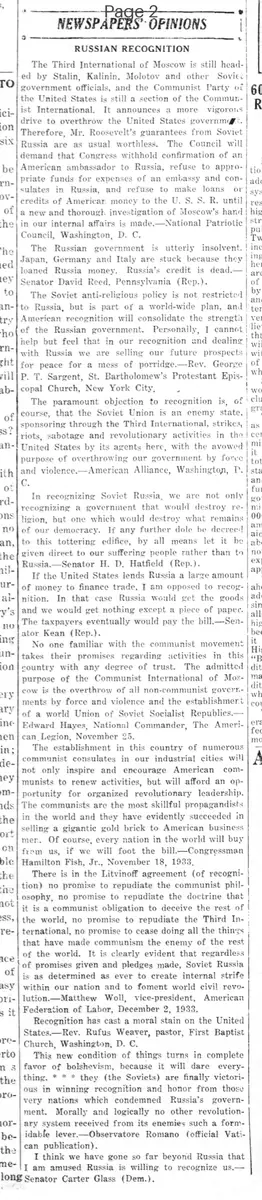
NEWSPAPERS' OPINIONS
RUSSIAN RECOGNITION
The Third International of Moscow is still headed by Stalin, Kalinin, Molotov and other Soviet government officials, and the Communist Party of the United States is still a section of the Communist International. It announces a more vigorous drive to overthrow the United States government.
Therefore, Mr. Roosevelt's guarantees from Soviet Russia are as usual worthless. The Council will demand that Congress withhold confirmation of an American ambassador to Russia, refuse to appropriate funds for expenses of an embassy and consulates in Russia, and refuse to make loans or credits of American money to the U. S. S. R. until a new and thorough investigation of Moscow's hand in our internal affairs is made.
—National Patriotic Council, Washington, D. C.
The Russian government is utterly insolvent. Japan, Germany and Italy are stuck because they loaned Russia money. Russia's credit is dead.
—Senator David Reed, Pennsylvania (Rep.).
The Soviet anti-religious policy is not restricted to Russia, but is part of a world-wide plan, and American recognition will consolidate the strength of the Russian government. Personally, I cannot help but feel that in our recognition and dealing with Russia we are selling our future prospects for peace for a mess of porridge.
—Rev. George P. T. Sargent, St. Bartholomew's Protestant Episcopal Church, New York City.
The paramount objection to recognition is, of course, that the Soviet Union is an enemy state, sponsoring through the Third International, strikes, riots, sabotage and revolutionary activities in the United States by its agents here, with the avowed purpose of overthrowing our government by force and violence.
—American Alliance, Washington, D. C.
In recognizing Soviet Russia, we are not only recognizing a government that would destroy religion, but one which would destroy what remains of our democracy. If any further dole be decreed to this tottering edifice, by all means let it be given direct to our suffering people rather than to Russia.
—Senator H. D. Hatfield (Rep.).
If the United States lends Russia a large amount of money to finance trade, I am opposed to recognition. In that case Russia would get the goods and we would get nothing except a piece of paper. The taxpayers eventually would pay the bill.
—Senator Kean (Rep.).
No one familiar with the communist movement takes their promises regarding activities in this country with any degree of trust. The admitted purpose of the Communist International of Moscow is the overthrow of all non-communist governments by force and violence and the establishment of a world Union of Soviet Socialist Republics.
—Edward Hayes, National Commander, The American Legion, November 25.
The establishment in this country of numerous communist consulates in our industrial cities will not only inspire and encourage American communists to renew activities, but will afford an opportunity for organized revolutionary leadership. The communists are the most skillful propagandists in the world and they have evidently succeeded in selling a gigantic gold brick to American business men. Of course, every nation in the world will buy from us, if we will foot the bill.
—Congressman Hamilton Fish, Jr., November 18, 1933.
There is in the Litvinoff agreement (of recognition) no promise to repudiate the communist philosophy, no promise to repudiate the doctrine that it is a communist obligation to deceive the rest of the world, no promise to repudiate the Third International, no promise to cease doing all the things that have made communism the enemy of the rest of the world. It is clearly evident that regardless of promises given and pledges made, Soviet Russia is as determined as ever to create internal strife within our nation and to foment world civil revolution.
—Matthew Woll, vice-president, American Federation of Labor, December 2, 1933.
Recognition has cast a moral stain on the United States.
—Rev. Rufus Weaver, pastor, First Baptist Church, Washington, D. C.
This new condition of things turns in complete favor of bolshevism, because it will dare everything. * * * they (the Soviets) are finally victorious in winning recognition and honor from those very nations which condemned Russia's government. Morally and logically no other revolutionary system received from its enemies such a formidable lever.
—Observatore Romano (official Vatican publication).
I think we have gone so far beyond Russia that I am amused Russia is willing to recognize us.
—Senator Carter Glass (Dem.).
RUSSIAN RECOGNITION
The Third International of Moscow is still headed by Stalin, Kalinin, Molotov and other Soviet government officials, and the Communist Party of the United States is still a section of the Communist International. It announces a more vigorous drive to overthrow the United States government.
Therefore, Mr. Roosevelt's guarantees from Soviet Russia are as usual worthless. The Council will demand that Congress withhold confirmation of an American ambassador to Russia, refuse to appropriate funds for expenses of an embassy and consulates in Russia, and refuse to make loans or credits of American money to the U. S. S. R. until a new and thorough investigation of Moscow's hand in our internal affairs is made.
—National Patriotic Council, Washington, D. C.
The Russian government is utterly insolvent. Japan, Germany and Italy are stuck because they loaned Russia money. Russia's credit is dead.
—Senator David Reed, Pennsylvania (Rep.).
The Soviet anti-religious policy is not restricted to Russia, but is part of a world-wide plan, and American recognition will consolidate the strength of the Russian government. Personally, I cannot help but feel that in our recognition and dealing with Russia we are selling our future prospects for peace for a mess of porridge.
—Rev. George P. T. Sargent, St. Bartholomew's Protestant Episcopal Church, New York City.
The paramount objection to recognition is, of course, that the Soviet Union is an enemy state, sponsoring through the Third International, strikes, riots, sabotage and revolutionary activities in the United States by its agents here, with the avowed purpose of overthrowing our government by force and violence.
—American Alliance, Washington, D. C.
In recognizing Soviet Russia, we are not only recognizing a government that would destroy religion, but one which would destroy what remains of our democracy. If any further dole be decreed to this tottering edifice, by all means let it be given direct to our suffering people rather than to Russia.
—Senator H. D. Hatfield (Rep.).
If the United States lends Russia a large amount of money to finance trade, I am opposed to recognition. In that case Russia would get the goods and we would get nothing except a piece of paper. The taxpayers eventually would pay the bill.
—Senator Kean (Rep.).
No one familiar with the communist movement takes their promises regarding activities in this country with any degree of trust. The admitted purpose of the Communist International of Moscow is the overthrow of all non-communist governments by force and violence and the establishment of a world Union of Soviet Socialist Republics.
—Edward Hayes, National Commander, The American Legion, November 25.
The establishment in this country of numerous communist consulates in our industrial cities will not only inspire and encourage American communists to renew activities, but will afford an opportunity for organized revolutionary leadership. The communists are the most skillful propagandists in the world and they have evidently succeeded in selling a gigantic gold brick to American business men. Of course, every nation in the world will buy from us, if we will foot the bill.
—Congressman Hamilton Fish, Jr., November 18, 1933.
There is in the Litvinoff agreement (of recognition) no promise to repudiate the communist philosophy, no promise to repudiate the doctrine that it is a communist obligation to deceive the rest of the world, no promise to repudiate the Third International, no promise to cease doing all the things that have made communism the enemy of the rest of the world. It is clearly evident that regardless of promises given and pledges made, Soviet Russia is as determined as ever to create internal strife within our nation and to foment world civil revolution.
—Matthew Woll, vice-president, American Federation of Labor, December 2, 1933.
Recognition has cast a moral stain on the United States.
—Rev. Rufus Weaver, pastor, First Baptist Church, Washington, D. C.
This new condition of things turns in complete favor of bolshevism, because it will dare everything. * * * they (the Soviets) are finally victorious in winning recognition and honor from those very nations which condemned Russia's government. Morally and logically no other revolutionary system received from its enemies such a formidable lever.
—Observatore Romano (official Vatican publication).
I think we have gone so far beyond Russia that I am amused Russia is willing to recognize us.
—Senator Carter Glass (Dem.).
What sub-type of article is it?
Foreign Affairs
Economic Policy
Moral Or Religious
What keywords are associated?
Russian Recognition
Soviet Union
Communism
Third International
Litvinoff Agreement
Anti Bolshevism
Us Foreign Policy
Communist Threats
What entities or persons were involved?
President Roosevelt
Stalin
Kalinin
Molotov
National Patriotic Council
Senator David Reed
Rev. George P. T. Sargent
American Alliance
Senator H. D. Hatfield
Senator Kean
Edward Hayes (American Legion)
Congressman Hamilton Fish Jr.
Matthew Woll (Afl)
Rev. Rufus Weaver
Observatore Romano (Vatican)
Senator Carter Glass
Editorial Details
Primary Topic
Opposition To Us Recognition Of Soviet Russia
Stance / Tone
Strongly Anti Recognition And Anti Communist
Key Figures
President Roosevelt
Stalin
Kalinin
Molotov
National Patriotic Council
Senator David Reed
Rev. George P. T. Sargent
American Alliance
Senator H. D. Hatfield
Senator Kean
Edward Hayes (American Legion)
Congressman Hamilton Fish Jr.
Matthew Woll (Afl)
Rev. Rufus Weaver
Observatore Romano (Vatican)
Senator Carter Glass
Key Arguments
Soviet Guarantees Are Worthless Due To Ongoing Communist Activities Against Us
Russia Is Financially Insolvent And Loans Would Be Lost
Soviet Anti Religious Policy Is Worldwide And Recognition Strengthens It
Soviet Union Sponsors Strikes, Riots, And Revolution In Us Via Third International
Recognition Endangers Religion And Democracy
Loans To Russia Benefit Them Without Us Gain, Burdening Taxpayers
Communist Promises Cannot Be Trusted; Aim Is Global Overthrow Of Governments
Consulates Would Boost Communist Propaganda And Revolution
Litvinoff Agreement Lacks Repudiation Of Communist Doctrines Or Activities
Recognition Morally Stains The Us And Aids Bolshevism