Thank you for visiting SNEWPapers!
Sign up free
Story
March 6, 1866
Baton Rouge Tri Weekly Gazette & Comet
Baton Rouge, East Baton Rouge County, Louisiana
What is this article about?
Article discusses steam boiler explosions on steamboats, defending tubular boilers against public panic and blaming negligence by engineers, captains, owners, and inspectors for fatalities. Advocates for better practices and machinery to ensure safety.
Clipping
OCR Quality
95%
Excellent
Full Text
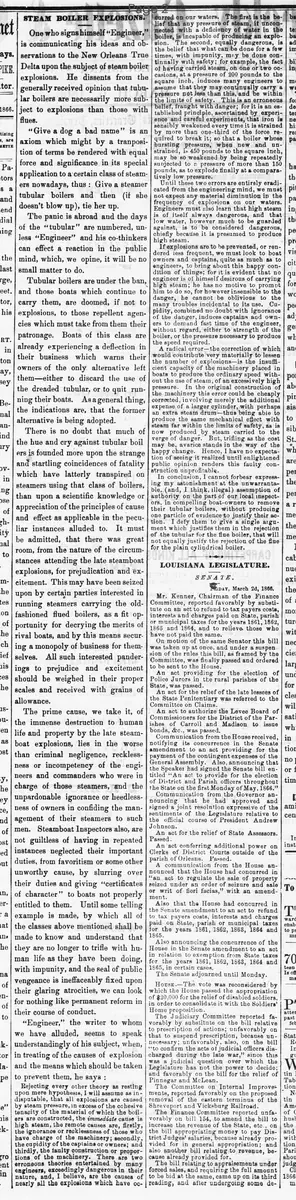
STEAM BOILER EXPLOSIONS.
One who signs himself "Engineer,"
is communicating his ideas and observations to the New Orleans True Delta upon the subject of steam boiler explosions. He dissents from the generally received opinion that tubular boilers are necessarily more subject to explosions than those with flues.
"Give a dog a bad name" is an axiom which might by a transposition of terms be rendered with equal force and significance in its special application to a certain class of steamers nowadays, thus: Give a steamer tubular boilers and then (if she doesn't blow up), tie her up.
The panic is abroad and the days of the "tubular" are numbered, unless "Engineer" and his co-thinkers can effect a reaction in the public mind, which, we opine, it will be no small matter to do.
Tubular boilers are under the ban, and those boats which continue to carry them, are doomed, if not to explosions, to those repellent agencies which must take from them their patronage. Boats of this class are already experiencing a deflection in their business which warns their owners of the only alternative left them-either to discard the use of the dreaded tubular, or to quit running their boats. As a general thing, the indications are, that the former alternative is being adopted.
There is no doubt that much of the hue and cry against tubular boilers is founded more upon the strange and startling coincidences of fatality which have latterly transpired on steamers using that class of boilers than upon a scientific knowledge or appreciation of the principles of cause and effect as applicable in the peculiar instances alluded to. It must be admitted, that there was great room, from the nature of the circumstances attending the late steamboat explosions, for prejudication and excitement. This may have been seized upon by certain parties interested in running steamers carrying the old-fashioned flued boilers, as a fit opportunity for decrying the merits of rival boats, and by this means securing a monopoly of business for themselves. All such interested panderings to prejudice and excitement should be weighed in their proper scales and received with grains of allowance.
The prime cause, we take it, of the immense destruction to human life and property by the late steamboat explosions, lies in the worse than criminal negligence, recklessness or incompetency of the engineers and commanders who were in charge of those steamers, and the unpardonable ignorance or heedlessness of owners in confiding the management of their steamers to such men. Steamboat Inspectors also, are not guiltless of having in repeated instances neglected their important duties, from favoritism or some other unworthy cause, by slurring over their duties and giving "certificates of character" to boats not properly entitled to them. Until some telling example is made, by which all of the classes above mentioned shall be made to know and understand that they are no longer to trifle with human life as they have been doing with impunity, and the seal of public vengeance is ineffaceably fixed upon their glaring atrocities, we can look for nothing like permanent reform in their course of conduct.
"Engineer," the writer to whom we have alluded, seems to speak understandingly of his subject, when, in treating of the causes of explosion and the means which should be taken to prevent them, he says:
Rejecting every other theory as resting upon mere hypothesis, I will assume as indisputable, that all explosions are caused by steam pressure, in excess of the cohesive tenacity of the material of which the boilers are constructed, the immediate cause is high steam, the remote causes are, firstly, the ignorance or recklessness of those who have charge of the machinery; secondly, the cupidity of the captains or owners; and thirdly, the faulty construction or proportions of the machinery. There are two erroneous theories entertained by many engineers, exceedingly dangerous in their nature, and, I believe, are the causes of nearly all the explosions which have occurred on our waters. The first is the belief that any pressure of steam, if unconnected with a deficiency of water in the boiler, is incapable of producing an explosion. The second, equally dangerous, is the belief that what can be done for a few times, with impunity, may be done continually with safety; for example, the fact of having carried steam, on one or two occasions, at a pressure of 200 pounds to the square inch, induces many engineers to assume that they may continually carry a pressure not less than this, and be within the limits of safety. This is an erroneous belief, fraught with danger; for it is an established principle, ascertained by experience and careful experiments, that iron is sensibly weakened every time it is strained by more than one-third of the force required to break it; so that a boiler whose bursting pressure, when new and unstrained, is 450 pounds to the square inch, may be so weakened by being repeatedly subjected to a pressure of more than 150 pounds, as to explode finally at a comparatively low pressure.
Until these two errors are entirely eradicated from the engineering mind, we must not expect any material diminution in the frequency of explosions on our waters.
Engineers must also learn that high steam is of itself always dangerous, and that low water, however much to be guarded against, is to be considered dangerous, chiefly because it is presumed to produce high steam.
If explosions are to be prevented, or rendered less frequent, we must look to boat owners and captains, quite as much as to engineers, to bring about this happy condition of things: for it is evident that no engineer is of himself desirous of carrying high steam; he has no motive to prompt him to do so, for however insensible to the danger, he cannot be oblivious to the many troubles incidental to its use. Cupidity, combined no doubt with ignorance of the danger, induces captains and owners to demand fast time of the engineer, without regard, either to strength of the boiler, or the pressure necessary to produce the speed required.
A radical error-the correction of which would contribute very materially to lessen the number of explosions-is the insufficient capacity of the machinery placed in boats to produce the ordinary speed without the use of steam, of an excessively high pressure. In the original construction of the machinery this error could be cheaply corrected, involving merely the additional expense of a larger cylinder, with perhaps an extra steam drum-thus being able to produce the same mechanical effect with steam far within the limits of safety, as is now produced by steam carried to the verge of danger. But, trifling as the cost may be, avarice stands in the way of the happy change. Hence, I have no expectation of seeing it realized until enlightened public opinion renders this faulty construction unprofitable.
In conclusion, I cannot forbear expressing my astonishment at the unwarrantable, (and, I think, illegal) assumption of authority on the part of our local inspectors, in compelling boat-owners to remove their tubular boilers, without producing one particle of evidence to justify their action. I defy them to give a single argument which justifies them in the rejection of the tubular for the flue boiler, that will not equally justify the rejection of the flue for the plain cylindrical boiler.
One who signs himself "Engineer,"
is communicating his ideas and observations to the New Orleans True Delta upon the subject of steam boiler explosions. He dissents from the generally received opinion that tubular boilers are necessarily more subject to explosions than those with flues.
"Give a dog a bad name" is an axiom which might by a transposition of terms be rendered with equal force and significance in its special application to a certain class of steamers nowadays, thus: Give a steamer tubular boilers and then (if she doesn't blow up), tie her up.
The panic is abroad and the days of the "tubular" are numbered, unless "Engineer" and his co-thinkers can effect a reaction in the public mind, which, we opine, it will be no small matter to do.
Tubular boilers are under the ban, and those boats which continue to carry them, are doomed, if not to explosions, to those repellent agencies which must take from them their patronage. Boats of this class are already experiencing a deflection in their business which warns their owners of the only alternative left them-either to discard the use of the dreaded tubular, or to quit running their boats. As a general thing, the indications are, that the former alternative is being adopted.
There is no doubt that much of the hue and cry against tubular boilers is founded more upon the strange and startling coincidences of fatality which have latterly transpired on steamers using that class of boilers than upon a scientific knowledge or appreciation of the principles of cause and effect as applicable in the peculiar instances alluded to. It must be admitted, that there was great room, from the nature of the circumstances attending the late steamboat explosions, for prejudication and excitement. This may have been seized upon by certain parties interested in running steamers carrying the old-fashioned flued boilers, as a fit opportunity for decrying the merits of rival boats, and by this means securing a monopoly of business for themselves. All such interested panderings to prejudice and excitement should be weighed in their proper scales and received with grains of allowance.
The prime cause, we take it, of the immense destruction to human life and property by the late steamboat explosions, lies in the worse than criminal negligence, recklessness or incompetency of the engineers and commanders who were in charge of those steamers, and the unpardonable ignorance or heedlessness of owners in confiding the management of their steamers to such men. Steamboat Inspectors also, are not guiltless of having in repeated instances neglected their important duties, from favoritism or some other unworthy cause, by slurring over their duties and giving "certificates of character" to boats not properly entitled to them. Until some telling example is made, by which all of the classes above mentioned shall be made to know and understand that they are no longer to trifle with human life as they have been doing with impunity, and the seal of public vengeance is ineffaceably fixed upon their glaring atrocities, we can look for nothing like permanent reform in their course of conduct.
"Engineer," the writer to whom we have alluded, seems to speak understandingly of his subject, when, in treating of the causes of explosion and the means which should be taken to prevent them, he says:
Rejecting every other theory as resting upon mere hypothesis, I will assume as indisputable, that all explosions are caused by steam pressure, in excess of the cohesive tenacity of the material of which the boilers are constructed, the immediate cause is high steam, the remote causes are, firstly, the ignorance or recklessness of those who have charge of the machinery; secondly, the cupidity of the captains or owners; and thirdly, the faulty construction or proportions of the machinery. There are two erroneous theories entertained by many engineers, exceedingly dangerous in their nature, and, I believe, are the causes of nearly all the explosions which have occurred on our waters. The first is the belief that any pressure of steam, if unconnected with a deficiency of water in the boiler, is incapable of producing an explosion. The second, equally dangerous, is the belief that what can be done for a few times, with impunity, may be done continually with safety; for example, the fact of having carried steam, on one or two occasions, at a pressure of 200 pounds to the square inch, induces many engineers to assume that they may continually carry a pressure not less than this, and be within the limits of safety. This is an erroneous belief, fraught with danger; for it is an established principle, ascertained by experience and careful experiments, that iron is sensibly weakened every time it is strained by more than one-third of the force required to break it; so that a boiler whose bursting pressure, when new and unstrained, is 450 pounds to the square inch, may be so weakened by being repeatedly subjected to a pressure of more than 150 pounds, as to explode finally at a comparatively low pressure.
Until these two errors are entirely eradicated from the engineering mind, we must not expect any material diminution in the frequency of explosions on our waters.
Engineers must also learn that high steam is of itself always dangerous, and that low water, however much to be guarded against, is to be considered dangerous, chiefly because it is presumed to produce high steam.
If explosions are to be prevented, or rendered less frequent, we must look to boat owners and captains, quite as much as to engineers, to bring about this happy condition of things: for it is evident that no engineer is of himself desirous of carrying high steam; he has no motive to prompt him to do so, for however insensible to the danger, he cannot be oblivious to the many troubles incidental to its use. Cupidity, combined no doubt with ignorance of the danger, induces captains and owners to demand fast time of the engineer, without regard, either to strength of the boiler, or the pressure necessary to produce the speed required.
A radical error-the correction of which would contribute very materially to lessen the number of explosions-is the insufficient capacity of the machinery placed in boats to produce the ordinary speed without the use of steam, of an excessively high pressure. In the original construction of the machinery this error could be cheaply corrected, involving merely the additional expense of a larger cylinder, with perhaps an extra steam drum-thus being able to produce the same mechanical effect with steam far within the limits of safety, as is now produced by steam carried to the verge of danger. But, trifling as the cost may be, avarice stands in the way of the happy change. Hence, I have no expectation of seeing it realized until enlightened public opinion renders this faulty construction unprofitable.
In conclusion, I cannot forbear expressing my astonishment at the unwarrantable, (and, I think, illegal) assumption of authority on the part of our local inspectors, in compelling boat-owners to remove their tubular boilers, without producing one particle of evidence to justify their action. I defy them to give a single argument which justifies them in the rejection of the tubular for the flue boiler, that will not equally justify the rejection of the flue for the plain cylindrical boiler.
What sub-type of article is it?
Disaster
Curiosity
What themes does it cover?
Catastrophe
Misfortune
Justice
What keywords are associated?
Steam Boiler Explosions
Tubular Boilers
Flue Boilers
Negligence
Steamboat Safety
Engineers
Inspectors
What entities or persons were involved?
Engineer
Where did it happen?
New Orleans
Story Details
Key Persons
Engineer
Location
New Orleans
Story Details
An engineer writes to the New Orleans True Delta defending tubular boilers against blame for recent steamboat explosions, attributing causes to negligence, recklessness, and faulty practices by engineers, captains, owners, and inspectors rather than boiler type. Calls for reform to prevent future disasters.