Thank you for visiting SNEWPapers!
Sign up free
The Virginia Gazette
Williamsburg, Virginia
What is this article about?
A Traveller writes to the Earl of Dunmore, Governor of Virginia, decrying the flawed administration of justice in a 1770s robbery case at Beaufort involving slaves. He criticizes biased and ignorant magistrates for rescuing a slave and failing to convict felons, urging selection of qualified judges to uphold laws and protect liberty.
Merged-components note: This is a single continuous letter addressed to the Earl of Dunmore, complaining about the administration of justice in Virginia, signed 'A TRAVELLER.' The text continues seamlessly from the first component to the second. Original labels were literary and letter_to_editor; literary is incorrect as this is non-fiction prose, not fiction/essays; letter_to_editor fits as a reader-submitted critique.
Clippings
1 of 2
OCR Quality
Full Text
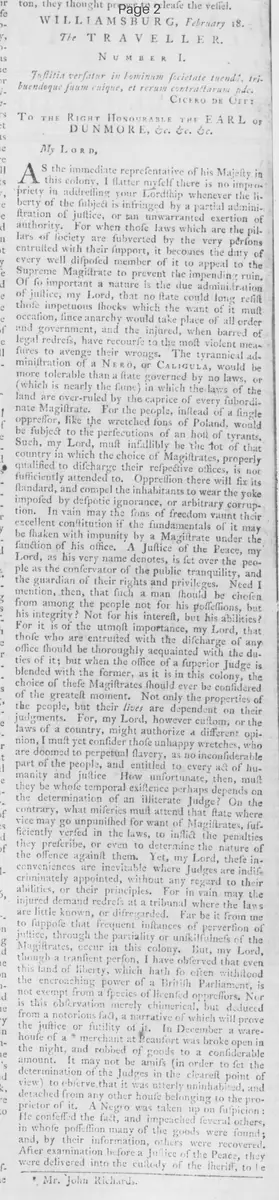
THE TRAVELLER.
NUMBER I.
Justitia servatur in Dominum societate tuenda, tribuendoque suum cuique, et rerum contractarum fide.
CICERO DE OFF.
TO THE Right Honourable THE EARL OF DUNMORE, &c. &c.
My Lord,
As the immediate representative of his Majesty in this colony, I flatter myself there is no impropriety in addressing your Lordship whenever the liberty of the subject is infringed by a partial administration of justice, or an unwarranted exertion of authority. For when those laws which are the pillars of society are subverted by the very persons entrusted with their support, it becomes the duty of every well disposed member of it to appeal to the Supreme Magistrate to prevent the impending ruin.
Of so important a nature is the due administration of justice, my Lord, that no state could long resist those impetuous shocks which the want of it must occasion, since anarchy would take place of all order and government, and the injured, when barred of legal redress, have recourse to the most violent measures to avenge their wrongs. The tyrannical administration of a Nero, or Caligula, would be more tolerable than a state governed by no laws, or (which is nearly the same) in which the laws of the land are over-ruled by the caprice of every subordinate Magistrate. For the people, instead of a single oppressor, like the wretched sons of Poland, would be subject to the persecutions of a host of tyrants.
Such, my Lord, must infallibly be the lot of that country in which the choice of Magistrates, properly qualified to discharge their respective offices, is not sufficiently attended to. Oppression there will fix its standard, and compel the inhabitants to wear the yoke imposed by despotic ignorance, or arbitrary corruption. In vain may the sons of freedom vaunt their excellent constitution if the fundamentals of it may be shaken with impunity by a Magistrate under the sanction of his office. A Justice of the Peace, my Lord, as his very name denotes, is set over the people as the conservator of the public tranquility, and the guardian of their rights and privileges. Need I mention, then, that such a man should be chosen from among the people not for his possessions, but his integrity? Not for his interest, but his abilities?
For it is of the utmost importance, my Lord, that those who are entrusted with the discharge of any office should be thoroughly acquainted with the duties of it; but when the office of a superior Judge is blended with the former, as it is in this colony, the choice of these Magistrates should ever be considered of the greatest moment. Not only the properties of the people, but their lives are dependent on their judgments. For, my Lord, however custom, or the laws of a country, might authorize a different opinion, I must yet consider those unhappy wretches, who are doomed to perpetual slavery, as no inconsiderable part of the people, and entitled to every act of humanity and justice How unfortunate, then, must they be whose temporal existence perhaps depends on the determination of an illiterate Judge? On the contrary, what miseries must attend that state where vice may go unpunished for want of Magistrates, sufficiently versed in the laws, to inflict the penalties they prescribe, or even to determine the nature of the offence against them. Yet, my Lord, these inconveniences are inevitable where Judges are indiscriminately appointed, without any regard to their abilities, or their principles. For in vain may the injured demand redress at a tribunal where the laws are little known, or disregarded. Far be it from me to suppose that frequent instances of perversion of justice, through the partiality or unskilfulness of the Magistrates, occur in this colony. But, my Lord, though a transient person, I have observed that even this land of liberty, which hath so often withstood the encroaching power of a British Parliament, is not exempt from a species of licensed oppressors. Nor is this observation merely chimerical, but deduced from a notorious fact, a narrative of which will prove the justice or futility of it. In December a warehouse of a * merchant at Beaufort was broke open in the night, and robbed of goods to a considerable amount. It may not be amiss (in order to set the determination of the Judges in the clearest point of view) to observe that it was utterly uninhabited, and detached from any other house belonging to the proprietor of it. A Negro was taken up on suspicion: He confessed the fact, and impeached several others, in whose possession many of the goods were found; and, by their information, others were recovered. After examination before a Justice of the Peace, they were delivered into the custody of the sheriff, to be
* Mr. John Richards.
committed to prison. But, my Lord, a Justice of the Peace (the master of one of the Negroes) in defiance of those laws, in conformity to which he was sworn to act, rescued his slave as the sheriff was performing the duty of his office. His great soul suggested to him that though the Sovereign on the throne is not exempt from obedience to the laws, yet he was beyond their reach. But let him tremble when he hears that by this violation of them he has incurred the offence of which the party rescued was afterwards convicted. Nor will his shameful excuse of ignorance, nor the specious one that he intended to produce his Negro before the court, avail him. For by the laws of this colony he could not have bailed him; consequently he could not take him without giving any security. My Lord, I do not barely assert that the Negro was not bailable. I have the authority of an act of Assembly, which declares, "That every slave committing such offence as by law is punishable with death, or loss of member, shall forthwith be committed to the common gaol of the county wherein such offence shall be done." And that the present offence was of that nature appears from the same law, which enacts, "That if any Negro, Mulatto, or Indian, shall be convicted of feloniously breaking and entering any house in the night time, and taking from thence any goods or chattels to the value of twenty shillings, they shall suffer death without benefit of clergy." My Lord, I have recited this law, not only as a confirmation of what I advanced, but in order to throw a stronger light on the determination of the court. But the rescue was productive of greater mischiefs than might at first occur. The Negro might probably have discovered more of the goods had he been committed to prison; but when he was released he was at liberty to fall on other methods of concealment, by which means it is likely the merchant was prevented from recovering the greater part of his lost effects. I must now beg leave to take a view of the proceedings at the trial. On the day appointed the Gentleman brought his Negro to court, wearing, in the presence of divers persons, that he should not be hanged, for he would not take two hundred pounds for him? This declaration, my Lord, was made by a Judge invested, as I have said before, with authority to determine on the lives and properties of his fellow subjects. What can be a more evident demonstration of tyrannical oppression than such an overt declaration? What man is secure in his liberty or possessions when justice is so totally disregarded, nay, set to open defiance? Yet this person, my Lord, was not only suffered to make such declarations, but permitted, in contempt of the court, in violation of all the rules of decorum, to interrupt, contradict, and abuse, the evidence, during his examination, in the grossest terms. Well, indeed, might he infringe the rules of decorum who had so openly broken the fundamental laws of the realm with impunity. From the Negro's evidence, with other concurring circumstances, it was clearly proved that he, in conjunction with the prisoners at the bar, had feloniously broken and entered the store in the night time, and had stolen out of it goods to a considerable amount, more than is required by the law to make the offence capital. As Jurors, the Gentlemen found the fact: As Judges, some of them were at a loss whether to define it burglary, or felony. Yet, my Lord, the least acquaintance with those laws, of which, ex officio, they are the oracles, would have readily pointed out the difference. After a long debate the offence was properly adjudged felony. Why then was not that sentence passed which the laws I have recited prescribe? Perhaps, my Lord, the Gentlemen were aware that should they pronounce sentence of death, their colleague, who had committed the rescue, might, on a prosecution, incur the like. If that was the motive, I cannot sufficiently applaud the method they embraced to ward off so foul a disgrace as that must inevitably have thrown upon their honourable Board. One of these Gentlemen delivered it as his opinion, in a most pathetic speech, that "as the affair was of so intricate a nature as not to admit of a determination whether the offence was capital or not, he thought it better to err on the side of mercy." This was embraced by another, who added, in confirmation of it, that ten guilty persons had better escape than one innocent man be punished. The maxim I allow to be a good one: But nought but blind partiality could have suggested the application of it. Thus, my Lord, the criminals were dismissed, with a gentle rebuke, without even the slightest corporal punishment. Well might the Roman Censor have exclaimed, O tempora! O mores! had such corrupt Judges presided in the forum. But such irregular, I had almost said unjust, proceedings are not uncommon in Essex court. Yet I cannot conclude without doing justice to three of the five Gentlemen, whose upright and impartial behaviour afforded examples worthy of imitation. But as the law requires the concurrence of four Judges to convict, their opinions were of little avail. I leave to your Lordship's own reflections the ill consequences which must inevitably attend a total disregard to the municipal, and particularly the penal laws, the end of which is to afford an asylum to the injured, to redress their grievances, and to restrain and punish vice whenever it is detected. When these objects of the laws are not attended to, the liberty of the subject is more dangerously wounded than by any act of sovereignty or despotism; and as laws are most effectually enforced by the penalties they inflict, so to neglect inflicting those penalties is the most effectual method of destroying the very end of their creation; that is, the happiness of society. As this address was dictated by the regard to justice only, without any prejudice against, or in favour of, any of the parties, to all whom I am an utter stranger, I shall make no apology, my Lord, for this appeal to your judgment on an affair of real importance to the well being of society. Your Lordship's regard to the subject's liberty will inform you that it is proper, and the love of justice will, I doubt not, suggest to you the most effectual method of preventing future oppressions of a similar nature. I am, With the utmost respect, My LORD, Your Lordship's most humble servant, A TRAVELLER.
What sub-type of article is it?
What themes does it cover?
What keywords are associated?
What entities or persons were involved?
Letter to Editor Details
Author
A Traveller
Recipient
The Right Honourable The Earl Of Dunmore
Main Argument
the administration of justice in virginia is undermined by unqualified and biased magistrates, as exemplified by a robbery case in beaufort where a slave owner rescued his property and the court failed to convict felons due to partiality, endangering liberty and society; the governor must ensure qualified appointments and enforcement of laws.
Notable Details