Thank you for visiting SNEWPapers!
Sign up free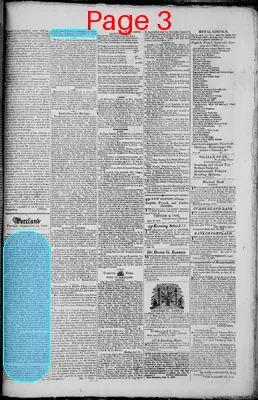
Domestic News
September 14, 1819
The Portland Gazette
Portland, Cumberland County, Maine
What is this article about?
Debate on whether all towns in the district should have full representation in the convention to form the new state's constitution, arguing for equal delegation based on the act to ensure proportional influence, despite potential inconveniences. Encourages liberal selection of qualified delegates.
Clipping
OCR Quality
98%
Excellent
Full Text
CONVENTION
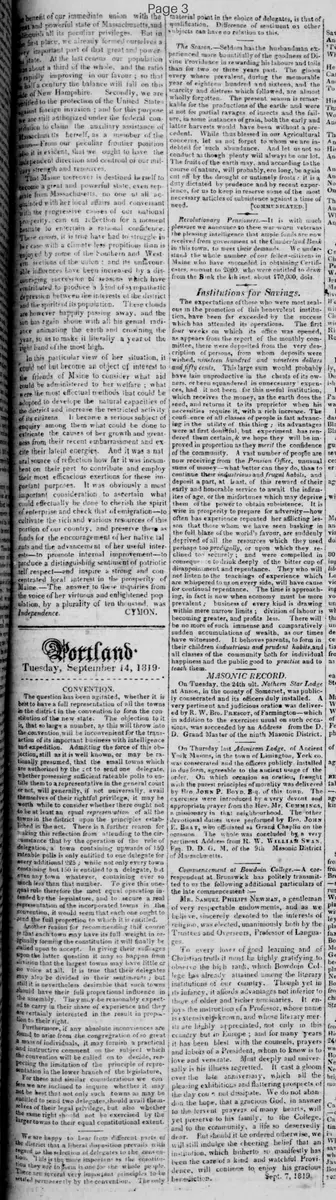
The question has been agitated, whether it is best to have a full representation of all the towns in the district in the convention to form the constitution of the new state. The objection to it is, that so large a number, as this will throw into the convention, will be inconvenient for the transaction of its important business with intelligence and expedition. Admitting the force of this objection still as it is well known, or may be rationally presumed, that the small towns which are authorized by the act to send one delegate, whether possessing sufficient rateable polls to entitle them to a representative in the general court or not, will generally, if not universally, avail themselves of their rightful privilege, it may be worth while to consider whether there ought not to be at least an equal representation of all the towns in the district upon the principles established in the act. There is a further reason for making this reflection from attending to the circumstance that by the operation of the rule of delegation, a town containing upwards of 150 rateable polls is only entitled to one delegate for every additional 225; while not only every town containing but 150 is entitled to a delegate, but even any town whatever, containing ever so much less than that number. To give this unequal rule therefore the most equal operation intended by the legislature, and to secure a real representation of the incorporated towns in the convention, it would seem that each one ought to send the full proportion to which it is entitled.
Another reason for recommending this course is that each town may have its full weight in originally forming the constitution it will finally be called upon to accept. In giving their suffrages upon the latter question it may so happen from division that the largest towns may have little or no voice at all. It is true that their delegates may also be divided in their sentiments; but still it is nevertheless desirable that such towns should have their full proportional influence in the assembly. They may be reasonably expected to carry in their share of experience and they are certainly interested in the result in proportion to their right.
Furthermore, if any absolute inconveniences are found to arise from the congregation of so great a mass of individuals, it may furnish a practical and instructive comment on the subject which the convention will be called on to decide, respecting the limitation of the principle of representation in the lower branch of the legislature.
For these and similar considerations we confess we are inclined to inquire whether it may not be best that not only such towns as may be entitled to send two delegates should avail themselves of their legal privilege, but also whether the same right should not be exercised by the larger towns to their equal constitutional extent.
We are happy to hear from different parts of the district that a liberal disposition prevails with regard to the selection of delegates to the convention. This is the more important as the constitution they are to form is one for the whole people.
There are several very important principles to be settled permanently by the convention. The only material point in the choice of delegates, is that of qualification. Difference of sentiment on other subjects can have no relation to this.
The question has been agitated, whether it is best to have a full representation of all the towns in the district in the convention to form the constitution of the new state. The objection to it is, that so large a number, as this will throw into the convention, will be inconvenient for the transaction of its important business with intelligence and expedition. Admitting the force of this objection still as it is well known, or may be rationally presumed, that the small towns which are authorized by the act to send one delegate, whether possessing sufficient rateable polls to entitle them to a representative in the general court or not, will generally, if not universally, avail themselves of their rightful privilege, it may be worth while to consider whether there ought not to be at least an equal representation of all the towns in the district upon the principles established in the act. There is a further reason for making this reflection from attending to the circumstance that by the operation of the rule of delegation, a town containing upwards of 150 rateable polls is only entitled to one delegate for every additional 225; while not only every town containing but 150 is entitled to a delegate, but even any town whatever, containing ever so much less than that number. To give this unequal rule therefore the most equal operation intended by the legislature, and to secure a real representation of the incorporated towns in the convention, it would seem that each one ought to send the full proportion to which it is entitled.
Another reason for recommending this course is that each town may have its full weight in originally forming the constitution it will finally be called upon to accept. In giving their suffrages upon the latter question it may so happen from division that the largest towns may have little or no voice at all. It is true that their delegates may also be divided in their sentiments; but still it is nevertheless desirable that such towns should have their full proportional influence in the assembly. They may be reasonably expected to carry in their share of experience and they are certainly interested in the result in proportion to their right.
Furthermore, if any absolute inconveniences are found to arise from the congregation of so great a mass of individuals, it may furnish a practical and instructive comment on the subject which the convention will be called on to decide, respecting the limitation of the principle of representation in the lower branch of the legislature.
For these and similar considerations we confess we are inclined to inquire whether it may not be best that not only such towns as may be entitled to send two delegates should avail themselves of their legal privilege, but also whether the same right should not be exercised by the larger towns to their equal constitutional extent.
We are happy to hear from different parts of the district that a liberal disposition prevails with regard to the selection of delegates to the convention. This is the more important as the constitution they are to form is one for the whole people.
There are several very important principles to be settled permanently by the convention. The only material point in the choice of delegates, is that of qualification. Difference of sentiment on other subjects can have no relation to this.
What sub-type of article is it?
Politics
What keywords are associated?
Constitutional Convention
Town Representation
Delegates
New State
Proportional Influence
Domestic News Details
Event Details
Discussion on the merits of full town representation in the constitutional convention, highlighting unequal delegation rules, the need for proportional influence in forming and accepting the constitution, and the importance of qualified delegates amid a liberal selection disposition.