Thank you for visiting SNEWPapers!
Sign up free
Jackson Advocate
Jackson, Hinds County, Mississippi
What is this article about?
UNCF to administer scholarship testing program for 28 member colleges starting 1958, expecting 3,500 high school seniors; tests in Feb-Mar, scored by ETS; reduces duplicate exams and aids objective admissions.
Merged-components note: Merged initial article on page 1 with continuation on page 8 about UNCF testing program; relabeled to domestic_news.
Clippings
1 of 2
OCR Quality
Full Text
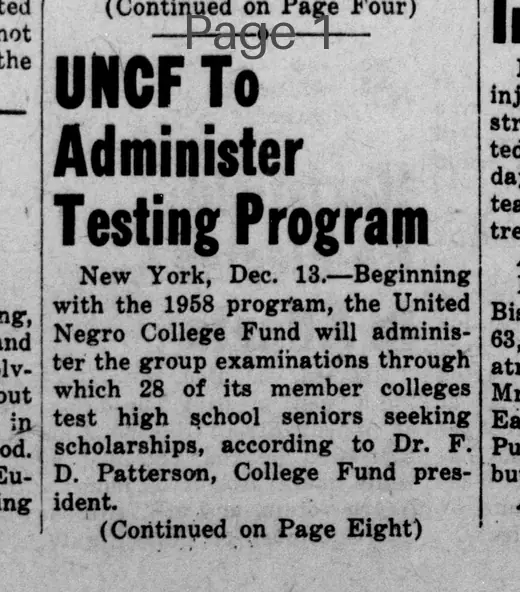
New York, Dec. 13. -- Beginning with the 1958 program, the United Negro College Fund will administer the group examinations through which 28 of its member colleges test high school seniors seeking scholarships, according to Dr. F. D. Patterson, College Fund president. (Continued on Page Eight)
UNCF TO...
(Continued from Page One)
"More than 3,500 candidates are expected to take the Cooperative Inter-collegiate Examinations this year," Dr. Patterson said.
"The tests will be given in 183 centers throughout the country between Feb. 24 and March 8."
Scoring and interpretation of test results are handled by the Educational Testing Service of Princeton.
More than 3,400 candidates took the examination in 1957. They represented 505 high schools, of which 377, or about 75 per cent, were located in nine southern states. The Virgin Islands, the District of Columbia and 18 other states were also represented. Candidates were selected for more than $200,000 in scholarship awards.
Inaugurated in 1951 by 15 of the Fund's 31 privately-supported member colleges, the program has been highly successful during the past seven years.
"Before this time it had been the practice of most of the private colleges to conduct their own qualifying examinations for their respective candidates." Dr. Patterson said. "This often resulted in the same students being tested by several colleges to which they had applied-often by means of identical examinations. Finally high school principals complained of the disruption to classroom studies by recurring testing sessions."
"The cooperative plan met these problems. It reduced the expenses of the colleges by scheduling one jointly-financed examination in strategically located centers. It also reduced the loss of classroom time by enabling interested high school seniors to compete, at one sitting for scholarships offered by different colleges."
"All of the Fund's member colleges will be encouraged to base admissions as well as scholarships on the cooperative examinations. Dr. Patterson said. "A few schools already do."
"Pre-admission testing of high school prospects provides a more objective and uniform method of selecting entering freshmen. High school grades and rank-in-class do not always give an accurate picture of an applicant's ability because of wide variations in grading systems and scholastic competition. Scores made on a standardized admission test remove much of the guess-work in selecting students and should reduce the number of freshmen failures in UNCF colleges."
Through its nation-wide annual appeal, the United Negro College Fund raises 10 per cent of the operating costs of its member colleges. The College Fund also conducts advisory services on educational curicula and business management for its member institutions.
What sub-type of article is it?
What keywords are associated?
What entities or persons were involved?
Where did it happen?
Domestic News Details
Primary Location
New York
Event Date
Dec. 13
Key Persons
Outcome
more than $200,000 in scholarship awards in 1957; program inaugurated in 1951 and successful for seven years; expected 3,500 candidates in 1958.
Event Details
Beginning with the 1958 program, the United Negro College Fund will administer the group examinations through which 28 of its member colleges test high school seniors seeking scholarships. More than 3,500 candidates are expected to take the Cooperative Inter-collegiate Examinations between Feb. 24 and March 8 in 183 centers. Scoring by Educational Testing Service of Princeton. In 1957, 3,400 candidates from 505 high schools, mostly in nine southern states, received over $200,000 in scholarships. The program reduces duplicate testing, expenses, and classroom disruption. All member colleges encouraged to use for admissions and scholarships. UNCF raises 10% of operating costs and provides advisory services.