Thank you for visiting SNEWPapers!
Sign up free
Letter to Editor
September 12, 1777
The Virginia Gazette
Richmond, Williamsburg, Richmond County, Virginia
What is this article about?
Joseph Stroud shares a detailed method for producing salt from river water, including boiling, clarifying with egg whites, draining, and drying on sand beds, offering it to the public for use during times of scarcity.
Clipping
OCR Quality
95%
Excellent
Full Text
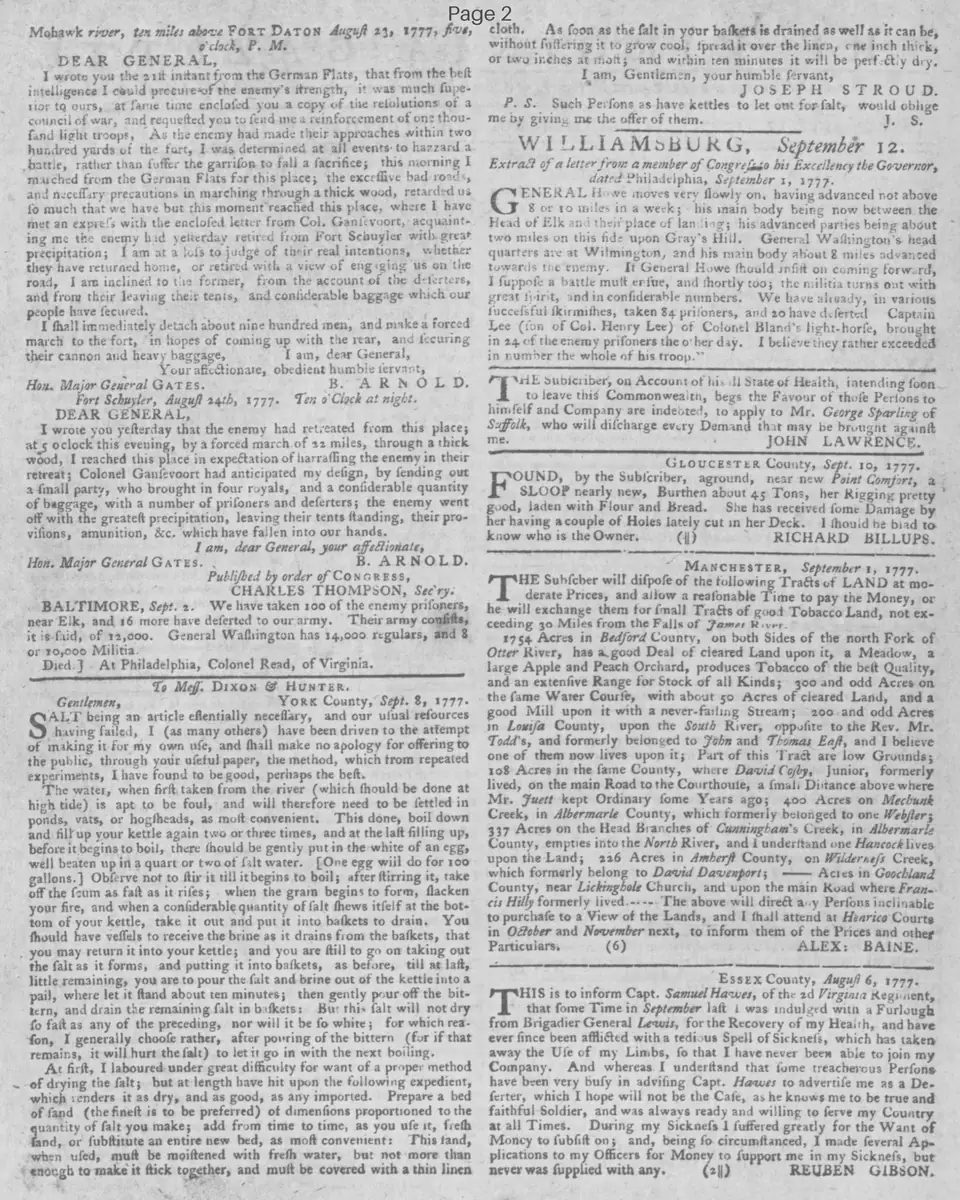
To Messrs. Dixon & Hunter.
SALT.
Gentlemen,
driven to the attempt of making it for my own use, and shall make no apology for offering to the public, through your useful paper, the method, which from repeated experiments, I have found to be good, perhaps the best.
The water, when first taken from the river (which should be done at high tide) is apt to be foul, and will therefore need to be settled in ponds, vats, or hogheads, as most convenient. This done, boil down and fill up your kettle again two or three times, and at the last filling up, before it begins to boil, there should be gently put in the white of an egg, well beaten up in a quart or two of salt water. [One egg will do for 100 gallons.] Observe not to stir it till it begins to boil; after stirring it, take off the scum as fast as it rises; when the grain begins to form, slacken your fire, and when a considerable quantity of salt shows itself at the bottom of your kettle, take it out and put it into baskets to drain. You should have vessels to receive the brine as it drains from the baskets, that you may return it into your kettle; and you are still to go on taking out the salt as it forms, and putting it into baskets, as before, till at last, little remaining, you are to pour the salt and brine out of the kettle into a pail, where let it stand about ten minutes; then gently pour off the bitter, and drain the remaining salt in baskets: But this salt will not dry so fast as any of the preceding, nor will it be so white; for which reason, I generally choose rather, after pouring off the bittern (for if that remains, it will hurt the salt) to let it go in with the next boiling.
At first, I laboured under great difficulty for want of a proper method of drying the salt; but at length have hit upon the following expedient, which renders it as dry, and as good, as any imported. Prepare a bed of sand (the finest is to be preferred) of dimensions proportioned to the quantity of salt you make; add from time to time, as you use it, fresh sand, or substitute an entire new bed, as most convenient: This sand, when used, must be moistened with fresh water, but not more than enough to make it stick together, and must be covered with a thin linen cloth.
As soon as the salt in your baskets is drained as well as it can be, without suffering it to grow cool, spread it over the linen, one inch thick, or two inches at most; and within ten minutes it will be perfectly dry.
I am, Gentlemen, your humble servant,
JOSEPH STROUD.
P. S. Such Persons as have kettles to let out for salt, would oblige me by giving me the offer of them.
J. S.
SALT.
Gentlemen,
driven to the attempt of making it for my own use, and shall make no apology for offering to the public, through your useful paper, the method, which from repeated experiments, I have found to be good, perhaps the best.
The water, when first taken from the river (which should be done at high tide) is apt to be foul, and will therefore need to be settled in ponds, vats, or hogheads, as most convenient. This done, boil down and fill up your kettle again two or three times, and at the last filling up, before it begins to boil, there should be gently put in the white of an egg, well beaten up in a quart or two of salt water. [One egg will do for 100 gallons.] Observe not to stir it till it begins to boil; after stirring it, take off the scum as fast as it rises; when the grain begins to form, slacken your fire, and when a considerable quantity of salt shows itself at the bottom of your kettle, take it out and put it into baskets to drain. You should have vessels to receive the brine as it drains from the baskets, that you may return it into your kettle; and you are still to go on taking out the salt as it forms, and putting it into baskets, as before, till at last, little remaining, you are to pour the salt and brine out of the kettle into a pail, where let it stand about ten minutes; then gently pour off the bitter, and drain the remaining salt in baskets: But this salt will not dry so fast as any of the preceding, nor will it be so white; for which reason, I generally choose rather, after pouring off the bittern (for if that remains, it will hurt the salt) to let it go in with the next boiling.
At first, I laboured under great difficulty for want of a proper method of drying the salt; but at length have hit upon the following expedient, which renders it as dry, and as good, as any imported. Prepare a bed of sand (the finest is to be preferred) of dimensions proportioned to the quantity of salt you make; add from time to time, as you use it, fresh sand, or substitute an entire new bed, as most convenient: This sand, when used, must be moistened with fresh water, but not more than enough to make it stick together, and must be covered with a thin linen cloth.
As soon as the salt in your baskets is drained as well as it can be, without suffering it to grow cool, spread it over the linen, one inch thick, or two inches at most; and within ten minutes it will be perfectly dry.
I am, Gentlemen, your humble servant,
JOSEPH STROUD.
P. S. Such Persons as have kettles to let out for salt, would oblige me by giving me the offer of them.
J. S.
What sub-type of article is it?
Informative
What themes does it cover?
Commerce Trade
What keywords are associated?
Salt Making
Brine Boiling
Egg Clarification
Sand Drying
Self Sufficiency
What entities or persons were involved?
Joseph Stroud
Messrs. Dixon & Hunter
Letter to Editor Details
Author
Joseph Stroud
Recipient
Messrs. Dixon & Hunter
Main Argument
the author provides a proven method for making salt from river water, which he recommends as effective and shares publicly for others' benefit.
Notable Details
Use Of Egg White To Clarify Brine
Drying Method Using Moistened Sand Bed Covered With Linen
P.S. Seeking Kettles For Salt Production