Thank you for visiting SNEWPapers!
Sign up free
Edgefield Advertiser
Edgefield, Edgefield County, South Carolina
What is this article about?
New York Tribune article offering advice to prospective California gold seekers, confirming gold's abundance in 1848, predicting reduced yields in 1849, discussing obstacles like high costs and routes, health, ideal emigrants, and potential congressional land policies.
Clipping
OCR Quality
Full Text
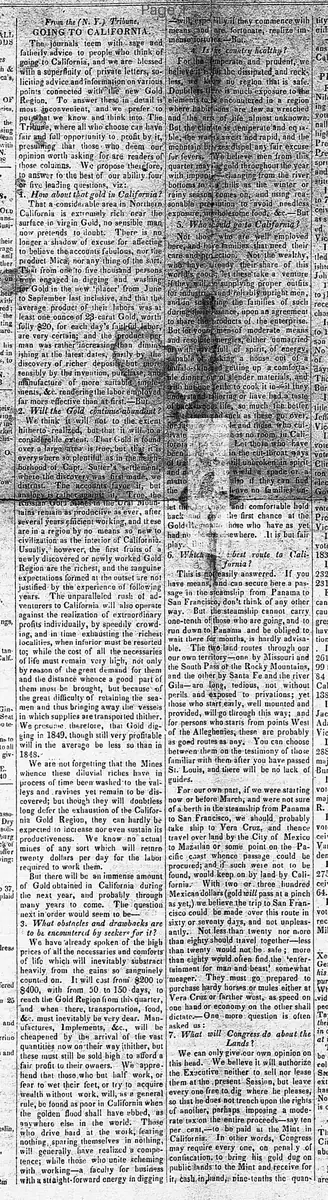
GOING TO CALIFORNIA
The journals teem with sage and fatherly advice to people who think of going to California, and we are blessed with a superfluity of private letters, soliciting advice and information on various points connected with the new Gold Region. To answer these in detail is most inconvenient, and we prefer to put what we know and think into this Tribune, where all who choose can have fair and full opportunity to profit by it. Presuming that those who deem our opinion worth asking are readers of those columns. We propose therefore, to answer to the best of our ability four or five leading questions, viz:
I. How about that gold in California?
That a considerable area in Northern California is extremely rich near the surface in virgin Gold, no sensible man now pretends to doubt: There is no longer a shadow of excuse for affecting to believe the accounts fabulous nor the product mica, nor any thing of the kind taken from one to five thousand persons were engaged in digging and washing for Gold in the new El Dorado from June to September last inclusive, and that the average product of their labors was at least one ounce of 23 carat Gold, worth fully $20, for each day's skillful labor, are very certain; and the product per man was rather increasing than diminishing at the latest dates, partly by the discovery of richer deposits but more sensibly by the invention purchase and manufacture of more suitable implements, &c. rendering the labor employed far more effective than at first. But
2. Will the Gold continue abundant?
We think not to the extent hitherto realized but that it will in all considerable degree. That Gold is found over a large area is true, but that it is everywhere so plentiful as in the neighborhood of Capt. Sutter's settlement, where the discovery was first made we distrust. The accounts favor but analogy rather against either true the Peruvian Gold Mines in the Ural Mountains remain as productive as ever, after several years efficient working, and these are in a region by no means so new to civilization as the interior of California. Usually, however, the first fruits of a newly discovered or newly worked Gold Region are the richest, and the sanguine expectations formed at the outset are not justified by the experience of following years. The unparalleled rush of adventurers to California will also operate against the realization of extraordinary profits individually, by speedily crowding, and in time exhausting the richest localities, when inferior must be resorted to: while the cost of all the necessaries of life must remain very high, not only by reason of the great demand for them and the distance whence a good part of them must be brought, but because of the great difficulty of retaining the seamen and thus bringing away the vessels in which supplies are transported thither. We presume, therefore, that Gold digging in 1849, though still very profitable will in the average be less so than in 1848.
We are not forgetting that the Mines whence these diluvial riches have in process of time been washed to the valleys and ravines yet remain to be discovered; but though they will doubtless long defer the exhaustion of the California Gold Region, they can hardly be expected to increase nor even sustain its productiveness. We know no actual mines of any sort which will return twenty dollars per day for the labor required to work them.
But there will be an immense amount of Gold obtained in California during the next year, and probably through many years to come. The question next in order would seem to be—
3. What obstacles and drawbacks are to be encountered by seekers for it?
We have already spoken of the high prices of all the necessaries and comforts of life which will inevitably subtract heavily, from the gains so sanguinely counted on. It will cost from $200 to $400, with from 50 to 150 days, to reach the Gold Region from this quarter, and when there, transportation, food, &c. must inevitably be very dear. Manufactures. Implements, &c., will be cheapened by the arrival of the vast quantities now on their way thither, but these must still be sold high to afford a fair profit to their owners. We apprehend that those, who but half work, or fear to wet their feet, or try to acquire wealth without work, will, as a general rule, be found as poor in California when the golden flood shall have ebbed, as anywhere else in the world. Those who drive hard at the work, fearing nothing, sparing themselves in nothing, will generally have realized a competence; while those who unite scheming with working—a faculty of business with a straightforward energy in digging will especially they commence with means and are fortunate realize immense. But to
4. Is the country healthy?
For the temperate and prudent, we believe it is. In the dissipated and reckless we know no region that is safe. Doubtless there is much exposure to the elements to be encountered in a region where habitations are few as wretched and the art of life almost unknown. But the climate is temperate and equable the air is sweet and rapid, and the mountain breezes dispel any fair excuse for fevers. We believe men from all quarters may dig gold throughout the year with impunity changing from the river bottoms to the hills as the winter or rainy season comes on, and using reasonable precaution to avoid needless exposure, unwholesome food &c. But
5. Who should go to California?
Not those who are well employed here and have families that need their care and protection. Nor the wealthy, who have already their share of this world's goods let these take a venture of their all on supplying proper outfits for industrious and reliable upright men, and deserving the families of such during their absence, upon an agreement to share the produce of the enterprise. But young men of moderate means and resolute energies either unmarried or with wives full of spirit, of energy, able to strike a house out of a buffalo skin and get up a comfortable dinner out of slender materials and with borne able to cook it if they understand tailoring or have had a taste for life so much the better.
Such as these go over for the country needs them, and those who cultivate fears no room in California.
Let those who have been in the cut throat ways of trade and are unbroken in spirit and as well as spade or a mattock.
As to if they can find the have no families let the poor and comfortable hold back and give the first chance at the Gold fields to those who have as yet had no chances elsewhere. It is but fair play.
6. Which best route to California?
This is not easily answered. If you have means and can secure here a passage in the steamship from Panama to San Francisco don't think of any other way. But the steamship cannot carry one-tenth of those who are going, and to run down to Panama and be obliged to wait there for months, is hardly advisable. The two land routes through our own territory—one by Missouri and the South Pass of the Rocky Mountains, and the other by Santa Fe and the river Gila—are long, tedious, not without perils, and exposed to privations; yet those who start early, well mounted and provided, will go through this way; and for persons who start from points West of the Alleghenies; these are probably as good routes as any. You can choose between them on the testimony of those familiar with them after you have passed St. Louis, and there will be no lack of guides.
For our own part, if we were starting now or before March; and were not sure of a berth in the steamship from Panama to San Francisco, we should probably take ship to Vera Cruz, and thence travel over land by the City of Mexico to Mazatlan or some point on the Pacific coast whence passage could be procured; and if such were not to be found, would keep on by land by California. With two or three hundred Mexican dollars (gold will pass at a pinch as yet,) we believe the trip to San Francisco could be made over this route in sixty or seventy days, and not unpleasantly. Not less than twenty nor more than eighty should travel together—less than twenty would not be safe; more than eighty would often find the entertainment of man and beast somewhat meager. They must go prepared to purchase hardy horses or mules either at Vera Cruz or farther west, as speed on one hand or economy on the other shall dictate. One more question is often asked us:
7. What will Congress do about the Lands?
We can only give our own opinion on this head. We believe it will authorize the Executive neither to sell nor lease them at the present Session, but leave every one free to dig where he pleases, so that he does not trench upon the rights of another, perhaps imposing a moderate tax on the entire proceeds—say ten per cent, to be paid at the Mint in California. In other words, Congress may require every one, on penalty of confiscation, to bring his gold dug on public lands to the Mint and receive for it cash in hand; nine-tenths the quan-
What sub-type of article is it?
What themes does it cover?
What keywords are associated?
What entities or persons were involved?
Where did it happen?
Story Details
Key Persons
Location
Northern California, Gold Region
Event Date
1848 1849
Story Details
The article addresses queries on California's gold: confirms rich surface deposits yielding $20/day in 1848; predicts continued but lesser abundance in 1849 due to crowds and exhaustion; notes high costs and obstacles; deems the climate healthy for prudent men; advises young, energetic individuals without families to go; suggests routes via Panama steamship, overland trails, or Mexico; speculates Congress will allow free digging with possible 10% tax.