Thank you for visiting SNEWPapers!
Sign up free
Richmond Palladium
Richmond, Wayne County, Indiana
What is this article about?
Inaugural address by the President of the Republic of Texas to the Parliament, expressing humility in his role, recounting the struggle for independence including the victory at San Jacinto, calling for unity, fair treatment of Indians, vigilance against enemies, maintenance of a disciplined army, and expressing the people's unanimous desire for annexation to the United States, concluding with the return of his sword.
Clipping
OCR Quality
Full Text
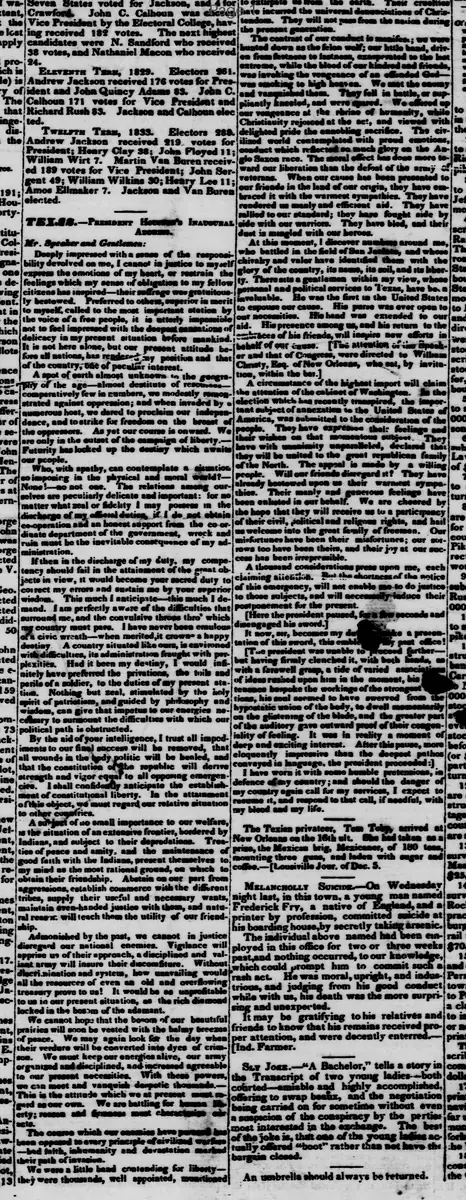
Inaugural Address.
Mr. Speaker and Gentlemen:
Deeply impressed with a sense of the responsibility devolved on me, I cannot in justice to myself expose the emotions of my heart, or restrain the feelings which my sense of obligation to my fellow citizens has inspired—their suffrage was gratuitously bestowed. Preferred to others superior in merit to myself, called to the most important station by the voice of a free people, it is utterly impossible not to feel impressed with the deepest sensations of delicacy in my present situation before you.
It is not here alone, but our present attitude before all nations, has rendered my position and that of the country one of peculiar interest. A spot of earth almost unknown to the geography of the age—almost destitute of resources—comparatively few in numbers, we modestly remonstrated against oppression; and when invaded by numerous hosts, we dared to proclaim our independence, and to strike for freedom on the breast of the oppressors.
As yet our course is onward. We are only in the outset of the campaign of liberty. Futurity has locked up the destiny which awaits our people.
Who, with apathy, can contemplate a situation so imposing in the physical and moral world?—None!—no not one. The relations among ourselves are peculiarly delicate and important: for no matter what zeal or fidelity I may possess in the discharge of my official duties if I do not obtain co-operation and an honest support from the co-ordinate department of the government, wreck and ruin must be the inevitable consequence of my administration.
If then in the discharge of my duty, my competency should fail in the attainment of the great objects in view, it would become your sacred duty to correct my errors and sustain me by your superior wisdom. This much I anticipate—this much I demand.
I am perfectly aware of the difficulties that surround me, and the convulsive throes through which my country must pass. I have never been emulous of a civic wreath—when merited, it crowns a happy destiny. A country situated like ours, is environed with difficulties, its administration fraught with perplexities.
Had it been my destiny, I would infinitely have preferred the privations, the toil and perils of a soldier, to the duties of my present station. Nothing but zeal, stimulated by the hallowed spirit of patriotism, and guided by philosophy and wisdom, can give that impetus to our energies necessary to surmount the difficulties with which our political path is obstructed.
By the aid of your intelligence, I trust all impediments to our final success will be removed, that all wounds in the body politic will be healed, and that the constitution of the republic will derive strength and vigor equal to all opposing emergencies.
I shall confidently anticipate the establishment of constitutional liberty. In the attainment of this object, we must regard our relative situation to other countries.
A subject of no small importance to our welfare, is the situation of an extensive frontier, bordered by Indians, and subject to their depredations. Treaties of peace and amity, and the maintenance of good faith with the Indians, present themselves to my mind as the most rational ground, on which to obtain their friendship.
Abstain on our part from aggressions, establish commerce with the different tribes, supply their useful and necessary wants, maintain even-handed justice with them, and natural reason will teach them the utility of our friendship.
Admonished by the past, we cannot in justice disregard our national enemies. Vigilance will apprise us of their approach, a disciplined and valiant army will insure their discomfiture.
Without discrimination and system, how unavailing would all the resources of even an old and overflowing treasury prove to us! It would be as unprofitable to us in our present situation, as the rich diamond locked in the bosom of the adamant.
We cannot hope that the bosom of our beautiful prairies will soon be vested with the balmy breezes of peace. We may again look for the day when their verdure will be converted into dyes of crimson.
We must keep our energies alive, our army organized and disciplined, and increased agreeable to our present necessities. With these powers, we can meet and vanquish despotic thousands.
This is the attitude which we at present must regard as our own. We are battling for liberty; reason and forbearance must characterize our deeds.
The course which our enemies have pursued has been opposed to every principle of civilized warfare—bad faith, inhumanity and devastation marked their path of invasion.
We were a little band contending for liberty—they were thousands, well appointed, amply munitioned.
They will not rise from the nations during the present generation. The contrast of our conduct is manifest; we were hunted down as the felon wolf; our little band driven from place to place, exhausted, while the blood of our kindred and friends was invoking the vengeance of an offended God—whose smoke was smoking to heaven.
We met the enemy and vanquished them. They fell in battle, or suppliantly kneeled, and were spared. We offered up our vengeance at the shrine of humanity, while Christianity rejoiced at the act, and viewed with delighted pride the emblematical sacrifice.
The civilized world contemplated with proud emotions a conduct which reflected so much glory on the Anglo Saxon race. The moral effect has done more toward our liberation than the defeat of the armies of veterans.
When our cause has been presented to our friends in the land of our origin, they have embraced it with the warmest sympathies. They have rendered us manly and efficient aid. They have rallied to our standard; they have fought side by side with our warriors. They have bled, and their dust is mingled with our heroes.
At this moment, I discover numbers around me, who battled in the field of San Jacinto, and whose chivalry and valor have identified them with the glory of the country, its name, its soil, and its liberty.
There sits a gentleman within my view, whose personal and political services to Texas, have been invaluable. He was the first in the United States to espouse our cause. His purse was ever open to our necessities. His hand was extended to our aid. His presence among us, and his return to the embraces of his friends, will inspire new efforts in behalf of our cause. [This allusion was to Wm. Christy, Esq. of New Orleans, who sat, by invitation, within the bar.]
A circumstance of the highest import will claim the attention of the cabinet of Washington. In the election which has recently transpired, the important subject of annexation to the United States of America, was submitted to the consideration of the people. They have expressed their feelings and their wishes on that momentous subject. They have with unanimity unparalleled, declared that they will be united to the great republican family of the North.
The appeal is made by a willing people. Will our friends disregard it? They have already bestowed upon us their warmest sympathies. Their manly and generous feelings have been enlisted in our behalf. We are cheered by the hope that they will receive us to a participation of their civil, political and religious rights, and hail us welcome into the great family of freemen.
Our misfortunes have been their misfortunes; our sorrows too have been theirs, and their joy at our success has been irrepressible.
A thousand considerations press upon me, each claiming attention. But the shortness of the notice of this emergency, will not enable me to do justice to those subjects, and will necessarily induce their postponement for the present.
[Here the president paused, for a few seconds and disengaged his sword.]
It now, sir, becomes my duty to return this sword, this emblem...
[The president was unable to proceed farther—but having firmly clenched it, with both hands, with a farewell grasp, a tide of varied associations of ideas rushed upon him in the moment, his countenance bespoke the workings of the strongest emotions, his soul seemed to have swerved from its hypostatic union of the body, to dwell momentarily on the glistening of the blade, and the greater part of the auditory have out with poor our dir co.sod iality of feeling. It was in reality a moment of deep and exciting interest.
After this pause, more eloquently impressive than the deepest pathos conveyed in language, the president proceeded:]
I have worn it with some humble pretensions, in defence of my country: and should the danger of my country again call for my services, I expect to resume it, and respond to that call, if needful, with my blood and my life.
What sub-type of article is it?
What themes does it cover?
What keywords are associated?
What entities or persons were involved?
Where did it happen?
Story Details
Key Persons
Location
Parliament House, Texas
Story Details
The President delivers an inaugural address expressing deep responsibility and humility in his elected role, recounts Texas's declaration of independence against oppression, emphasizes the need for governmental cooperation and wisdom to overcome difficulties, advocates for treaties and commerce with Indians to secure friendship, calls for vigilance and a disciplined army against national enemies, highlights the recent unanimous vote for annexation to the United States, praises the conduct at San Jacinto that earned international admiration, acknowledges supporters like Wm. Christy, and emotionally returns his sword, pledging to resume it if needed for the country's defense.