Thank you for visiting SNEWPapers!
Sign up free
The Herald And News
Newberry, Newberry County, South Carolina
What is this article about?
The South Carolina General Assembly begins its third week in Columbia on Jan. 24, with interruptions for elections and visits to Citadel and Clemson. Key debates focus on prohibition bills, including statewide measure and injunctions against liquor nuisances. Political gossip highlights potential gubernatorial candidates like McLeod, Richards, Manning, Blease, and Featherstone. Other bills cover labor rights, crop mortgages, Dillon county creation, and pool room restrictions.
Clipping
OCR Quality
Full Text
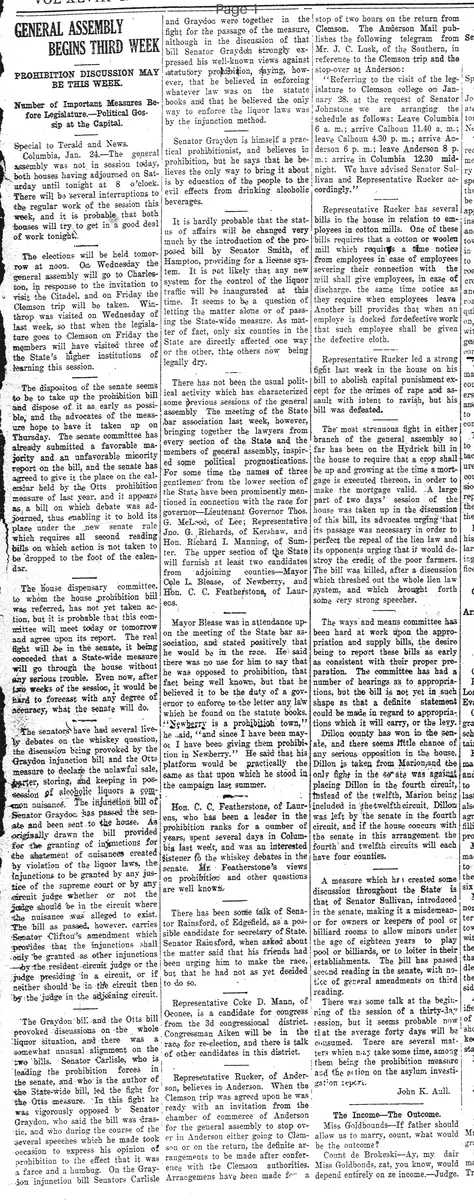
BEGINS THIRD WEEK
PROHIBITION DISCUSSION MAY
BE THIS WEEK.
Number of Important Measures Before
Legislature.—Political Gossip at the Capital.
Special to Herald and News.
Columbia, Jan. 24.—The general
assembly was not in session today,
both houses having adjourned on Saturday
until tonight at 8 o'clock.
There will be several interruptions to
the regular work of the session this
week, and it is probable that both
houses will try to get in a good deal
of work tonight.
The elections will be held tomorrow
at noon. On Wednesday the
general assembly will go to Charleston,
in response to the invitation to
visit the Citadel, and on Friday the
Clemson trip will be taken. Winthrop
was visited on Wednesday of
last week, so that when the legislature
goes to Clemson on Friday the
members will have visited three of
the State's higher institutions of
learning this session.
The disposition of the senate seems
to be to take up the prohibition bill
and dispose of it as early as possible,
and the advocates of the measure hope
to have it taken up on
Thursday. The senate committee has
already submitted a favorable majority
and an unfavorable minority
report on the bill, and the senate has
agreed to give it the place on the calendar
held by the Otts prohibition
measure of last year, and it appears
as a bill on which debate was adjourned,
thus enabling it to hold its
place under the new senate rule
which requires all second reading
bills on which action is not taken to
be dropped to the foot of the calendar.
The house dispensary committee,
to whom the house prohibition bill
was referred, has not yet taken action,
but it is probable that this committee
will meet today or tomorrow
and agree upon its report. The real
fight will be in the senate, it being
conceded that a State-wide measure
will go through the house without
any serious trouble. Even now, after
two weeks of the session, it would be
hard to forecast with any degree of
accuracy what the senate will do.
The senators have had several lively
debates on the whiskey question,
the discussion being provoked by the
Graydon injunction bill and the Otts
measure to declare the unlawful sale,
barter, storing, and keeping in possession
of alcoholic liquors a common nuisance.
The injunction bill of
Senator Graydon has passed the senate
and been sent to the house. As
originally drawn the bill provided
for the granting of injunctions for
the abatement of nuisances created
by violation of the liquor laws, the
injunctions to be granted by any justice
of the supreme court or by any
circuit judge whether or not the
judge should be in the circuit where
the nuisance was alleged to exist.
The bill as passed, however, carries
Senator Clifton's amendment which
provides that the injunctions shall
only be granted as other injunctions
by the resident circuit judge or the
judge presiding in a circuit, or if
neither should be in the circuit then
by the judge in the adjoining circuit.
The Graydon bill and the Otts bill
provoked discussions on the whole
liquor situation, and there was a
somewhat unusual alignment on the
two bills. Senator Carlisle, who is
leading the prohibition forces in
the senate, and who is the author of
the State-wide bill, led the fight for
the Otts measure. In this fight he
was vigorously opposed by Senator
Graydon, who said the bill was drastic,
and who during the course of the
several speeches which he made took
occasion to express his opinion of
prohibition to the effect that it was
a farce and a humbug. On the Graydon
injunction bill Senators Carlisle
and Graydon were together in the
fight for the passage of the measure,
although in the discussion of that
bill Senator Graydon strongly expressed
his well-known views against
statutory prohibition, saying, however,
that he believed in enforcing
whatever law was on the statute
books and that he believed the only
way to enforce the liquor laws was
by the injunction method.
Senator Graydon is himself a practical
prohibitionist, and believes in
prohibition, but he says that he believes
the only way to bring it about
is by education of the people to the
evil effects from drinking alcoholic
beverages.
It is hardly probable that the status
of affairs will be changed very
much by the introduction of the proposed
bill by Senator Smith, of
Hampton, providing for a license system.
It is not likely that any new
system for the control of the liquor
traffic will be inaugurated at this
time. It seems to be a question of
letting the matter alone or of passing
the State-wide measure. As matter
of fact, only six counties in the
State are directly affected one way
or the other, the others now being
legally dry.
There has not been the usual political
activity which has characterized
some previous sessions of the general
assembly. The meeting of the State
bar association last week, however,
bringing together the lawyers from
every section of the State and the
members of general assembly, inspired
some political prognostications.
For some time the names of three
gentlemen from the lower section of
the State have been prominently mentioned
in connection with the race for
governor—Lieutenant Governor Thos.
G. McLeod, of Lee; Representative
Jno. G. Richards, of Kershaw, and
Hon. Richard I. Manning, of Sumter.
The upper section of the State
will furnish at least two candidates
from adjoining counties—Mayor
Cole L. Blease, of Newberry, and
Hon. C. C. Featherstone, of Laurens.
Mayor Blease was in attendance upon
the meeting of the State bar association,
and stated positively that
he would be in the race. He said
there was no use for him to say that
he was opposed to prohibition, that
fact being well known, but that he
believed it to be the duty of a governor
to enforce to the letter any law
which he found on the statute books.
"Newberry is a prohibition town,"
he said, "and since I have been mayor
I have been giving them prohibition
in Newberry." He said that his
platform would be practically the
same as that upon which he stood in
the campaign last summer.
Hon. C. C. Featherstone, of Laurens,
who has been a leader in the
prohibition ranks for a number of
years, spent several days in Columbia
last week, and was an interested
listener to the whiskey debates in the
senate. Mr. Featherstone's views
on prohibition and other questions
are well known.
There has been some talk of Senator
Rainsford, of Edgefield, as a possible
candidate for secretary of State.
Senator Rainsford, when asked about
the matter said that his friends had
been urging him to make the race,
but that he had not as yet decided
to do so.
Representative Coke D. Mann, of
Oconee, is a candidate for congress
from the 3d congressional district.
Congressman Aiken will be in the
race for re-election, and there is talk
of other candidates in this district.
Representative Rucker, of Anderson,
believes in Anderson. When the
Clemson trip was agreed upon he was
ready with an invitation from the
chamber of commerce of Anderson
for the general assembly to stop over
in Anderson either going to Clemson
or on the return, the definite arrangements
to be made after conference
with the Clemson authorities.
Arrangements have been made for a
stop of two hours on the return from
Clemson. The Anderson Mail publishes
the following telegram from
Mr. J. C. Lusk, of the Southern, in
reference to the Clemson trip and the
stop-over at Anderson:
"Referring to the visit of the legislature
to Clemson college on January
28, at the request of Senator
Johnstone we are arranging the
schedule as follows: Leave Columbia
6 a. m.; arrive Calhoun 11.40 a. m.;
leave Calhoun 4.30 p. m.; arrive Anderson
6 p. m.; leave Anderson 8 p.
m.; arrive in Columbia 12.30 midnight.
We have advised Senator Sullivan
and Representative Rucker accordingly."
Representative Rucker has several
bills in the house in relation to employees
in cotton mills. One of these
bills requires that a cotton or woolen
mill which requires a time notice
from employees in case of employees
severing their connection with the
mill shall give employees, in case of
discharge, the same time notice as
they require when employees leave.
Another bill provides that when an
employee is docked for defective work
that such employee shall be given
the defective cloth.
Representative Rucker led a strong
fight last week in the house on his
bill to abolish capital punishment except
for the crimes of rape and assault
with intent to ravish, but his
bill was defeated.
The most strenuous fight in either
branch of the general assembly so
far has been on the Hydrick bill in
the house to require that a crop shall
be up and growing at the time a mortgage
is executed thereon, in order to
make the mortgage valid. A large
part of two days' session of the
house was taken up in the discussion
of this bill, its advocates urging that
its passage was necessary in order to
perfect the repeal of the lien law and
its opponents urging that it would destroy
the credit of the poor farmers.
The bill was killed, after a discussion
which threshed out the whole lien law
system, and which brought forth
some very strong speeches.
The ways and means committee has
been hard at work upon the appropriation
and supply bills, the desire
being to report these bills as early
as consistent with their proper preparation.
The committee has had a
number of hearings as to appropriations,
but the bill is not yet in such
shape as that a definite statement
could be made in regard to appropriations
which it will carry, or the levy.
Dillon county has won in the senate,
and there seems little chance of
any serious opposition in the house.
Dillon is taken from Marion, and the
only fight in the senate was against
placing Dillon in the fourth circuit,
instead of the twelfth, Marion being
included in the twelfth circuit. Dillon
was left by the senate in the fourth
circuit, and if the house concurs with
the senate in this arrangement, the
fourth and twelfth circuits will each
have four counties.
A measure which has created some
discussion throughout the State is
that of Senator Sullivan, introduced
in the senate, making it a misdemeanor
for owners or keepers of pool or
billiard rooms to allow minors under
the age of eighteen years to play
pool or billiards, or to loiter in their
establishments. The bill has passed
second reading in the senate, with notice
of general amendments on third
reading.
There was some talk at the beginning
of the session of a thirty-day
session, but it seems probable now
that the average forty days will be
consumed. There are several matters
which may take some time, among
them being the prohibition measure
and the action on the asylum investigation
report.
John K. Aull.
What sub-type of article is it?
What keywords are associated?
What entities or persons were involved?
Where did it happen?
Domestic News Details
Primary Location
Columbia
Event Date
Jan. 24
Key Persons
Outcome
prohibition bill debate ongoing; graydon injunction bill passed senate with amendment; otts measure debated; hydrick crop mortgage bill defeated; rucker capital punishment bill defeated; dillon county creation approved in senate; sullivan pool room bill passed second reading; political candidates announced for governor and other offices.
Event Details
The South Carolina General Assembly's third week features interruptions for elections, visits to Citadel, Clemson, and prior Winthrop. Senate pushes for early prohibition bill debate with favorable majority report; house committee to report soon. Lively debates on Graydon injunction and Otts nuisance bills regarding liquor laws. Political gossip on gubernatorial race involving McLeod, Richards, Manning, Blease, Featherstone. Other bills on cotton mill labor, crop mortgages, county circuits, pool rooms, appropriations discussed.