Thank you for visiting SNEWPapers!
Sign up free
Story
March 20, 1877
The New Orleans Daily Democrat
New Orleans, Orleans County, Louisiana
What is this article about?
Colonel Robert G. Ingersoll lectures in Steinway Hall, New York, on March 14, 1877, critiquing the bitter 1876 presidential campaign, proposing electoral reforms for ballot purity, advocating national unity, and endorsing President Hayes' cabinet selections.
Clipping
OCR Quality
98%
Excellent
Full Text
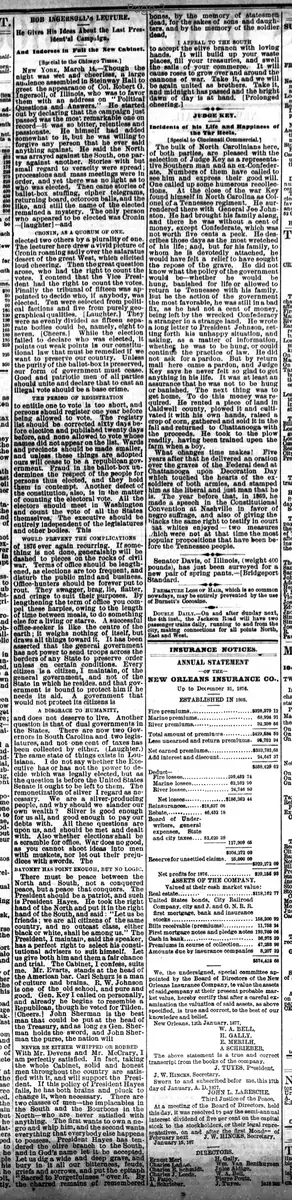
Bob Ingersoll's Lecture.
He Gives His Ideas About the Last Presidential Campaign.
And Indorses in Full the New Cabinet.
[Special to the Chicago Times.]
NEW YORK, March 14.—Though the audience assembled in Steinway Hall to night was wet and cheerless, a large one assembled to greet the appearance of Col. Robert G. Ingersoll, of Illinois, who was to favor them with an address on "Political Questions and Answers." He started out by declaring that the campaign just passed was the most remarkable one on record—it was so bitter, relentless and passionate. He himself had added somewhat to it, but he was willing to forgive any person that he ever said anything against. He said the North was arrayed against the South, one party against another. Stories with but small regard to veracity were spread broadcast. Processions and mass meetings were in order, and yet there was no light as to who was elected. Then came stories of ballot-box stuffing, cipher telegrams, returning board, octoroon balls, and the like, and still the name of the elected remained a mystery. The only person who appeared to be elected was Cronin—[laughter]—and
CRONIN, AS A QUORUM OF ONE,
elected two others by a plurality of one.
The lecturer here drew a vivid picture of Cronin roaming sadly over the salaratus desert of the great West, which elicited loud cheering. Then the great question arose, who had the right to count the votes. I contend that the Vice President had the right to count the votes.
Finally the tribunal of fifteen was appointed to decide who, if anybody, was elected. Ten were selected from political factions and five from purely geographical qualities. [Laughter.] They were as evenly divided as fifteen separate bodies could be, namely, eight to seven, [Cheers.] While the election failed to declare who was elected, it points out weak points in our constitutional law that must be remedied if we want to preserve our country. Unless the purity of the ballot-box is preserved, our form of government must cease.
Good and patriotic men of all parties should unite and declare that to cast an illegal vote should be a base crime.
THE PERIOD OF REGISTRATION
to entitle one to vote is too short, and persons should register one year before being allowed to vote. The registry list should be corrected sixty days before election and published twenty days before, and none allowed to vote whose names did not appear on the list. Wards and precincts should be made smaller, and unless these things are adopted ours will cease to be a republican government. Fraud in the ballot-box undermines the respect of the people for persons thus elected, and they hold them in contempt. Another defect of the constitution, also, is in the matter of counting the electoral vote. All the electors should meet in Washington and count the vote of all the States themselves. The executive should be entirely independent of the legislatures and other bodies. This
WOULD PREVENT THE COMPLICATIONS
of 1876 ever again recurring. If something is not done, generalship will be dashed to pieces on the rocks of civil war. Terms of office should be lengthened, as elections are too frequent, and disturb the public mind and business.
Office-hunters should be forever put to rout. They swagger, brag, lie, flatter, and cringe to suit their purposes. By lengthening the term of office you compel these harpies, owing to the length of time between meals, to do something else for a living or starve. A successful office-seeker is like the centre of the earth: it weighs nothing of itself, but draws all things toward it. It has been asserted that the general government has not power to send troops across the borders of any State to preserve order unless on certain conditions. Every citizen is a citizen, I maintain, of the general government, and not of the State in which he resides, and that government is bound to protect him if he needs its aid. A government that
A DISGRACE TO HUMANITY,
and does not deserve to live. Another question is that of dual governments in the States. There are now two Governors in South Carolina and two legislatures, and not one cent of taxes has been collected by either. [Laughter.] The same state of things exists in Louisiana. I do not say whether the Executive has or has not the power to decide which was legally elected, but as the question is before the United States Senate it ought to be left to them. The remonetization of silver I regard as necessary. We are a silver-producing people, and why should we slander our own wealth? "Silver is good enough for us all, and good enough to pay our debts with. All these questions are upon us, and should be met and dealt with. Also whether elections shall be a scramble for office. War does no good, as you cannot shoot ideas into men with muskets, nor let out their prejudices with swords. The
BAYONET HAS POINT ENOUGH, BUT NO LOGIC.
There must be peace between the North and South, not a conquered peace, but a peace that conquers. "The President should be a patriot, and such is President Hayes. He took the right hand of the North and put it in the right hand of the South, and said: "Let us be friends: we are all citizens of the same country, and no outcast class, either black or white, shall be among us." The President, I maintain, said the speaker, has a perfect right to select his constitutional advisers to suit himself. Let us give both him and them a fair chance and trial. The Cabinet, I confess, suits me. Mr. Evarts, stands at the head of the American bar. Carl Schurz is a man of culture and brains. R. W. Johnson is one of the old school, and pure and good. Gen. Key I called on personally, and already he begins to resemble a Republican, though he voted for Tilden. [Cheers.] John Sherman is the best man that could be put at the head of the Treasury, and as long as Gen. Sherman holds the sword, and John Sherman the purse, the nation will
NEVER BE EITHER WHIPPED OR ROBBED
With Mr. Devens and Mr. McCrary, I am perfectly satisfied. In fact, taking the whole Cabinet, solid and honest men throughout the country are satisfied with it, and will support the President. If this policy of President Hayes fails, he has both brains and pluck to change it, when necessary. There are two classes of men—the implacables in the South and the Bourbons in the North—who are never satisfied with anything. The first wants to own a negro and whip him, and the second wants everything that everybody else happens to possess. President Hayes has tendered the olive branch to the South, and in God's name let it be accepted. Let us dig a wide and deep grave, and bury in it all our bitterness, feuds, griefs and sorrows, and put the epitaph "Sacred to Forgetfulness" over it. By the charred remains of remembered
bones, by the memory of statesmen dead, for the sakes of sons and daughters, and by the memory of the soldier dead,
I APPEAL TO THE SOUTH
to accept the olive branch with loving hands. It will build up your waste places, fill your treasuries, and swell the sails of your commerce. It will cause roses to grow over and around the cannons of war. Take it, and we will be again united as brothers. Take it and midnight has passed and the bright dawn of day is at hand. [Prolonged cheering.]
He Gives His Ideas About the Last Presidential Campaign.
And Indorses in Full the New Cabinet.
[Special to the Chicago Times.]
NEW YORK, March 14.—Though the audience assembled in Steinway Hall to night was wet and cheerless, a large one assembled to greet the appearance of Col. Robert G. Ingersoll, of Illinois, who was to favor them with an address on "Political Questions and Answers." He started out by declaring that the campaign just passed was the most remarkable one on record—it was so bitter, relentless and passionate. He himself had added somewhat to it, but he was willing to forgive any person that he ever said anything against. He said the North was arrayed against the South, one party against another. Stories with but small regard to veracity were spread broadcast. Processions and mass meetings were in order, and yet there was no light as to who was elected. Then came stories of ballot-box stuffing, cipher telegrams, returning board, octoroon balls, and the like, and still the name of the elected remained a mystery. The only person who appeared to be elected was Cronin—[laughter]—and
CRONIN, AS A QUORUM OF ONE,
elected two others by a plurality of one.
The lecturer here drew a vivid picture of Cronin roaming sadly over the salaratus desert of the great West, which elicited loud cheering. Then the great question arose, who had the right to count the votes. I contend that the Vice President had the right to count the votes.
Finally the tribunal of fifteen was appointed to decide who, if anybody, was elected. Ten were selected from political factions and five from purely geographical qualities. [Laughter.] They were as evenly divided as fifteen separate bodies could be, namely, eight to seven, [Cheers.] While the election failed to declare who was elected, it points out weak points in our constitutional law that must be remedied if we want to preserve our country. Unless the purity of the ballot-box is preserved, our form of government must cease.
Good and patriotic men of all parties should unite and declare that to cast an illegal vote should be a base crime.
THE PERIOD OF REGISTRATION
to entitle one to vote is too short, and persons should register one year before being allowed to vote. The registry list should be corrected sixty days before election and published twenty days before, and none allowed to vote whose names did not appear on the list. Wards and precincts should be made smaller, and unless these things are adopted ours will cease to be a republican government. Fraud in the ballot-box undermines the respect of the people for persons thus elected, and they hold them in contempt. Another defect of the constitution, also, is in the matter of counting the electoral vote. All the electors should meet in Washington and count the vote of all the States themselves. The executive should be entirely independent of the legislatures and other bodies. This
WOULD PREVENT THE COMPLICATIONS
of 1876 ever again recurring. If something is not done, generalship will be dashed to pieces on the rocks of civil war. Terms of office should be lengthened, as elections are too frequent, and disturb the public mind and business.
Office-hunters should be forever put to rout. They swagger, brag, lie, flatter, and cringe to suit their purposes. By lengthening the term of office you compel these harpies, owing to the length of time between meals, to do something else for a living or starve. A successful office-seeker is like the centre of the earth: it weighs nothing of itself, but draws all things toward it. It has been asserted that the general government has not power to send troops across the borders of any State to preserve order unless on certain conditions. Every citizen is a citizen, I maintain, of the general government, and not of the State in which he resides, and that government is bound to protect him if he needs its aid. A government that
A DISGRACE TO HUMANITY,
and does not deserve to live. Another question is that of dual governments in the States. There are now two Governors in South Carolina and two legislatures, and not one cent of taxes has been collected by either. [Laughter.] The same state of things exists in Louisiana. I do not say whether the Executive has or has not the power to decide which was legally elected, but as the question is before the United States Senate it ought to be left to them. The remonetization of silver I regard as necessary. We are a silver-producing people, and why should we slander our own wealth? "Silver is good enough for us all, and good enough to pay our debts with. All these questions are upon us, and should be met and dealt with. Also whether elections shall be a scramble for office. War does no good, as you cannot shoot ideas into men with muskets, nor let out their prejudices with swords. The
BAYONET HAS POINT ENOUGH, BUT NO LOGIC.
There must be peace between the North and South, not a conquered peace, but a peace that conquers. "The President should be a patriot, and such is President Hayes. He took the right hand of the North and put it in the right hand of the South, and said: "Let us be friends: we are all citizens of the same country, and no outcast class, either black or white, shall be among us." The President, I maintain, said the speaker, has a perfect right to select his constitutional advisers to suit himself. Let us give both him and them a fair chance and trial. The Cabinet, I confess, suits me. Mr. Evarts, stands at the head of the American bar. Carl Schurz is a man of culture and brains. R. W. Johnson is one of the old school, and pure and good. Gen. Key I called on personally, and already he begins to resemble a Republican, though he voted for Tilden. [Cheers.] John Sherman is the best man that could be put at the head of the Treasury, and as long as Gen. Sherman holds the sword, and John Sherman the purse, the nation will
NEVER BE EITHER WHIPPED OR ROBBED
With Mr. Devens and Mr. McCrary, I am perfectly satisfied. In fact, taking the whole Cabinet, solid and honest men throughout the country are satisfied with it, and will support the President. If this policy of President Hayes fails, he has both brains and pluck to change it, when necessary. There are two classes of men—the implacables in the South and the Bourbons in the North—who are never satisfied with anything. The first wants to own a negro and whip him, and the second wants everything that everybody else happens to possess. President Hayes has tendered the olive branch to the South, and in God's name let it be accepted. Let us dig a wide and deep grave, and bury in it all our bitterness, feuds, griefs and sorrows, and put the epitaph "Sacred to Forgetfulness" over it. By the charred remains of remembered
bones, by the memory of statesmen dead, for the sakes of sons and daughters, and by the memory of the soldier dead,
I APPEAL TO THE SOUTH
to accept the olive branch with loving hands. It will build up your waste places, fill your treasuries, and swell the sails of your commerce. It will cause roses to grow over and around the cannons of war. Take it, and we will be again united as brothers. Take it and midnight has passed and the bright dawn of day is at hand. [Prolonged cheering.]
What sub-type of article is it?
Historical Event
Biography
What themes does it cover?
Justice
Moral Virtue
Triumph
What keywords are associated?
1876 Election
Electoral Reform
Ballot Purity
National Unity
Hayes Cabinet
Ingersoll Lecture
Political Reconciliation
What entities or persons were involved?
Robert G. Ingersoll
Rutherford B. Hayes
Cronin
William M. Evarts
Carl Schurz
Reverdy Johnson
David M. Key
John Sherman
William Tecumseh Sherman
Charles Devens
Thomas Mccrary
Where did it happen?
Steinway Hall, New York
Story Details
Key Persons
Robert G. Ingersoll
Rutherford B. Hayes
Cronin
William M. Evarts
Carl Schurz
Reverdy Johnson
David M. Key
John Sherman
William Tecumseh Sherman
Charles Devens
Thomas Mccrary
Location
Steinway Hall, New York
Event Date
March 14
Story Details
Col. Robert G. Ingersoll delivers a lecture recapping the contentious 1876 presidential election, proposes reforms for electoral integrity and constitutional fixes, advocates for national reconciliation between North and South, and praises President Hayes' cabinet choices.