Thank you for visiting SNEWPapers!
Sign up free
Literary
August 19, 1912
Atlanta Georgian
Atlanta, Fulton County, Georgia
What is this article about?
In Bilmouth prison, convict Jack Rimington is tormented by a dream of his beloved Betty in peril, fueling his escape plans. He witnesses a fellow prisoner's fatal dash for freedom, crushed by a locomotive, leading to his own collapse and infirmary stay. There, he resolves to seek aid from the new chaplain.
Clipping
OCR Quality
95%
Excellent
Full Text
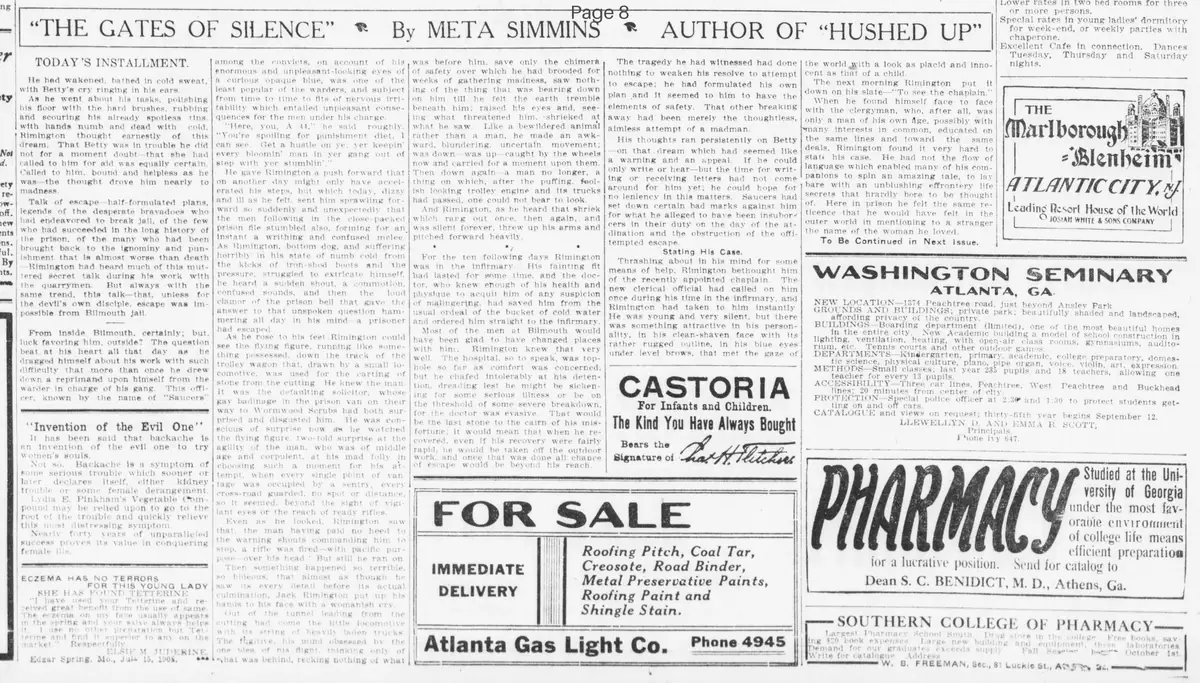
"THE GATES OF SILENCE"
TODAY'S INSTALLMENT.
He had wakened, bathed in cold sweat, with Betty's cry ringing in his ears.
As he went about his tasks, polishing his floor with the hard brushes, rubbing and scouring his already spotless tins with hands numb and dead with cold, Rimington thought earnestly of this dream. That Betty was in trouble he did not for a moment doubt; that she had called to him for aid was equally certain—called to him, bound and helpless as he was—the thought drove him nearly to madness.
Talk of escape, half-formulated plans, legends of the desperate bravadoes who had endeavored to break jail, of the few who had succeeded in the long history of the prison, of the many who had been brought back to the ignominy and punishment that is almost worse than death—Rimington had heard much of this muttered secret talk during his work with the quarrymen.
But always with the same trend, this talk—that, unless for the devil's own disciple, escape was impossible from Bilmouth jail.
From inside Bilmouth, certainly; but, luck favoring him, outside? The question beat at his heart all that day as he dragged himself about his work with such difficulty that more than once he drew down a reprimand upon himself from the warder in charge of his gang.
This officer, known by the name of "Saucers," among the convicts, on account of his enormous and unpleasant-looking eyes of a curious opaque blue, was one of the least popular of the warders, and subject from time to time to fits of nervous irritability which entailed unpleasant consequences for the men under his charge.
"Here, you, A 44," he said roughly. "You're spoiling for punishment, I can see. Get a hustle on yer; you're keepin' every bloomin' man in yer gang out of step with yer stumblin'.
He gave Rimington a push forward that on another day might only have accelerated his steps, but which today, dizzy and ill as he felt, sent him sprawling forward so suddenly and unexpectedly that the men following in the close-packed prison file stumbled also, forming for an instant a writhing and confused melee.
As Rimington, bottom dog, and suffering horribly in his state of numb cold from the kicks of iron-shod boots and the pressure, struggled to extricate himself, he heard a sudden shout, a commotion, confused sounds, and then the loud clamor of the prison bell that gave the answer to that unspoken question hammering all day in his mind—a prisoner had escaped.
As he rose to his feet Rimington could see the flying figure, running like something possessed down the track of the trolley wagon that, drawn by a small locomotive, was used for the carting of stone from the cutting. He knew the man. It was the defaulting solicitor, whose gay badinage in the prison van on their way to Wormwood Scrubs had both surprised and disgusted him. He was conscious of surprise now as he watched the flying figure, twofold surprise at the agility of the man, who was of middle age and corpulent, at his mad folly in choosing such a moment for his attempt, when every single point of vantage was occupied by a sentry, every cross-road guarded, no spot or distance, so it seemed, beyond the sight of vigilant eyes or the reach of ready rifles.
Even as he looked Rimington saw that the man having paid no heed to the warning shouts commanding him to stop, a rifle was fired with pacific purpose over his head. But still he ran on.
Then something happened so terrible, so hideous, that almost as though he saw its every detail before its actual culmination, Jack Rimington put up his hands to his face with a womanish cry.
Out of the tunnel leading from the cutting had come the little locomotive with its string of heavily laden trucks.
The fugitive, his mind obsessed by the one idea of his flight, thinking only of what was behind, recking nothing of what was before him, save only the chimera of safety over which he had brooded for weeks of gathering madness, saw nothing of the thing that was bearing down on him till he felt the earth tremble beneath him, raised his eyes and, seeing what threatened him, shrieked at what he saw. Like a bewildered animal rather than a man, he made an awkward, blundering, uncertain movement; was down, was up, caught by the wheels now and carried for a moment upon them.
Then down again—a man no longer, a thing on which, after the puffing, foolish-looking trolley engine and its trucks had passed, one could not bear to look.
And Rimington, as he heard that shriek which rang out once, then again, and was silent forever, threw up his arms and pitched forward heavily.
For the ten following days Rimington was in the infirmary. His fainting fit had lasted for some time, and the doctor, who knew enough of his health and physique to acquit him of any suspicion of malingering, had saved him from the usual ordeal of the bucket of cold water and ordered him straight to the infirmary.
Most of the men at Bilmouth would have been glad to have changed places with him. Rimington knew that very well. The hospital, so to speak, was top-hole so far as comfort was concerned, but he chafed intolerably at his detention, dreading lest he might be sickening for some serious illness or be on the threshold of some severe breakdown, for the doctor was evasive. That would be the last straw to the cairn of his misfortune. It would mean that when he recovered, even if his recovery were fairly rapid, he would be taken off the outdoor work—and once that was done all chance of escape would be beyond his reach.
The tragedy he had witnessed had done nothing to weaken his resolve to attempt to escape; he had formulated his own plan and it seemed to him to have the elements of safety. That other breaking away had been merely the thoughtless, aimless attempt of a madman.
His thoughts ran persistently on Betty, on that dream which had seemed like a warning and an appeal. If he could only write or hear—but the time for writing or receiving letters had not come around for him yet. He could hope for no leniency in this matter. Saucers had set down certain bad marks against him for what he alleged to have been insubordination and the obstruction of the officers in their duty on the day of the attempted escape.
Thrashing about in his mind for some means of help, Rimington bethought him of the recently appointed chaplain. The new clerical official had called on him once during his time in the infirmary, and Rimington had taken to him instantly. He was young and very silent, but there was something attractive in his personality, in his clean-shaven face with its rather rugged outline, in his blue eyes under level brows, that met the gaze of the world with a look as placid and innocent as that of a child.
The next morning Rimington put it down on his slate—'To see the chaplain.'
When he found himself face to face with the clergyman, who, after all, was only a man of his own age, possibly with many interests in common, educated on the same lines and toward the same ideals, Rimington found it very hard to state his case. He had not the flow of language which enabled many of his companions to spin an amazing tale, to lay bare with an unblushing effrontery life secrets that hardly bore to be thought of. Here in prison he felt the same reticence that he would have felt in the outer world in mentioning to a stranger the name of the woman he loved.
To Be Continued in Next Issue.
TODAY'S INSTALLMENT.
He had wakened, bathed in cold sweat, with Betty's cry ringing in his ears.
As he went about his tasks, polishing his floor with the hard brushes, rubbing and scouring his already spotless tins with hands numb and dead with cold, Rimington thought earnestly of this dream. That Betty was in trouble he did not for a moment doubt; that she had called to him for aid was equally certain—called to him, bound and helpless as he was—the thought drove him nearly to madness.
Talk of escape, half-formulated plans, legends of the desperate bravadoes who had endeavored to break jail, of the few who had succeeded in the long history of the prison, of the many who had been brought back to the ignominy and punishment that is almost worse than death—Rimington had heard much of this muttered secret talk during his work with the quarrymen.
But always with the same trend, this talk—that, unless for the devil's own disciple, escape was impossible from Bilmouth jail.
From inside Bilmouth, certainly; but, luck favoring him, outside? The question beat at his heart all that day as he dragged himself about his work with such difficulty that more than once he drew down a reprimand upon himself from the warder in charge of his gang.
This officer, known by the name of "Saucers," among the convicts, on account of his enormous and unpleasant-looking eyes of a curious opaque blue, was one of the least popular of the warders, and subject from time to time to fits of nervous irritability which entailed unpleasant consequences for the men under his charge.
"Here, you, A 44," he said roughly. "You're spoiling for punishment, I can see. Get a hustle on yer; you're keepin' every bloomin' man in yer gang out of step with yer stumblin'.
He gave Rimington a push forward that on another day might only have accelerated his steps, but which today, dizzy and ill as he felt, sent him sprawling forward so suddenly and unexpectedly that the men following in the close-packed prison file stumbled also, forming for an instant a writhing and confused melee.
As Rimington, bottom dog, and suffering horribly in his state of numb cold from the kicks of iron-shod boots and the pressure, struggled to extricate himself, he heard a sudden shout, a commotion, confused sounds, and then the loud clamor of the prison bell that gave the answer to that unspoken question hammering all day in his mind—a prisoner had escaped.
As he rose to his feet Rimington could see the flying figure, running like something possessed down the track of the trolley wagon that, drawn by a small locomotive, was used for the carting of stone from the cutting. He knew the man. It was the defaulting solicitor, whose gay badinage in the prison van on their way to Wormwood Scrubs had both surprised and disgusted him. He was conscious of surprise now as he watched the flying figure, twofold surprise at the agility of the man, who was of middle age and corpulent, at his mad folly in choosing such a moment for his attempt, when every single point of vantage was occupied by a sentry, every cross-road guarded, no spot or distance, so it seemed, beyond the sight of vigilant eyes or the reach of ready rifles.
Even as he looked Rimington saw that the man having paid no heed to the warning shouts commanding him to stop, a rifle was fired with pacific purpose over his head. But still he ran on.
Then something happened so terrible, so hideous, that almost as though he saw its every detail before its actual culmination, Jack Rimington put up his hands to his face with a womanish cry.
Out of the tunnel leading from the cutting had come the little locomotive with its string of heavily laden trucks.
The fugitive, his mind obsessed by the one idea of his flight, thinking only of what was behind, recking nothing of what was before him, save only the chimera of safety over which he had brooded for weeks of gathering madness, saw nothing of the thing that was bearing down on him till he felt the earth tremble beneath him, raised his eyes and, seeing what threatened him, shrieked at what he saw. Like a bewildered animal rather than a man, he made an awkward, blundering, uncertain movement; was down, was up, caught by the wheels now and carried for a moment upon them.
Then down again—a man no longer, a thing on which, after the puffing, foolish-looking trolley engine and its trucks had passed, one could not bear to look.
And Rimington, as he heard that shriek which rang out once, then again, and was silent forever, threw up his arms and pitched forward heavily.
For the ten following days Rimington was in the infirmary. His fainting fit had lasted for some time, and the doctor, who knew enough of his health and physique to acquit him of any suspicion of malingering, had saved him from the usual ordeal of the bucket of cold water and ordered him straight to the infirmary.
Most of the men at Bilmouth would have been glad to have changed places with him. Rimington knew that very well. The hospital, so to speak, was top-hole so far as comfort was concerned, but he chafed intolerably at his detention, dreading lest he might be sickening for some serious illness or be on the threshold of some severe breakdown, for the doctor was evasive. That would be the last straw to the cairn of his misfortune. It would mean that when he recovered, even if his recovery were fairly rapid, he would be taken off the outdoor work—and once that was done all chance of escape would be beyond his reach.
The tragedy he had witnessed had done nothing to weaken his resolve to attempt to escape; he had formulated his own plan and it seemed to him to have the elements of safety. That other breaking away had been merely the thoughtless, aimless attempt of a madman.
His thoughts ran persistently on Betty, on that dream which had seemed like a warning and an appeal. If he could only write or hear—but the time for writing or receiving letters had not come around for him yet. He could hope for no leniency in this matter. Saucers had set down certain bad marks against him for what he alleged to have been insubordination and the obstruction of the officers in their duty on the day of the attempted escape.
Thrashing about in his mind for some means of help, Rimington bethought him of the recently appointed chaplain. The new clerical official had called on him once during his time in the infirmary, and Rimington had taken to him instantly. He was young and very silent, but there was something attractive in his personality, in his clean-shaven face with its rather rugged outline, in his blue eyes under level brows, that met the gaze of the world with a look as placid and innocent as that of a child.
The next morning Rimington put it down on his slate—'To see the chaplain.'
When he found himself face to face with the clergyman, who, after all, was only a man of his own age, possibly with many interests in common, educated on the same lines and toward the same ideals, Rimington found it very hard to state his case. He had not the flow of language which enabled many of his companions to spin an amazing tale, to lay bare with an unblushing effrontery life secrets that hardly bore to be thought of. Here in prison he felt the same reticence that he would have felt in the outer world in mentioning to a stranger the name of the woman he loved.
To Be Continued in Next Issue.
What sub-type of article is it?
Prose Fiction
What themes does it cover?
Liberty Freedom
Love Romance
Death Mortality
What keywords are associated?
Prison Escape
Bilmouth Jail
Locomotive Accident
Infirmary Stay
Chaplain Help
Betty Dream
Warder Saucers
Literary Details
Title
"The Gates Of Silence" Today's Installment.
Key Lines
That Betty Was In Trouble He Did Not For A Moment Doubt; That She Had Called To Him For Aid Was Equally Certain—Called To Him, Bound And Helpless As He Was—The Thought Drove Him Nearly To Madness.
A Prisoner Had Escaped.
Then Down Again—A Man No Longer, A Thing On Which, After The Puffing, Foolish Looking Trolley Engine And Its Trucks Had Passed, One Could Not Bear To Look.
The Tragedy He Had Witnessed Had Done Nothing To Weaken His Resolve To Attempt To Escape; He Had Formulated His Own Plan And It Seemed To Him To Have The Elements Of Safety.
Here In Prison He Felt The Same Reticence That He Would Have Felt In The Outer World In Mentioning To A Stranger The Name Of The Woman He Loved.